

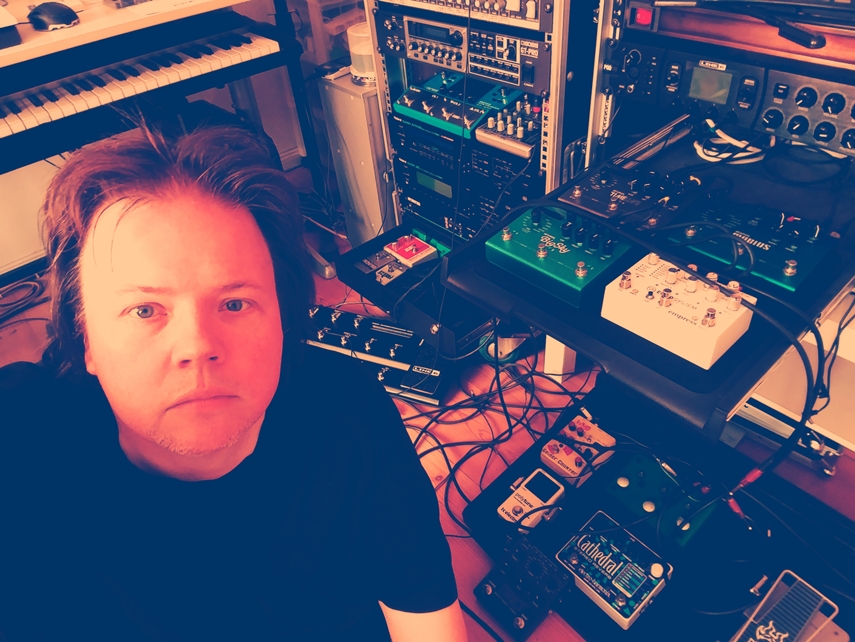
Photo by Anja Kathmann
Jerome Froese is back with a new album ‘Sunsets in Stereo’.
Hailed as “The Sound Architect Between Electronics, Guitar, and Emotion”, Jerome is the son of the late TANGERINE DREAM co-founder Edgar Froese and was a member from 1990 to 2006. Known for his distinctive fusion of electronic textures and guitar-driven soundscapes, he has carved out his own distinct niche in ambient rock.
Defying traditional genre labels, his signature “Guitartronica” style has served him well across his various solo albums and collaborations including LOOM with another former TANGERINE DREAM member Johannes Schmoelling as well as an album ‘Beginn’ with Claudia Brücken.
While no longer active in TANGERINE DREAM, Jerome Froese serves as the curator of their official photo and video archive, preserving over 10,000 images and extensive historical film material documenting every era of the band. Much of the visual archive was created by his mother, Monika Froese, who photographed the group for decades. As the only individual to have witnessed all major TANGERINE DREAM periods including the classic line-up of Edgar Froese, Christopher Franke and Peter Baumann, he is uniquely positioned to safeguard and carry forward this cultural legacy.
Meanwhile in ‘Sunsets In Stereo’, Jerome Froese bridges the past and the future with this cinematic and deeply personal album. Providing a combination of noisier guitar-derived textures and brighter electronic soundscapes, this is a record that will be appreciated by those who prefer their ambient on the rockier spectrum.
Jerome Froese stopped by to talk to ELECTRICITYCLUB.CO.UK for a conversation about ‘Sunsets in Stereo’ and a lot more…
It’s been 4 years since ‘Asymetric’ while ‘Beginn’ with Claudia Brücken was in 2018, how did you decide it was time for a new solo creation, what inspires your creative muse?
I’ve actually been working on my solo album for longer than I originally planned. That’s partly because I scrapped an almost finished version about two years ago and started over almost from scratch. Since production tools and techniques are evolving so rapidly, new ideas and inspirations keep emerging, and it’s tempting to keep adding them to one piece or another. At some point, though, you have to discipline yourself and draw a line in order to finally reach a result. The pandemic, fortunately, played a rather positive role in that process. The general slowdown gave me the time and space to focus productively on things that normally get neglected in everyday life.
Inspiration can come from just about anything – a good conversation, an intriguing sound, a positive or even a negative experience. An external impulse isn’t always necessary, but it’s usually very helpful.

So does ‘Sunsets In Stereo’ have a concept as such?
There wasn’t really a strict concept behind the album, but it was important to me that it carries an overall positive vibe. Over the past few years, I’ve spent a lot of time traveling around Europe, picking up inspiration from all sorts of random situations along the way. I’ve always been fascinated by different social environments, so wherever I go, I like to explore the spots most tourists would probably skip.
In a city like London, for example, I’d much rather grab a coffee somewhere out in Tube Zone 7 or 8 and just watch people and the surroundings than hang around at Big Ben. Once, a few years back, I stumbled across this butcher’s shop that, weirdly enough, also rented out horror DVDs – right there in the same room, across from the counter with all the steaks and offal. Stuff like that just makes my day.
Talking of stereo, there is a fashion now for re-releases of classic records remixed in Surround Sound 5.1 and Dolby Atmos, are these audio formats something which you personally are interested in?
From a technical perspective, that’s certainly interesting, but I see little point in investing in specialized equipment just for certain ways of listening to music. Music I like always works; bad music mostly remains bad, no matter what you listen to it on.
The ‘Sunsets In Stereo’ album has influences from post-rock and dreampop, were there any particular artists or tracks that shaped your “guitartronica” approach?
I enjoy blending the raw, instrumentally unconventional aspects of post-rock with the melancholic and sometimes sweet elements of dream pop. A good example of this is the track ‘Feel Your Ghosts’ on ‘Sunsets In Stereo’. It aims to translate, purely instrumentally, a therapeutic session dealing with the intangible thoughts and feelings in someone’s mind. For this reason, the track deliberately moves between extremes of harshness and harmony.
My guitar playing is often inspired by artists who might not be immediately on everyone’s radar, such as Donald ‘Buck Dharma’ Roeser or Eric Johnson. While they haven’t fundamentally shaped my playing style, their work contains small or larger elements that have influenced or challenged my approach to my own ideas.
When I share my music with friends, colleagues, or acquaintances, I often hear: “No matter what you produce, it always sounds like Froese” ; I take this as a compliment, but also as a recognition that my musical identity – both its strengths and quirks – are difficult to hide. Some have also mentioned that my style or certain melodies occasionally remind them, in a positive way, of children’s songs.

Whereas ‘Asymetric’ was only in the digital domain, ‘Sunsets In Stereo’ gets issued on CD although not vinyl LP, how do you decide on your release formats? Is it economically dictated?
First off, I should say that, like a lot of other artists, I’ve never really been a fan of streaming services. A few years back, I even pulled off almost all of my music from them. The reasons are probably pretty obvious.
Now that we’re back working with a distributor that operates internationally, I’m figuring out how I want to handle things going forward. SIS, for example, will be on all digital platforms. But it’s not uncommon for whole albums to vanish when contracts expire or licensing issues pop up. A situation that Claudia Brücken and I are currently experiencing with the ‘Beginn’ album, for example. Most of my fans don’t want to risk that, which is why they still prefer physical copies like CDs.
Vinyl is a bit of a tricky one. Around the turn of the millennium, I was doing some DJ stuff exclusively on vinyl. Small runs barely sold, simply because nobody really wanted it back then. We originally planned a vinyl version of ‘Sunsets In Stereo’, but then the questions started: how do you fit the entire album on one record? Do you cut tracks? Multiple records felt complicated and expensive, which would push the price up for fans, and I didn’t want that.
Even today, the so-called “vinyl revival” looks impressive in percentages, but in reality, we’re still talking pretty small numbers. That said, who knows – maybe we’ll do something spontaneous for RSD 2026.
One of the album highlights is ‘The Clock That Forgot Time’, how did that build up from its initial composition to recording?
This song actually came about quite spontaneously and, as the title suggests, was meant to be a homage to my childhood, and to the people around me who shaped it, both personally and musically.
Since my mother had already given me her entire visual archive during her lifetime, I thought it would be a great idea to support the track with some striking images. So, over the past few weeks, I spent quite some time putting together suitable material for a YouTube video clip. Honestly, I could have edited a hundred different versions of it without repeating a single image. Narrowing it all down to five and a half minutes was quite a challenge.
For the music, I even used a few original vintage synthesizers to capture an authentic sound. Some TANGERINE DREAM fans might think that Edgar and myself lost the inspiration or the ability to create songs in the classic TD tradition, but that’s not true. We could have done that at any time. It’s just that we’ve always been guided by what lay ahead of us, by what we were musically curious about and excited to explore.
That’s why, with TANGERINE DREAM, fans have always come and gone – and that was perfectly fine.
You are using a female voice on ‘Hope’ and ‘A Game of Hearts, Played with Fire’, did you use a singer or is this a sample or VST?
It’s got a bit of all that, but, like the rest of the album, it doesn’t feature an AI.
Have you or do you intend to experiment with AI in your music?
Out of curiosity, I checked out the common tools. At first glance, the results might seem impressive, but for anyone with years of experience as a composer and producer, the flaws become obvious almost immediately. Sure, these algorithms will keep improving as they endlessly “train” on all available material, but that only underscores the urgent need for updates to copyright law.
What’s truly infuriating is this Suno guy claiming that composing yourself or learning an instrument isn’t fun. Instead, he suggests you should just “prompt” and feel proud when the AI spits out music it stole ideas from – music originally created by people who actually enjoyed composing and mastering an instrument. Let’s be clear: AI doesn’t create anything on its own. There’s no way to sugarcoat that.
In the technical aspects of making this record, where there any other new instruments or developments which you found to be important in realising the final product?
As I mentioned earlier, new and fascinating things keep appearing almost daily, both in the digital and physical realms. For example, after almost three decades, I finally retired my DAW, Cubase. Many features that have long been standard elsewhere were simply missing. Switching to a new software was an important liberating move.
For the lead guitars, I once again used my Charvel Model 4, which I bought in Los Angeles back in 1988 for $800. It’s the same guitar I used to record my first solo on the TANGERINE DREAM album ‘Lily On The Beach’ in 1989. I also had a box full of stomp boxes on hand, which were used for all kinds of sonic experiments. And of course, on ‘The Clock That Forgot Time’ you’ll hear vintage synths: a Prophet 5, PPG Wave 2, and Oberheim OB-X. Those familiar with these classics will surely recognize their sounds.
‘Endless Sympathy’ closes the album and moves from being quite floaty to rocking out before drifting into flutey-type sounds almost like a reference to classic TANGERINE DREAM, had this been an intentional “Easter Egg”?
Interesting that you feel that way! I actually added the middle part only at the very end, when the song was almost finished. The idea was more to briefly pull the listener out of their cozy state, only to let them settle back in right after. But you’re right, there are definitely associations there. So even for me, it has now turned into an Easter Egg! 🙂
You took part in the documentary ‘Revolution Of Sound: TANGERINE DREAM’ which came out on DVD in 2018, were you satisfied with how it turned out?
The project largely did not match my personal taste. I was offered the opportunity to come on as a co-producer, but since my stepmother wanted to take the creative lead herself and also be a co-producer, I quickly withdrew and only licensed the images from my archive to the production company.
Key figures, such as Chris Franke, were not included as interviewees at all, and some others apparently refused to participate. Johannes Schmoelling and I appear only because the director wanted it that way. Had it been up to my stepmother, she would likely have conducted all the interviews herself. Overall, there was so much more that could have been done with the topic, both visually and content-wise.
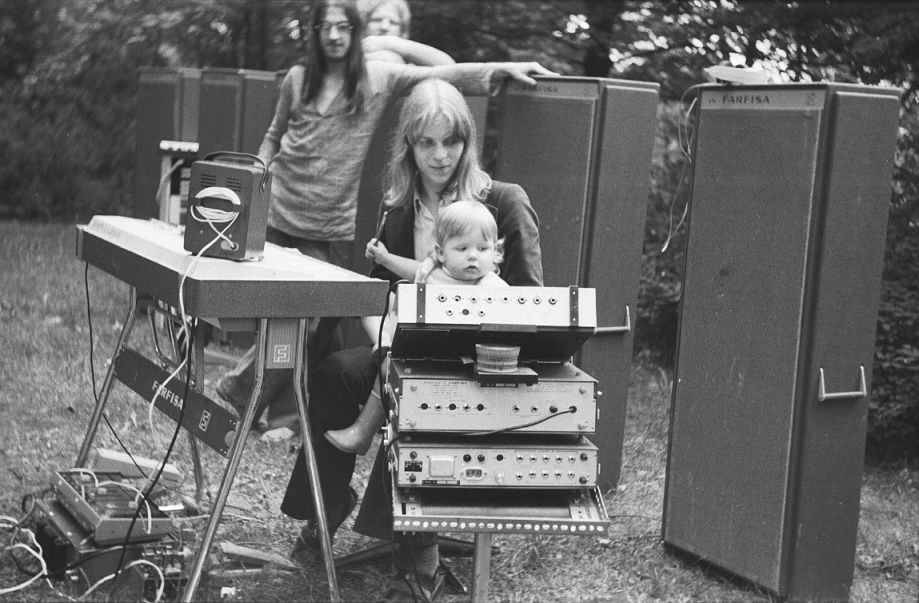
I interviewed Peter Baumann earlier this year and he was happily reminiscing about the old days; how is your media project The TANGERINE DREAM Archive coming along and are there any plans with it?
There are now many plans in motion. Unfortunately, our fundraising efforts for fully digitizing my mother’s analog archive fell slightly short of the desired amount. However, we were able to acquire a professional scanner, which allows us to digitize almost all formats. Compared to a specialized company, this is a very time-consuming process, and since we only have one workstation, multiple people cannot work on it simultaneously.
The Super 8 film material was already digitized back in the 1990s, so it is available to us more quickly. I have already spoken with various people about potential projects related to this and have generated a lot of interest. Now I just need to carve out more time for myself to push things forward, and I hope to manage that soon.
Which are your own favourite tracks on ‘Sunsets In Stereo’?
I usually like the tracks that were added last to a production the most, since they haven’t been heard as often. In this case, that would be ‘Where We Belong’, ‘A Game of Hearts, Played with Fire’ and the title track ‘Sunsets in Stereo’.
It’s hard to pick a favorite, as I think the album is very versatile and doesn’t want to settle in one particular direction. How each song resonates really depends on your mood, so every track can be experienced differently at any given time. For example, ‘A Game of Hearts, Played With Fire’ was almost consistently the favorite among the female listeners who pre-listened the album.
It’s been a while since you ventured out live, is this something that you would like to do again?
Absolutely, especially since I’d love to perform in the UK again. The audience there has always given great feedback at the shows. I’m not the type who needs to be on stage all the time to live off the applause, but a few small, cozy events would definitely be enjoyable. Let’s see if something comes up in the near future.
What is next for you solo or in collaboration with others?
Once the album drops, I’ll probably take a few days just to breathe, recharge, and let everything sink in. After that, there’s a whole world waiting: my entire TANGERINE DREAM catalog, ready to be re-released on physical formats – the plans for that are already laid out on my desk. On top of that, I’ve got remastered versions of my first three solo albums in the works, and who knows, maybe even a box set down the line.
Meanwhile, I’ve wrapped up a full album with Marty Willson-Piper (THE CHURCH, ALL ABOUT EVE), and we’re hoping to release it soon. And then there’s something I recently cooked up with Susanne Freytag – who’s now living in Berlin – which has this wonderfully dark, morbid edge. We’re thinking it could become an EP sometime soon.
But before all that, before even thinking about grand plans or releases, I’m heading to the kitchen to make myself a coffee. Sometimes the simplest things come first.
ELECTRICITYCLUB.CO.UK gives its warmest thanks to Jerome Froese
Additional thanks to Anja Kathmann at Moonpop
‘Sunsets in Stereo’ is released by Moonpop on 31st October 2025 in CD and digital formats
https://instagram.com/jeromefroese
https://facebook.com/jeromefroese
https://youtube.com/@jeromefroeseofficial
https://tangerinedreamarchive.com/
Text and Interview by Chi Ming Lai
24th November 2025
Follow Us!