
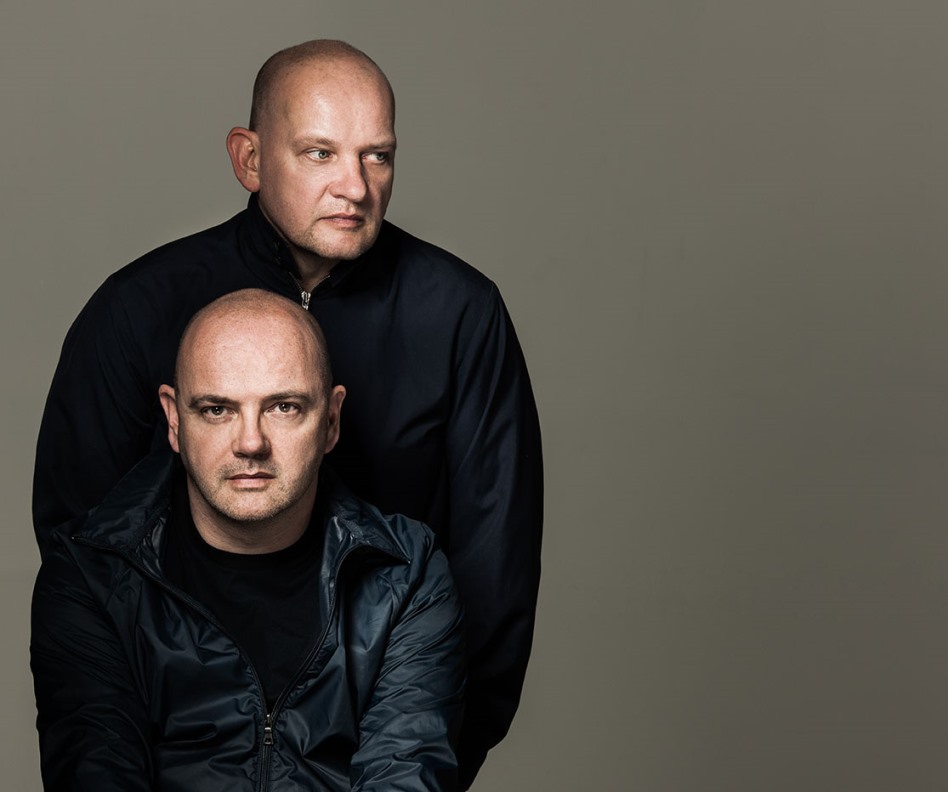
HUE & CRY may be best known for their sophistipop hits ‘Labour Of Love’, Ordinary Angel’, ‘Looking For Linda’ and ‘Violently’ but for their new album ‘Everybody’, they have surprised all by expanding their sonic palette and going “electro”.
Finding success of the wave of soul jazz tinged acts making use of modern music technology such as JOHNNY HATES JAZZ, BLACK and PREFAB SPROUT, the transition therefore is perhaps not as surprising as first thought. Formed by brothers Pat and Greg Kane, HUE & CRY have used DeepMind arpeggiators, hydrasynths, wavetables and classic drum machines accompanied by future-facing lyrical subjects for ‘Everybody’.
Exemplified by the first single ‘Stronger’ with its message of resilience and hope, the Kanes certainly cannot be accused of replicating their past. As well as electronic pop, the album also features experiments in related sub-genres like Latin House and Future Disco but the biggest surprise is the frantic Germanic thrust of ‘Everybody Deserves To Be Loved’.
The songs on ‘Everybody’ confront powerlessness, polarisation, climate change, authoritarianism and technological overreach, while also championing active love as a counterforce. A true labour of love, Pat and Greg Kane chatted to ELECTRICITYCLUB.CO.UK about why ‘Everybody’ matters…
Nearly 40 years after the breakthrough banger ‘Labour Of Love’, having already experimented with folk, latin, country, jazz, drum ‘n’ bass and acoustic along the way, Hue & Cry have gone “electro”, what has prompted this new direction?
Greg: My brother Pat was pushing for this. I knew a bit about synthesizers, but I hadn’t been that hands on with them. I found out that I actually knew very little about them. But I researched. Using podcasts like Sonictalk, Why we bleep, Data Cult Audio etc, I chose synths that resonated with me. We built an arsenal of over 20 synths, Moog, Roland, Arturia, Dreadbox, Berhinger, Korg and I set about learning and studying. It was a long slog, but I got good enough that we could write songs with them.
Pat: We’ve always been a little bit electro–composing demos on computers, being excited by the latest synth sounds. I was an addict of John Peel’s radio show, and I remember being fascinated by the harsh hypnoticness of CABARET VOLTAIRE, DAF, Thomas Leer, which lead me on a pathway to the first few albums of SIMPLE MINDS, particularly the track ‘I Travel’.
Were there any particular acts using synths that you particularly enjoyed or admired?
Greg: I always liked THE HUMAN LEAGUE, but during my research I was drawn to acts like Surgeon, Clark, Colin Benders.
Pat: In recent years, I’ve loved what bands like BONOBO and DISCLOSURE do with EDM – all the rhythmic twists and tricks of dance, but a real chordal depth and even jazz sensibility to their music. But I’ve also come to reappreciate SCRITTI POLITTI and THE HUMAN LEAGUE – outrageously catchy and deeply moving songs, but sounding like they come out of a few square black boxes.
Traditional singer-songwriters like Neil Young, Paul McCartney and Leonard Cohen have gone “electro” before with varying levels of success in the past, while Lloyd Cole has successfully made the transition with his recent albums ‘Guesswork’ and ‘On Pain’, did you feel the artistic challenge was a risk worth taking?
Greg: Yes, I have followed Lloyd Cole on his Patreon site for a while (I didn’t move to Substack with him). He is more drawn to modular than me, but I like the stuff he produces. The sonic palette that our synths provided really excited us. I did not use a computer when we were writing with them. The machines kinda lead us. It was chaotic at times, many times, but they inspired us to write in ways we hadn’t before.
Pat: Totally. I love the way an arpeggiator or Moog simulator just throws out a musical part of such elemental power, and the best that we can do as songwriters – which is what we are – is to hang on tight, and see where the ride takes us. A few years ago, I listened to the NASA sound library, which has clips of sonic renditions of deep space phenomena – quasars and pulsars, background radiation, black holes, etc. Truth be told, the universe at its basic level sounds like Giorgio Moroder! Just to annoy people, we’ve taken to say that what we’re now playing is the ultimate folk music – you can’t get more “rootsy”, gritty, elemental or ground-level than a Hydrosynth working on a wave-form.
As a duo, has the songwriting and demo process always been technology-based before?
Pat: Yes, my dear bro Greg can give you a rich history of the tech we’ve used over the years.
Greg: In the 80s, our demo writing had elements of technology, mostly drum machines, but I remember using a Roland MC-500 for sequences at times. But over the last 20 years we’ve mostly written around a piano.
What have been the tools and tech which you have been using to realise and perform this new sound?
Greg: The live set-up to perform these new electro songs was a bit of a head scratcher for me. I didn’t want to load it all into Albeton and just hit the space bar. I wanted to create the chaos live on stage in front of audience, be able to adapt to different venues. I use my trusty Nord Grand piano live and the music stand with is wide enough to accommodate some synths. I thought about loading it with Volcas, but gigs are dark environments and the Volcas are small… so I stuck my Roland TR-8s on the stand and augmented that with an iPad Pro running the Loopy Pro App. That worked great in our studio, but iPads don’t like hot sweaty gig environments, so it wasn’t stable. So I looked at the Roland MC-707 to take over from the iPad. It was a steep learning curve, but I got there.
So my current live setup is:
NORD Grand stage piano
Roland TR-8s
Roland MC-707
Electro Harmonix Voice Box
Pat: Again, I defer to Greg here. But I have marvelled at the way Greg has wrangled with scores of specific devices and sound generators in the process of making ‘Everybody’ – often misunderstanding them, but thereby producing some unexpected weirdness (or sweetness) in the process. I’m an intuitive, non-technical musician – but I know what makes me surge. And Greg has the mastery to make that surge real.
The ‘Everybody’ album has a rawer aesthetic with stranger things like vintage drum machines and squelchy textures when compared to the more sophisticated pop usually associated with HUE & CRY?
Pat: That was deliberate!
Greg: Yes, our synths and drum machines were allowed to veer off. I’m glad you can hear that. We kept as much of the initial chaos when we first wrote the tunes on the final mixes.
‘Stronger’ is a self-explanatory opening statement, what was its genesis?
Greg: Musically I was exploring complex bass sequences and atonal arps with sweeping resonances. They had a tension that really influenced how the song took shape.
‘Everybody Deserves To Be Loved’ is very rhythmically Motorik which will surprise people, what brought this energy about?
Greg: I’d not heard the phrase ‘Motorik’ before. And I guess this song does adhere to this. Its tempo is 194bpm! I introduced Pat to the Moog DFAM. He immediately took to it and started tweaking it. I left him for 15mins and I came back to him dancing round the room to the Motorik beat he had managed to create with it. It was so fast I just started playing 1/8 note pedals on a bass sound on the Moog Subsequent 37… as a kinda playful reaction to this beat, but it worked!
Did your soul sensibilities make it more natural to adapt to the more house-based material like ‘Make My Day’ and ‘And Then You Bloom’?
Greg: Yes I hear lots of latin influences in house music, so it’s easy for me to get off on EDM. I still reach for mid 90s Jeff Mills stuff when I down tools. The more I studied EDM, the more I realised the precision they go into when it comes to grooves, I like that. But I come from a more “loose” jazz place, so I guess ‘Make My Day’ and ‘And Then You Bloom’ are a mixture of both.
The synth bassline of ‘In Our Ruins’ sounds like it was inspired by the comparatively obscure DALEK I LOVE YOU track called ‘Two Chameleons’ which OMD used to cover live in their earlier days, was this intentional or pure coincidence?
Greg: Just pure coincidence. Again I was experimenting with complex bass sequences, this one does not start on the downbeat, but on the AND of ONE. It does not deviate from its form for the whole duration of the song, so sometimes it seems out of sync, but it’s not. I had to change the odd note for the clashes not to be too jarring, but I get great joy form listening to that bassline cause havoc throughout the song. A fave of mine.
There is this PET SHOP BOYS vibe to ‘Kinda Blue, Kinda Love’, so had they been an influence on this album?
Greg: I wouldn’t say they were an influence, but I do like them. It was the simplicity of the their early productions in the 80s I was most drawn too. I also like their humour.
‘Force Majeure’ has this uplifting musical backdrop but is there something darker going on lyrically?
Greg: I liked when Pat brought this lyric into the room. I had never heard the phrase ‘Force Majeure’ before and I enjoyed hearing his explanation. That really did inspire how the music was formed.
‘Broken Gods’ utilises these cutting and detuned synth sounds to close the album, how do you think your usual fanbase will take to these more avant sonics?
Greg: ‘Broken Gods’ was my fave song for ages whilst the album took shape. It’s hard to play live, but when we get it right, it’s so right. We are blessed to have enough fans that are as musically adventurous as us. They’ve hung about for over 40 years, so guess they know what to expect (or not). We built our Patreon site a couple of years ago, the fans on there can go pretty avant sometimes. We’re all in this together I guess.
Which are your own favourite tracks on the new album?
Greg: For me it is between ‘In Our Ruins’ and ‘Force Majeure’. ‘In Our Ruins’ for its quirky popness and nod to 70s synth TV theme tunes. ‘Force Majeure’ for its beat and pulse… I love its poise and the chord change to the bridge… and the chromatic resolve at the end of the chorus, which is a nod to early 80s PET SHOP BOYS I guess. The synth sounds made me do it! 🙂
Have you rearranged the older songs like ‘Labour Of Love’, ‘Ordinary Angel’ or ‘Looking For Linda’ to be more electro for your live shows, or would that be a step too far?
Greg: We have. But in a simpler, songwriter way. Pat is pushing me to go further with them though. I’m looking into it.
What would be your pitch to those reading who perhaps have not been into HUE & CRY before, to give the ‘Everybody’ album a try?
Greg: ‘Everybody’ is a synth album made by 2 musicians who have enjoyed successful careers in music for over 40 years. We are drawn to the avant-garde, but succumb to soaring melodies and head bopping grooves. Feel the love in EVERYBODY.
What is next for HUE & CRY?
Greg: Positive promo of ‘Everybody’. Get it great live. Go again soon.
ELECTRICITYCLUB.CO.UK gives its sincerest thanks to HUE & CRY
Special thanks to Asher Alexander at Republic Media
‘Everybody’ is released on 29th May 2026 as a limited-edition ultimate collector’s box set, CD, vinyl LP and digital download
HUE & CRY 2026 live dates include:
Manchester Bridgewater Hall (9th October)*, London, IndigO2 (10 October)*, Cambridge Corn Exchange (11th October)*, Birmingham Symphony Hall (16th October)*, Gateshead ICM Glasshouse Sage 1 (17th October) **, Inverness, Eden Court (22nd October)**, Aberdeen Music Hall (23 October)**, Edinburgh, Usher Hall (24 October)**, Glasgow Royal Concert Hall (30th October)***, Perth Concert Hall (31 October)***
* Co-headline with ROACHFORD
** Special guest: ROACHFORD
*** Special guests: JOHNNY HATES JAZZ
https://www.facebook.com/hueandcry
https://www.instagram.com/hueandcryofficial
https://bsky.app/profile/hueandcry.bsky.social
https://www.patreon.com/hueandcry
Text and Interview by Chi Ming Lai
21st April 2026
Follow Us!