

Photo by Katja Ruge
Karl Bartos needs no introduction to electronic music aficionados as a member of the classic KRAFTWERK line-up; he co-wrote acknowledged electronic classics such as ‘The Model’, ‘The Robots’, ‘Neon Lights’, ‘Computer World’, ‘Numbers’, ‘Computer Love’, ‘Tour De France’ and ‘The Telephone Call’.
Born in 1952, Karl Bartos studied at the Robert Schumann Conservatory in Düsseldorf before joining KRAFTWERK for their US tour in 1975 after the success of ‘Autobahn’; working alongside Ralf Hütter, Florian Schneider and Wolfgang Flür, he featured on the pioneering albums ‘Radio-Activity’, ‘Trans-Europe Express’, ‘The Man Machine’, ‘Computer World’ and ‘Electric Café’.
As well as playing the iconic elektronisches schlagzeug pads first widely seen in the UK on the BBC show ‘Tomorrow’s World’, Bartos also used other customised electronic instruments such as the Vibrolux electronic vibraphone and the Triggersumme percussion sequencer.
Leaving KRAFTWERK after years of work on ‘The Mix’ for which he was not credited, he formed ELEKTRIC MUSIC, releasing the album ‘Esperanto’ in 1993 which featured the original version of the brilliant ‘Kissing The Machine’ with Andy McCluskey on lead vocals that was later included in reworked form on the 2013 OMD album ‘English Electric’.
Collaborations with Bernard Sumner and Johnny Marr for the ELECTRONIC album ‘Raise The Pressure’ and a psychedelic rock-infused number ‘The Moon & The Sun’ with OMD for their more conventional ‘Universal’ long player followed in 1996; the various influences from these British sojourns led to the 1998 six string driven ‘Electric Music’ album which Bartos would describe as “guitar pop out of the computer”.
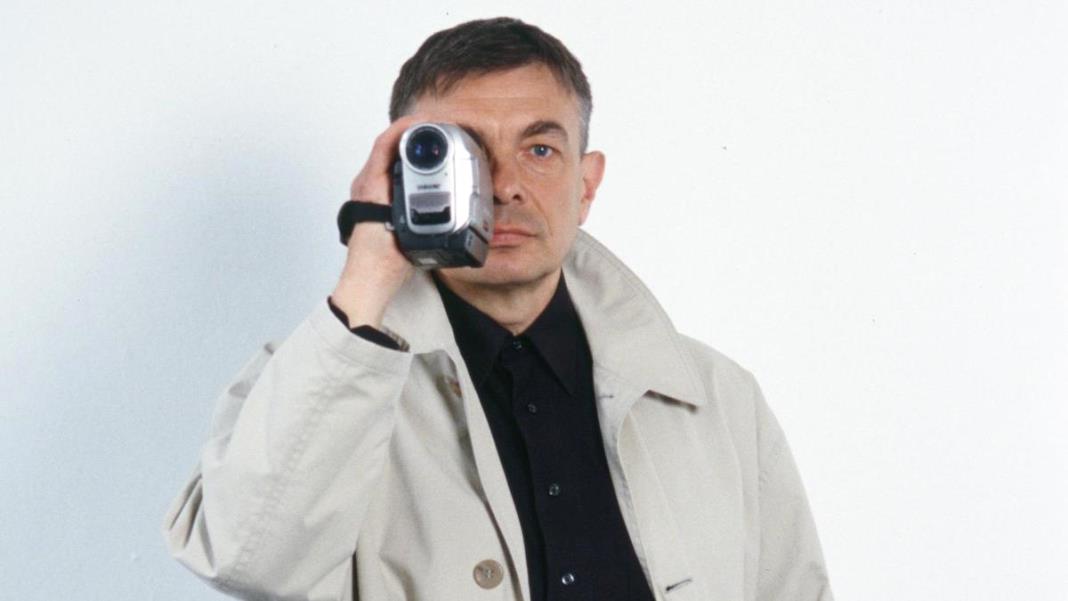
Photo by Gaby Gerster
But Bartos would return to electronics for his debut solo album proper ‘Communication’ in 2003. He acted as a guest professor in Auditory Media Design at the Berlin University of the Arts between 2004 to 2009 before formulating his second solo album ‘Off The Record’ which came out in 2013. His most recent music project has been a present day soundtrack to ‘The Cabinet of Dr Caligari’, the 1920 German Expressionist silent horror film directed by Robert Wiene.
His autobiography ‘The Sound Of The Machine – My Life in KRAFTWERK & Beyond’ was published in English in 2022 by Omnibus Press and among the interesting factoids contained within was that the inspiration for the ‘Numbers’ beat was a Cliff Richard recording called ‘Do You Want To Dance?’; almost everything about the creative process at Kling Klang from an eyewitness point of view was contained in this book.
With a remastered version of ‘The Sound Of The Machine’ recently published with a new foreword by music academic Dr Leah Kardos, Karl Bartos kindly entertained a career spanning chat with ELECTRICITYCLUB.CO.UK

You have published a remastered edition of your book ‘The Sound Of The Machine’, are there any specific differences with this new version. How was it to write, from the original German transcript through to translation into English?
After the book’s publication in Germany, I began revising the text with the English translation in mind. Many sections had been cut and I’ve now reinserted them elsewhere. Meanwhile, I had also analysed my time with KRAFTWERK and, for example, added the paragraph ‘Progress as a Shining Promise’ to Chapter 16. Digitisation was one of the decisive reasons for the end of our creative community.
When we then worked on the translation with the fantastic Katy Derbyshire, several other things came to light that I had noticed in the other language. And my magnificent editor, David Buckley, brought another expertise. It wasn’t really work for me, but rather very educational and a great pleasure. Yes, I’m happy with Omnibus Press’ remastered edition. And, of course, I love the profound foreword. Dankeschön, Leah Kardos.

You are still performing your contemporary soundtrack to ‘The Cabinet of Dr Caligari’ live, what fascinated you about this film and how did you find composing to moving images and a storyline?
The industry of killing machines was invented then. For the first time, a war was fought with modern weapons: machine guns, tanks, airplanes, flamethrowers, chemical weapons, and much more – everything that scientists had developed. The film reflected the horrors of World War I. It was a sensation at its premiere in Berlin in 1920. It was considered a new art form. Reproducible – made for the masses. The new medium of film combined the expressionist worldview with psychoanalysis and the mystical ghost world of Romanticism.
Composing functional music was an enriching experience. But I didn’t just compose music, but also integrated all the sounds of the narrative world into the music. That’s why my partner, sound director Mathias Black, and I called it narrative film music.
Your debut solo album ‘Communication’ was reissued in 2025 by Bureau B, but it sort of got lost when it was first released in 2003. How was the reception to it 22 years later on its now prescient themes?
Yes, I’ve been living with this album for a while now. I can’t say much about the reactions to the reissue yet. A friend from England wrote to me that it’s difficult to determine the order of my music releases anyway. The events of September 11th deeply shook me at the time, and I wanted to focus on the power of images.
How do you look back on the making of 2013’s ‘Off The Record’ and how it brought some of your past into the present? Are there any more “secret acoustic diary” entries that can be developed?
During my professorship at the Berlin University of the Arts, the idea for an autobiography gradually matured. My pocket diaries, scores, and audio diary were all kept close together. Yes, I often write things down. Perhaps because I want to know how I think.
‘Ohm Sweet Ohm’ remains an underrated classic, it is very emotional and human in its realisation with your “knitting needle schlagzeug” being among the key components, how did your pop mind and classical training take to this new technology and sound when in the studio for the ‘Radio-Activity’ album?
The 1970s were a decade of avant-garde music. And Düsseldorf was an artistic centre for all directions of the avant-garde. As a student, one was very involved in experimentation. Compositions for percussion generated quite a lot of buzz. Steve Reich played at the Kunsthalle in Düsseldorf in the early 1970s. That was an enlightening experience. I also studied Stockhausen’s ‘Zyklus for a Percussionist’ and, with the percussion ensemble, Carlos Chávez’s ‘Toccata for Percussion Instruments’. It was also around that period that I first heard pieces from John Cage’s ‘Imaginary Landscape series’. It was an amazing time, living and learning amidst the sounds of music.
But bear in mind: even in the 60s, THE BEATLES had one foot in the avant-garde of sound art. The recording sessions for ‘Radio-Activity’ were cool and the atmosphere was great. I remember thinking to myself that it was a good mix of pop and avant-garde. That was then.
In today’s capitalist, computerised world, however, many are more concerned with content management than with music. We once imagined this digital world and translated it into music. But yesterday’s future is now the past. Many people love this retro-futurism. That’s fine with me. Nostalgia is very potent. However, nostalgia should not degenerate into retro-perplexity. Because art, by its very nature, enters into a dialogue with the world. And as Canadian Prime Minister Mark Carney recently said in a different context in Davos: ‘Nostalgia is not a strategy.’
Before MIDI, you had the customised Vibrolux electronic vibraphone which you used on ‘The Hall Of Mirrors’, how did you find using to it compared to an acoustic one?
It was rather basic, but it could control a synthesizer, and that was the point.
You came up with the bassline of ‘Metropolis’ while the percussion was sequenced for the first time, how do you see your role as a musician changing at the time?
When I was young I‘d played in pop bands and in classical music, for example in modern ensembles and opera. From the beginning, I felt that composing came naturally to me. Since I never saw myself as a drummer in the traditional sense of pop music, I had no reservations about automating the rhythm. I somehow liked the anonymity of a formula. Similar to the bar lines in musical notation, which represent the pulse, it is the framework that holds the music together. After all, we wanted the quantification to aestheticise the logic of the machine. Essentially, I’m an artist who just happens to be a musician.
One of your new tools in the reconfigured Kling Klang for 1981 was the Triggersumme, what was that like to use and what possibilities did it open up?
It involved the automation of a beatbox with the ability to make variations ‘on the fly’. In fact, the synchronization of the analog sequencer and the Triggersumme for controlling percussive sounds was an ingenious unit. The engineer Hajo Wiechers has done an excellent job. Unfortunately, we weren’t aware of how beneficial this technique was for merging our creativity.
Isn’t it strange that after our 1981 world tour, we didn’t perform live again with our classic line-up until 1990. Progress was a shining promise, and our belief in technology clouded our vision. The digital hysteria of those years diverted our attention from people to machines, and the machines, in turn, blocked our view of what we should have been doing. Because up to that point, all our music had been created through the interplay of our creativity. And the creation was supported by a few music boxes.
Our group of artists then became a digital business model. It is really remarkable how many things we’ve experienced as a result of technological progress are now being repeated in information society worldwide. I view the invasion of artificial intelligence with great concern. I’m not afraid of technology, but of people and their intentions.
The ‘Computer World’ tour saw you playing more keyboards but do you have a favourite synthesizer of all time?
I still own two Minimoogs. Yes, this machine was truly brilliantly designed by Mr Bob Moog. I also have a digital plug-in. Most of the time, we end up with distortions in the digital hall of mirrors. But I think the Moog plug-in turned out well too.
What is your favourite drum machine or rhythm unit?
I’m afraid I can’t help you here. I believe the analog sequencer and Triggersumme of Hajo Wiechers had the ability to awaken creativity and be receptive to inspiration.
Digital synthesis and sampling entered the fray on ‘Tour De France’, how did you view these sonic developments?
Every work of art has two faces: one looks to the present, the other to eternity. I believe that we were too focused on the present during this phase. From a top-down perspective: Technology isn’t all that important for the creation of music. We know that with a few colourful building blocks, children can let their creativity run wild. But we can’t imagine life without technology either. The most important inventions for music were notation, the metronome tempered tuning and the circle of fifths, the fortepiano, and sound recording.
But there’s one more! The idea of automating music on a timeline has been around for a very long time. In the past, people used a cylinder to pluck a comb made of metal tongues of different lengths, thus producing sounds. Essentially, this very clever principle has been transferred to the computer. Anyway, what’s important is the emotion that the music contains and can communicate.
How did you come to sing the lead vocal on ‘The Telephone Call’, had you presented it as a complete song?
Yes, I came up with the lyrics and the melody, I seem to remember. That was a long time ago and isn’t so important to me anymore. I’d have to look that up in my autobiography…
Your music has been very influential and in 1992, you were asked to remix ‘Planet Rock’ which appropriated the ‘Numbers’ beat and brought things full circle… what was your reaction when you first heard it in 1982?
I forgot. I’d have to look that up in my autobiography too… meanwhile, the rhythm has been used over and over.
When you started ELEKTRIC MUSIK, you opted not to front it as such and left the lead vocals primarily to Lothar Manteuffel and guest Andy McCluskey, had your first lead vocal with ‘The Telephone Call’ not provided the confidence you needed?
That’s a good question. My main goal was to have a roof over my head. Others could be here too. That’s why I used the name of my music publishing company Electric Music for the band. By mistake it turned out as ELEKTRIC MUSIC. At the time, I wasn’t sure whether I should use my own name for the product. I have been working under my own name for a long time now, like in classical music.
When Andy showed up I gave him a little melody and a few chords, which were called ‘Loreley’ back then, and he turned it into a song ‘Kissing The Machine’. I certainly hadn’t expected lyrics about artificial intelligence in 1993. That was a blast, of course.
And I had written ‘TV’ in 1987, shortly after ‘Electric Café’ / ’Techno Pop’. At that time I was following the work of Marshall McLuhan and Neil Postman because I felt that with ‘Radio-Activity’ we had missed the point regarding the topic of media. And when I finally got the record deal for ELEKTRIC MUSIC, I was forced to write the album in no time at all. Some days I’ve been working 16 hours. The guys where mixing one track at the studio and I was at our place, the Klangwerkstatt, composing / arranging the next song. So Lothar Manteuffel of RHEINGOLD was getting the job to sing ‘TV’. Because I worked overtime to compose and produce the album.
Was the cover of ‘Baby Come Back’ for the NME ‘Ruby Trax’ collection some fun and light relief from your past?
Yes, that’s true. Andy McCluskey suggested the title for our contribution during a dinner at Wolfgang’s place. Emil was there too and Lothar. We had a wonderful time; it was one of those nights.
How true is the legend that you inspired Andy McCluskey to conceive ATOMIC KITTEN?
Oh yeah, I don’t even remember where it was… Düsseldorf, Liverpool, Dublin, Los Angeles? We were just throwing some ideas for the next OMD album into the computer. Andy was in his element, and we tried out a few things that didn’t necessarily sound like OMD. At some point during the session, I asked him if he’d ever written music for other artists. I was thinking of the golden age of songwriting in Tin Pan Alley, or its modern-day counterpart, the Brill Building. I later learned that he’d looked into it. Andy is incredibly talented, but of course, everyone knows that.
You did productions for INFORMATION SOCIETY, THE MOBILE HOMES, VIENNA and FLATZ while among your collaborations were OMD and ELECTRONIC… do you ever wish you did more as a producer? Is there anyone you would have liked to have worked with?
That was a long time ago. The collaborations with Bernard and Johnny, or Andy, were outstanding and completely different.
Today I no longer feel the urge to produce music for other artists. I produce for myself when I compose. For me, nowadays much of the production process revolves around the measurable side of the world. It has a lot to do with technical applications and physics. My mindset is far too abstract for that. I achieve the best results when I play with the elements of music like a child, without any intention or goal. Just for the sake of playing. Sometimes I manage to get into that state…
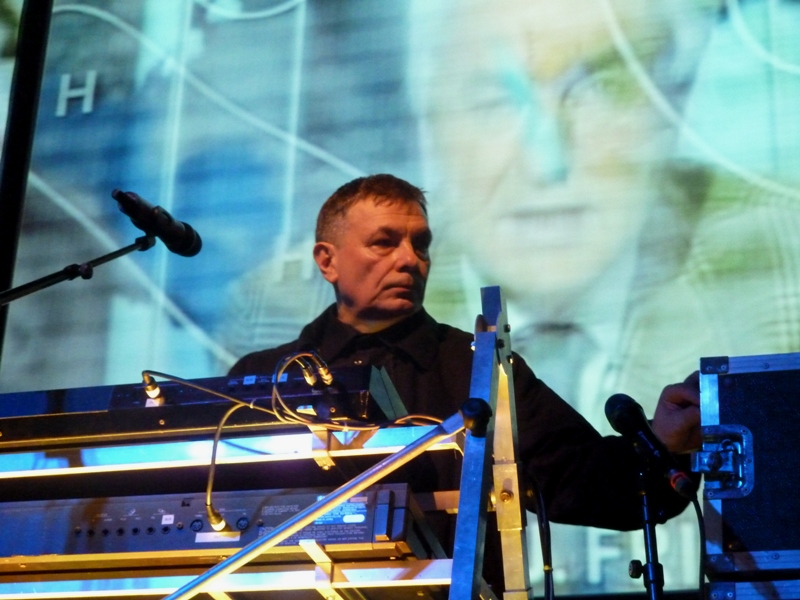
Photo by Chi Ming Lai
An interesting by-product of working with Johnny Marr and Bernard Sumner in ELECTRONIC was you returned to Germany “with a Rickenbacker strapped to your back” which took you into an unexpected direction?
The computer is an extremely powerful production tool. Unfortunately, the device itself, and the digital copy of the world, is very time-consuming. The Silicon Valley people have understood how they can shift a significant part of the work onto the customers. That happens everywhere. There’s a lot of fairy dust being sprinkled around. The business model of digital companies isn’t exactly in love with traditions. However, I’m an artist who feels at home in traditional European culture. We’ll see what the new world order will bring about in terms of art.
That’s why I’m glad I have a few old acoustic instruments in the house. No dirty tech, outdated operating systems, updates, algorithms, feedback loops, AI hallucinations and no looney tech billionaires with their feudal-sounding visions for human kind, the planet and even space.
While working on ‘Caligari’, I composed some of the music for my upcoming electronic album acoustically. As always, it’s primarily about listening, feeling, playing, and thinking. I didn’t record anything for a long time, but made handwritten notes, just like during my musical studies or at Kling Klang Studio. The golden trail, so to speak. That way my subconscious is constantly adding to what’s already there. Or it’s about reducing what’s already been achieved. When I then transfer the music to the computer’s timeline, the musical elements have already developed a life of their own. Music, after all, originates from life.
But of course, I sometimes start with a blank timeline. Ha, the void! I should really write a short piece about creativity sometime. It’s like this: inspiration doesn’t arise when you hope for it, but only during the work itself.
Which are your 5 favourite pieces of your own work?
I’m afraid I can’t answer that question. I don’t know. For me, life in music is like breathing.

Photo by Philipp Rathmer
What is next for you?
I hope that one day I will release my next electronic album. A long-cherished wish of mine, the re-recording of ‘Esperanto’ (1993) is also planned. There are so many unheard melodies and musical elements from the early 1990s and before that I would love to come to life.
Will you ever perform your KRAFTWERK co-writes and solo “pop” material live again, as it’s been a while since you’ve done that?
I don’t know yet. Igor Stravinsky once said, in essence, that music is a speculation with sound and time. The live music business is also about speculation – nothing is certain until the tickets are sold.
But my music is constantly being performed live. My former musician friend is touring the world with his show. He seems to be omnipresent. You know, I don’t regret anything. But I also don’t forget anything. And I’m really grateful and happy that people don’t stop listening to our songs. That means a lot to me. I believe our music will outlive us. And that’s not too bad, is it?
ELECTRICITYCLUB.CO.UK gives its grateful thanks to Karl Bartos
Special thanks to Sean Newsham at Bureau B and Bettina Michael
The Karl Bartos solo albums ‘Communication’, ‘Off The Record’ and ‘The Cabinet Of Dr Caligari’ are all available via Bureau B at https://www.bureau-b.com/artists/karl-bartos
‘The Sound Of The Machine’ is published as a remastered paperback edition by Ominbus Press
https://www.facebook.com/OriginalBartos
https://www.instagram.com/karlbartosofficial/
https://www.youtube.com/@karlbartos/videos
https://open.spotify.com/artist/5tJ5CFnO4JQmLXaarEyHKt
Text and Interview by Chi Ming Lai
25th February 2026
Follow Us!