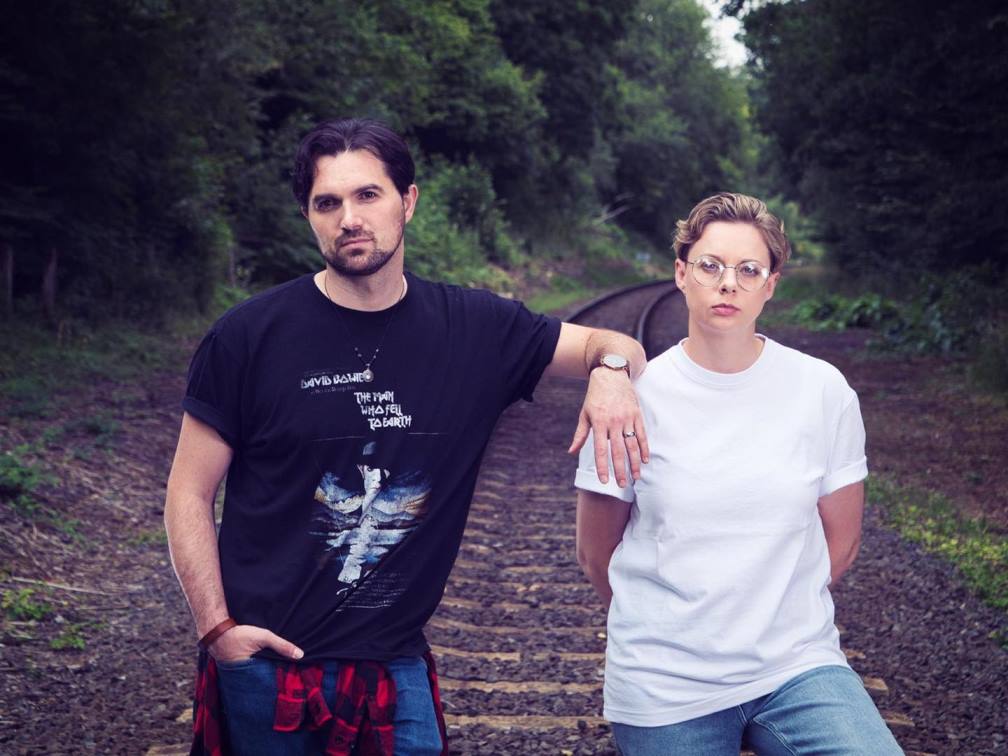
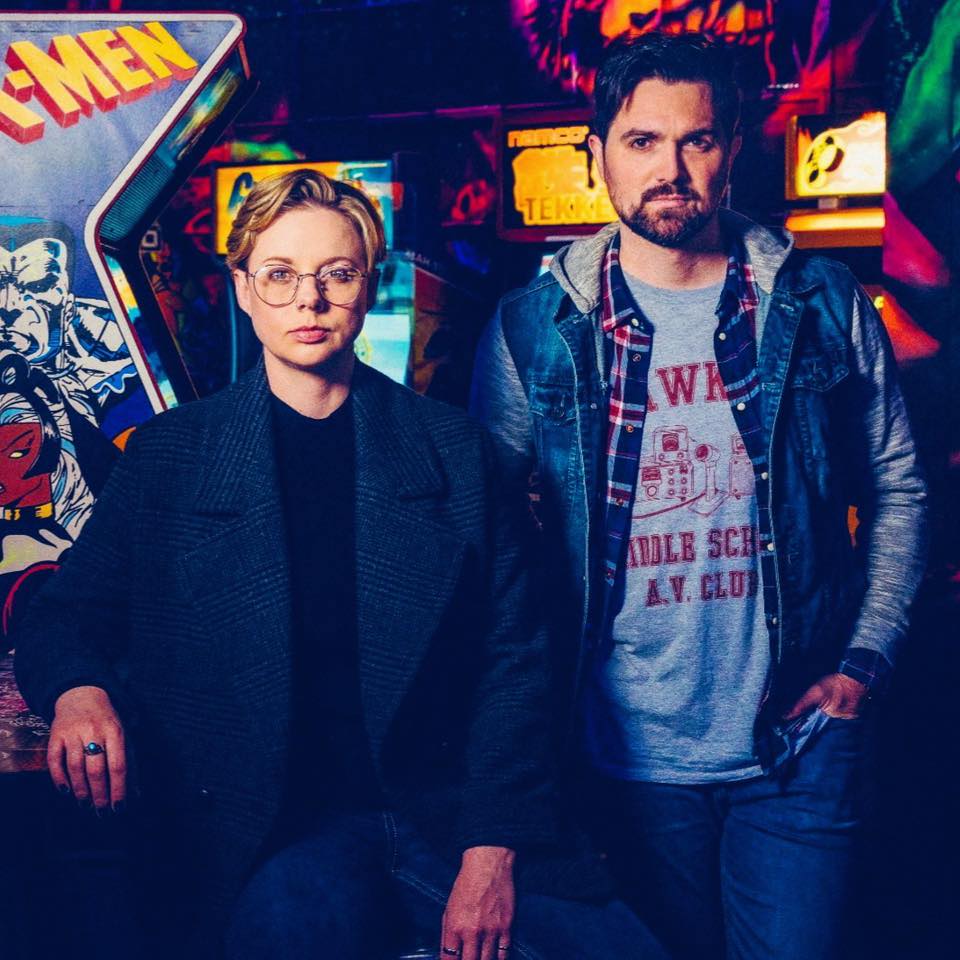
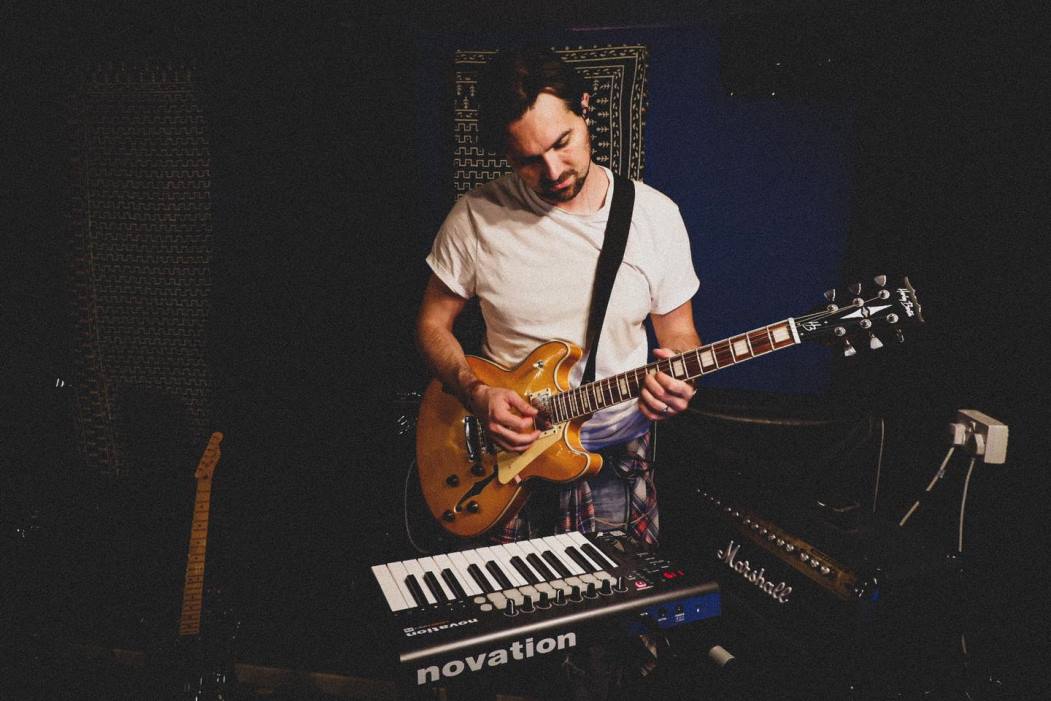
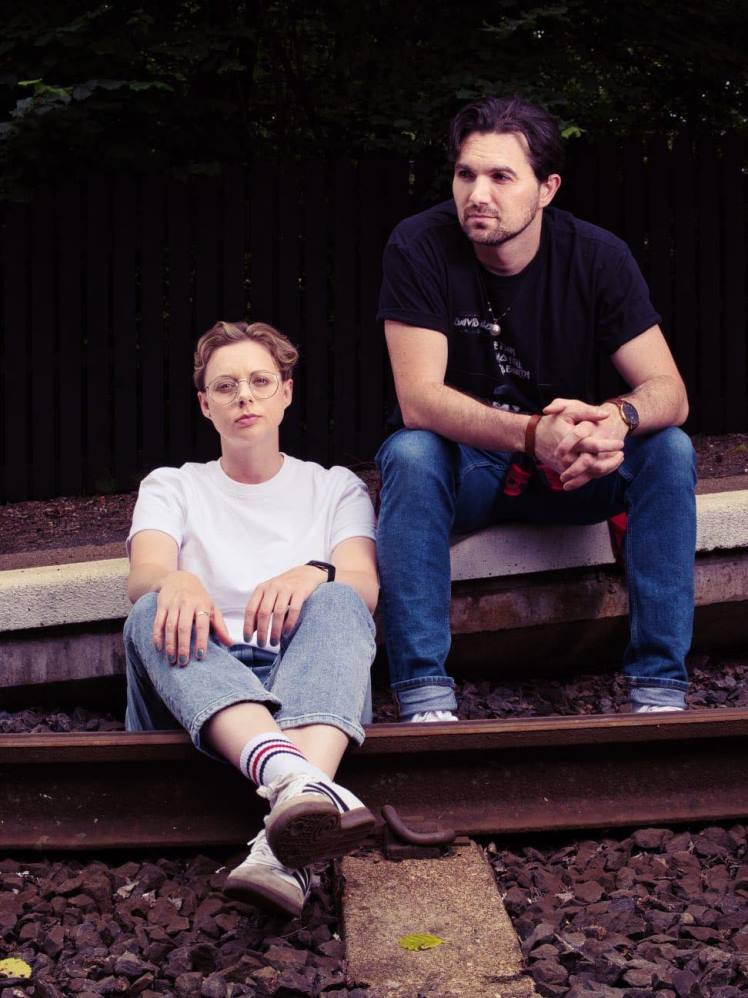
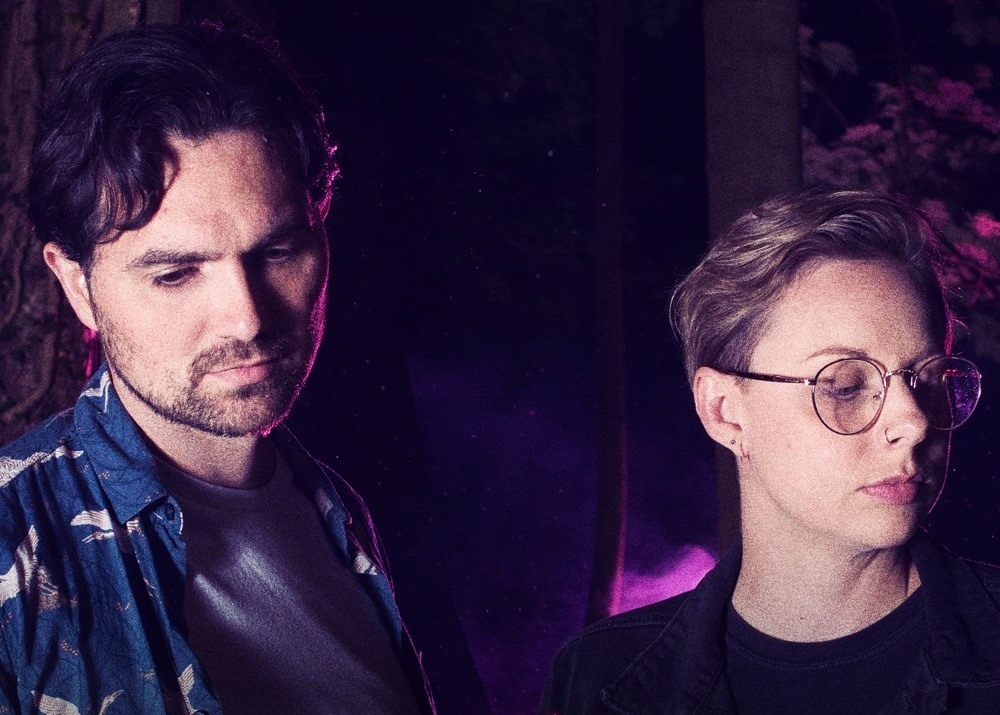
Based in Wolverhampton, the unrelated duo of Rebecca Davies and Robin Davies are YOUNG EMPRESS.
Combining synths, guitars, bass and other live instrumentation with modern technology, YOUNG EMPRESS opened their account with the strident single ‘Peacemaker’ in late 2020. Using the art of cinema as a prime influence, their sound found an audience within the Synthwave community.
The haunting arpeggiated ‘Ghosts’ maintained the standard while ‘Christine’ entered darker territory in an ode to the John Carpenter film of the same name.
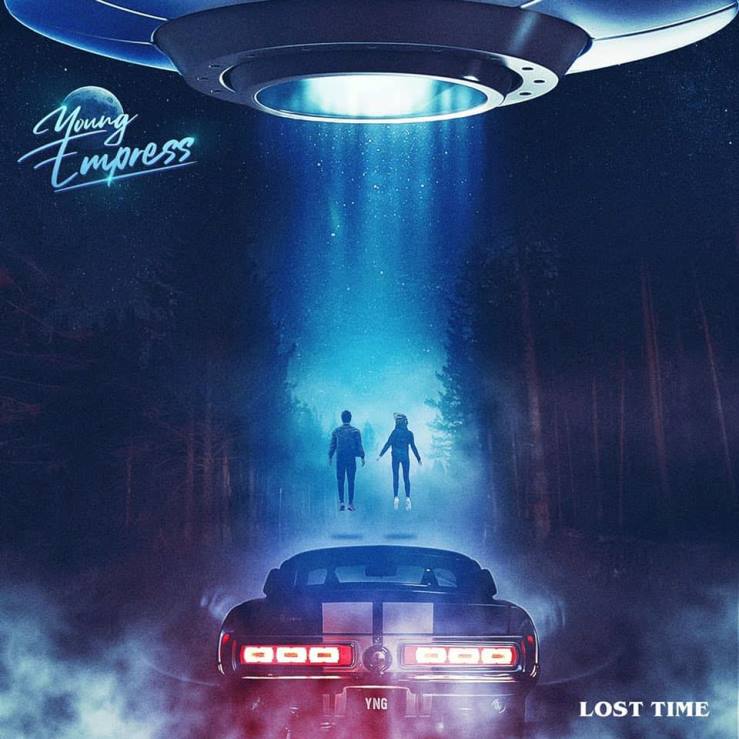
The summer of 2021 saw YOUNG EMPRESS issue their best single yet in the ‘Dead Poets Society’ inspired dreamwave of ‘Eyes Closed’ as a trailer to their well-received debut long player ‘Lost Time’ on Aztec Records. But prior to the release of their first album, there was a collaboration with Zak Vortex on a moody synth laden cover of FLEETWOOD MAC’s embittered break-up anthem ‘Go Your Own Way’.
During a studio break, YOUNG EMPRESS collectively answered some questions put to them by ELECTRICITYCLUB.CO.UK about their musical ethos, the influence of visuals and the making of the ‘Lost Time’ album.
Your motto is “Drink Tab, play Robotron, listen to DURAN DURAN”, but neither of you look old enough to have drunk Tab? 😉
That’s very kind of you. We certainly drink a lot of water so perhaps that’s responsible for our youthful looks. This is a quote from ‘Ready Player One’ by Ernest Cline. We’re big fans. It’s a great read for book worms and a great watch for film lovers too.
Have you come across a real vintage arcade version of Robotron? Do you have any favourite games?
Funnily enough, we shot some scenes for our short, self-titled film ‘Young Empress’ in a local arcade that had a version of Roboton: 2048.
We both love retro games – especially Outrun – which we would love to have in our music studio. We may invest one day. Although we’d probably spend more time driving than writing music if we did.
So why DURAN DURAN over SPANDAU BALLET? 😉
Both are great! One of Bex’s favourite songs is ‘True’ by SPANDAU BALLET but DURAN DURAN has that get up and dance vibe. That would pull us to the dance floor of any family wedding disco in a heartbeat. We wouldn’t say no to either it just depends what mood we’re in.
What are the musical roots of YOUNG EMPRESS’ vocal and instrumentation format?
We gather inspiration from such a wide variety of sources. It’s not just exclusive to the electronic music scene. We are children of the 80s and loved that era of music but the 90s music played a big part in our youth too. It spans the decades for us and I think we would both agree that it was music from the 60s and 70s that encouraged our first musical awakenings. Even now we’re still open to suggestion and we love stumbling across older bands and artists that we have yet explored fully. We’ve been likened to a handful of musicians over the years but hopefully our love of both male and female vocals from the 80s helps us to create elements of a more androgynous vocal sound.
In terms of palette, where are you sourcing your sounds from? Hardware, software, vintage and traditional instruments?
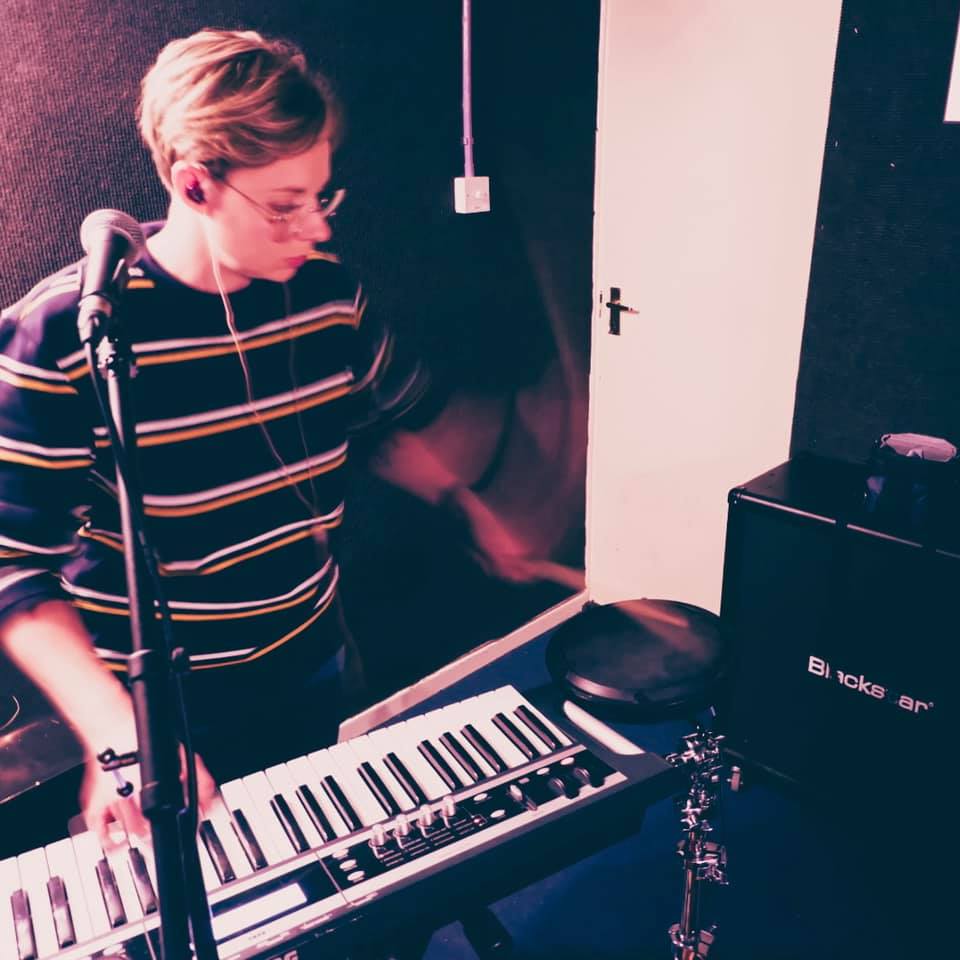
A lot of our synth sounds are VST versions of retro synths, mainly Juno, Jupiter, DX7 and Moogs, but we also include aspects of live drums, sax, guitar and bass too. We are both multi-instrumentalists, so we like to keep an element of live sound in the mix of our tracks. Even when we are looping sounds and programming instruments, we still start with real live instruments and lean on them heavily in the writing and recording process. It’s a combination for sure and finding the right balance throughout.
‘Peacemaker’ has this marvellous anthemic quality which appears to recall the penultimate section of ‘Music’ by John Miles from 1975, what was the song’s genesis?
When we wrote the tracks for ‘Lost Time’, we used movies as our inspiration and often had them running on a TV screen in the background while we chucking new ideas around. ‘Peacemaker’ was written with ‘The Magnificent Seven’ playing silently and on loop. The main synth riff just kind of came out from watching the screen and playing along. It soon developed into the track you hear today and the vocals tell a narrative of the action shown in the movie.
Where did that marvellous synth solo on ‘Eyes Closed’ come from? Were there any particular influences at play?
Any of the synth solos in the tracks are played and written by Bex. Sometimes they stem from us humming ideas at each other until something sticks, but mainly it comes from her ability to write a catchy little hook. We wanted something that ran a scale and jumped between octaves. We’ve always thought that it has old school ‘Doctor Who’ vibes to it. We love the sound we chose for that one so we’re happy it’s a catchy section.
‘Ghosts’ has many different aesthetic layers and a strong lyrical message and with the sax coming in, it almost turns into QUARTERFLASH?
That’s a great reference. We haven’t heard that one before. We love a good sax solo. Bex wrote and played the sax solo for this, then we layered up everything with a session musician playing over the top. It’s one of our favourite tracks. It’s the second song we ever wrote for YOUNG EMPRESS before we even thought about making an album. It’s based on the film ‘The Sixth Sense’ which gave us a great selection of dialogue to play around – especially the tag line “we see ghosts all the time”. We had really good fun writing this one. When we could see it gaining popularity, it made us really proud. It will always be a special track for us.
Aside from the collaborations, the ‘Lost Time’ album is self-produced. As independent musicians, what do you think is in your extra 10% that has made it stand up next to the deluge of bedroom electronic-based acts that are now ten-a-penny these days?
We have always written and produced our own material. We think it’s really important to have a handle on your own sound, how it develops, how it sounds live and how you can get that across in your mix. Robin will spend hours trying to find the right sounds, FX and levels for YOUNG EMPRESS, with Bex waiting the wings, listening in the dark, co-producing from the side lines.
We also work with an amazing guy called Ryan Pinson from RML studios in Wolverhampton. He takes our mixes to the next level with production and mastering. He has honestly been the 3rd member of YOUNG EMPRESS at times, and he brings an outside ear to our tracks that we wouldn’t hear when we’re locked away on our own for days writing. You can become deaf to your own mixes when you hear them day in and day out. So we draft in trusted talent to listen and guide us forwards. That’s a really important part of the writing process for us.
How was it to work on tracks with Sunglasses Kid and Maxx Parker while aiming to maintain the continuity of ‘Lost Time’ as a body of work?
Both artists are amazing, and we feel really privileged to have worked with them on the tracks that made it to our album. We are all on the same label with Aztec Records and we reached out to Sunglasses Kid who had written a short idea for a track which he posted on Instagram. It instantly grabbed our attention so we asked if we could put vocals over the top for him. Luckily, he liked what we wrote so he agreed to let us lay guitars over the top and add it to our album tracks. He’s a great guy and a real talent on the scene, and we really admire what he’s creating.
Maxx Parker has fast become a good friend of ours and he’s an incredibly talented chap. He asked us to collaborate with him on a track called ‘Last Dance’ which appeared on his debut album ‘Outsider’, then we returned the favour and drafted him in to craft a track for ‘Lost Time’. He came back with the fundamentals of ‘It’s Always Dark’ and we instantly loved it. He understood the brief and absolutely nailed this track for us. It’s another firm favourite of ours and it’s really fun to play live too.
Your music has an impressionistic visual quality about it and you produced a short film featuring ‘Peacemaker’, ‘Ghosts’, ‘Christine’ and ‘Home’, how did the story board and track selection come about?
We always wanted to make a short film and have our music be the soundtrack. We wrote the songs before we wrote the story itself. It was a collaborative project with filmmaker Anthony Davies of 12:42 Studios and Kayleigh Watson, who created a fantastic screenplay for us without the need for dialogue. A tricky task but we think she nailed it! ‘Peacemaker’, ‘Ghosts’ and ‘Christine’ were written ahead of filming and helped sculpt the narrative for what we shot but ‘Home’ was written specifically for the project. All of our other tracks are inspired by movies so naturally we took our experiences of what we were filming, the actors we were working with and the story that was coming to life in front of us to bring this final song to its completion.
We took inspiration from films we loved from our childhood and mirrored scenes to give the project a nostalgic feel. The character of Death was probably the most time consuming to create. Manifesting an entity that was a physical embodiment of grief, fear and depression took a long time. We spent many hours discussing our own fears and films we were scared by as kids. All of it came together to create the final cut. It’s something that we really enjoyed doing and we will be venturing outside of the realms of song writing again in the near future so keep your eyes peeled for updates.
YOUNG EMPRESS have released an instrumental version of ‘Lost Time’, did you feel any particular pressure to do this as there’s to be this oddball elitist line that’s been drawn between vocal and instrumental synthwave. Just taking off a vocal from a song does not necessarily make it a good instrumental track, while a number of intended synthwave instrumentals sound like someone has forgotten to sing because those tracks lack hooks and themes…
I think the way we tend to look at it is our audience is quite diverse and everyone has different opinions about what they like musically, especially on the synthwave scene. There are certain gatekeepers who believe an artist’s sound should complete a tick box of dos and don’ts to meet the criteria of the genre. We aren’t necessarily out to please anyone but ourselves so when we write, so long as we enjoy what we’re creating then that’s all that matters.
We are fans of vocal driven tracks just as much as we are instrumentals, and although it should be more than just removing lyrics from a song, sometimes it takes elements of silence within a track to isolate what’s really happening in the background. You can’t always appreciate the work that goes on behind a track once vocals are over the top. It tends to become more about the lyrical hook sometimes but when you strip it back to the music beneath it can be just as enjoyable.
With our instrumental album, we just wanted to give our listeners the option to hear it with and without vocals. Beyond that, we’ve remixed our own tracks, reworked and re-envisioned them, as well as asking our peers to recreate them for us with their own spin on it. It’s all just about experimentation for us. How far can we push ourselves, how far outside of this box can we step and how can our tracks continue to evolve. The science of synthwave! We love to flex it a little. That’s the real fun.
Which are you own favourite tracks on ‘Lost Time’? How do you feel the album has been received?
We are so pleased with what we’ve created and how well it’s done in such a short space of time.
We are thrilled with the number of streams we have on the tracks, and we couldn’t ever have imagined that so many people would stumble across our music and keep us spinning but more than that, what makes all the difference to us is the feedback we get, the people who come up and chat to us at gigs, the messages they send us online. That’s really heart-warming and we appreciate everyone who gets in touch to talk to us about our music.
Its early days for us but we’re currently at 150k streams on the album and that still blows our minds! It’s all those streams that build an audience for us and a fanbase who take an interest in what we are doing. It gives us a platform to write more and progress as musicians towards whatever comes next, and we are really grateful for that opportunity.
When we perform live, Robin enjoys ‘Lost Time’ and ‘Christine’ because they are a lot of fun to play on guitar but this changes regularly. Bex likes ‘It’s Always Dark’, which was one of the last tracks we wrote for the album. It’s based on ‘The Never Ending Story’ – one of her favourite films from her childhood, and with one of the main characters being the inspiration for the band’s name (The Childlike Empress) it will always be special to both of us. We are just so happy that people are listening to our music and coming to our gigs. It’s been a really wild ride so far but we are enjoying every minute.
Which character from either ‘The Breakfast Club’ or ‘St Elmo’s Fire’ would you be and why?
We love ‘The Breakfast Club’! It was our inspiration for the track ‘Saturday’. Robin would probably associate himself with Emilio Estevez’s character Andrew. Growing up as a sensitive, sporty kid who had a lot of pressure to succeed but never really ‘belonged’ in the social circle – that seems very familiar.
Bex would like to think she’s a hybrid of more than one character. A bit nerdy like Brian, a bit of a rebel like John Bender and a bit of a weirdo like Ally Sheedy. Definitely not sporty like Andrew or a beauty queen like Claire. It’s a great film for highlighting all the awkward parts of teenage life I’m sure many of us can relate to.
If we can be anyone from ‘St Elmo’s Fire’ then we’re opting for Rob Lowe. Who wouldn’t love that beautiful face!
There was this drummer who so depressed about his timing, he threw himself behind a train… what is your favourite drummer joke? 😁
How can you tell a drummer is at your door? The knocking speeds up.
What’s next for YOUNG EMPRESS?
We have another tour coming up at the end of the year and we will be announcing dates soon. We loved hitting the road to perform this summer so why stop now! For the next run of dates we are ramping up our live performance and we have a few ideas in the making to pump everyone up. Album Two is in the making – don’t you worry! Studio time is just the best. We can’t rest – we love to write. Our sound is developing, and the ideas are rolling in already. The synths are out in full force, and we are really excited to see how this one evolves.
There will be more videos, more content across our social media platforms, more laughing and joking too and a few more surprises to announce along the way. We hope to end the year on a high and start 2023 with a bang. Watch this space!
ELECTRICITYCLUB.CO.UK gives its warmest thanks to YOUNG EMPRESS
You’ve heard the music, listened to the podcast, now you can read the book…
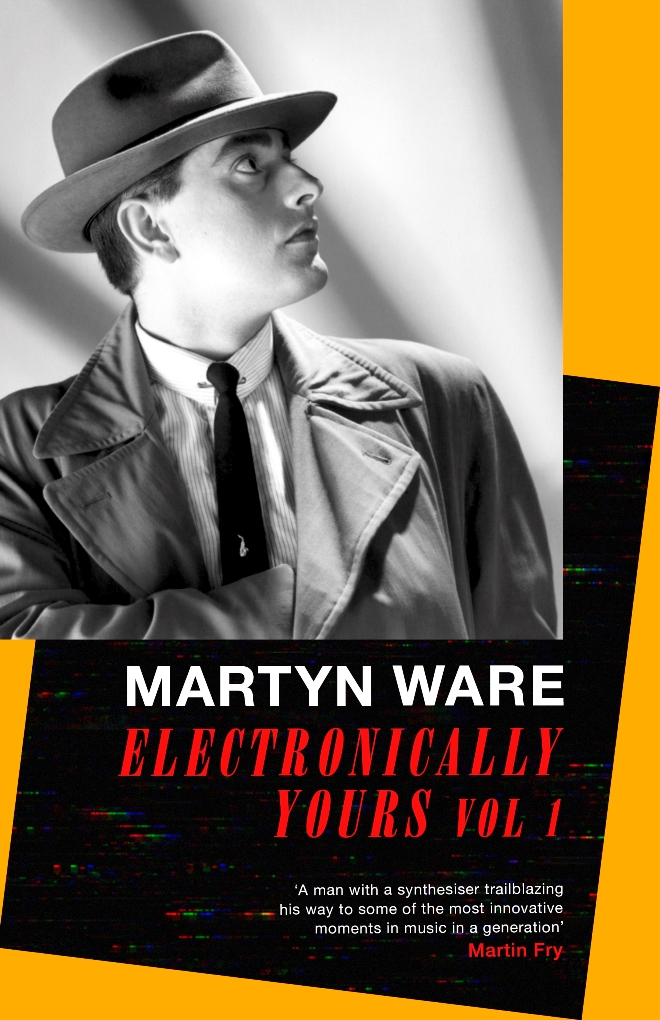
‘Electronically Yours Vol 1’ is the autobiography of Martyn Ware. From his synth innovation with THE HUMAN LEAGUE and HEAVEN 17 to productions for Tina Turner and Terence Trent D’Arby to ambient collaborations with Vince Clarke, it is the story of his humble working class origins in Sheffield, rise to acclaim and million selling records.
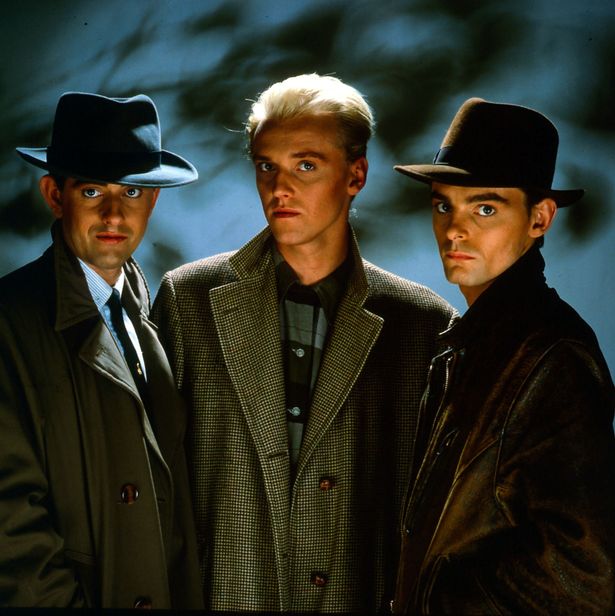
In between, there was his teenage friendship with former-bandmate Phil Oakey that led to the formation of THE HUMAN LEAGUE who were subsequently declared “the future of music” by David Bowie. After a Coup d’état that led to Ware leaving THE HUMAN LEAGUE, he formed BEF, a production company from which an umbrella project named HEAVEN 17 with singer Glenn Gregory and fellow League refugee Ian Craig Marsh became an international success, most notably with the huge hit single ‘Temptation’.
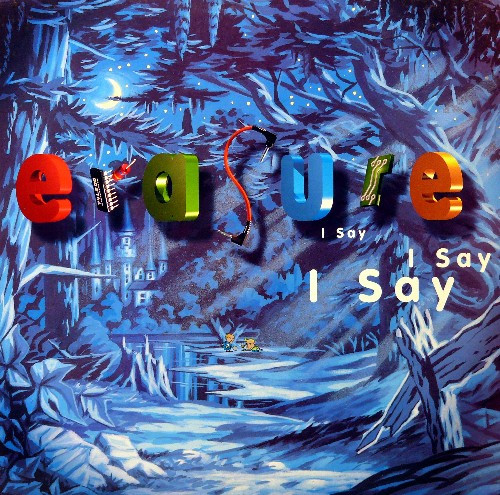
Ware achieved two No1 albums as the producer of ‘Introducing The Hardline According To Terence Trent D’Arby’ in 1987 and after HEAVEN 17 went into hiatus, the sixth ERASURE album ‘I Say I Say I Say’ in 1994. The latter link up with Andy Bell and Vince Clarke eventually led to HEAVEN 17 returning to the fold as the opening act on 1997’s ‘Cowboy’ tour and becoming a favourite on the live circuit to this very day.
‘Electronically Yours Vol 1’ also allows Ware to articulate his views as a proud socialist, something he considers to be a soulful, personal and moral duty. Anyone who considers politics and music should not mix have perhaps missed the point of his music; the themes of HEAVEN 17’s first two albums ‘Penthouse & Pavement’ and ‘The Luxury Gap’ highlighted the class divide that got only wider under the government led by Margaret Thatcher.
Martyn Ware chatted candidly with ELECTRICITYCLUB.CO.CO.UK over a game of Vintage Synth Trumps about the history of technology, how the music industry has changed over his multi-decade career and his fruitful working relationship with Vince Clarke.
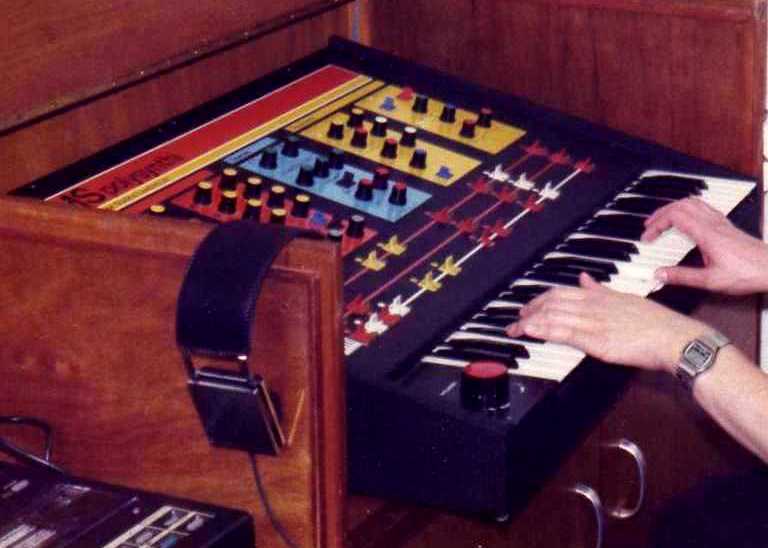
The first card is the EMS Polysynthi…
I’ve never played one of those but I’m a big fan of EMS design in general, my first band THE FUTURE featured Adi Newton who owned an EMS Synthi AKS suitcase synth. I couldn’t get any sense out of it at all but it made a fantastic racket that you couldn’t predict.
The number of people I have talked to on the ‘Electronically Yours’ podcast who have talked about EMS in fond terms, it’s the one that I covet…
The EMS Polysynthi was at our college studio and it sounded horrible… I thought it was just me but then a few years ago, Vince Clarke declared it as “the worst sounding synth ever made”*laughs*
It looks nice and colourful which is generally a good sign but how weird is that? I never saw it in his studio, maybe he didn’t have it out because he didn’t like it.
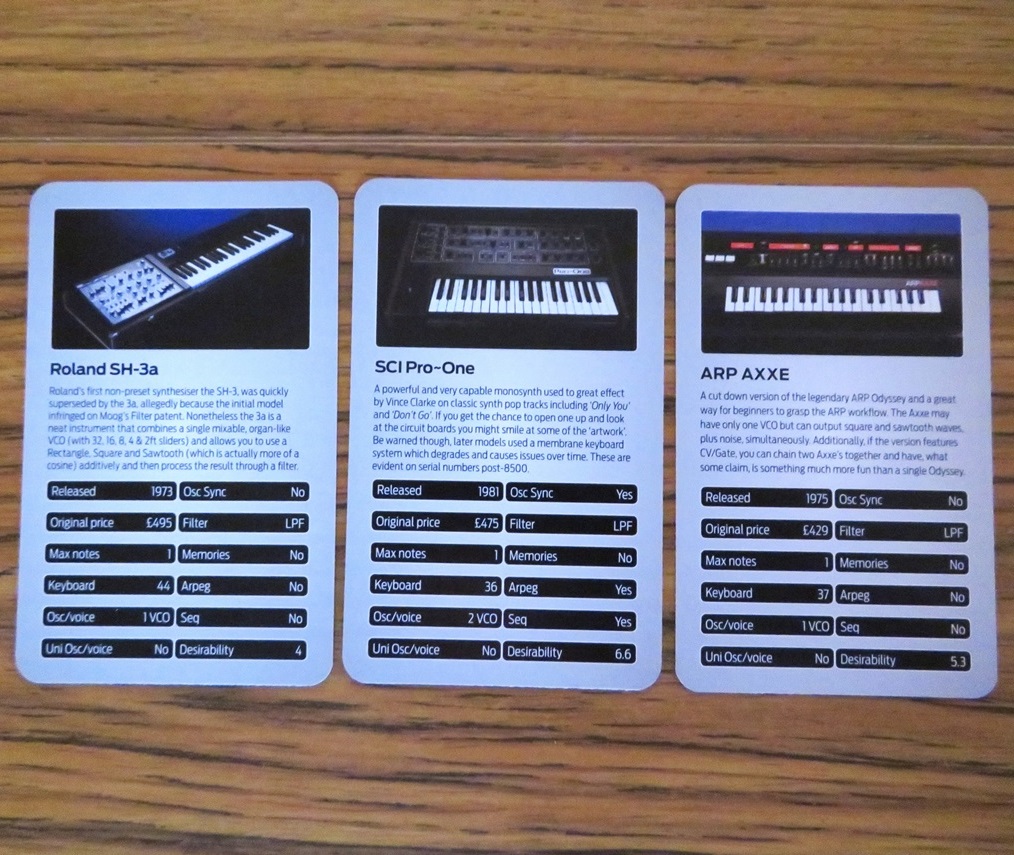
Next card is a Roland SH3a…
I had one of those! This was around 1979-80, it was a very nice synth, I liked it a lot but it wasn’t as good as the modular synths that I was more familiar with. Roland were starting to move into more mass production stuff at that point and appealing to a bigger market. They were using a lot of the same components but somehow, the filter was not as extreme so the sounds were less electro-punky like I preferred at that time. They redeemed themselves with the Jupiter 4 but it was too effete, too soft.
So did it get used on ‘Reproduction’ or ‘Travelogue’?
No, it was sort of the unloved runt of the litter. I just couldn’t get it to go far enough for my taste, it was a bit safe. I think Roland toned down the extremities of the filters to make it more usable for the average Joe.
I’m always fascinated by synths that artists don’t like, I remember Billy Currie of ULTRAVOX saying his was the Prophet T8 because it cost a fortune and was nothing like the Yamaha CS80 which he’d sold it for…
Haha! We’ve all done that! We regularly sold our old synths for whatever the latest thing was, that proved to be a massive mistake as soon as we approached the FM synthesis period which I never really got on with.
So with your book, you mentioned you started it 3 years ago, is it basically a product of lockdown?
I’d been thinking about it for a while and then lockdown happened, I thought if I don’t do it now, I’m not going to do it. I’m one of those people that HAS to be doing something. If I’d had been locked inside during lockdown like in some countries, I would have gone insane. During lockdown, there were two things that I quickly determined; one was to start this autobiography.
My daughter was living with us then so I employed her with the research as I can’t remember a lot of it as I never kept diaries. I’ve got a sketchy knowledge of stuff and remember individual incidents. So over three months, we did solid research using a spreadsheet with a timeline but after a month, this spreadsheet took up a whole wall!
It’s like getting your ducks in a row, you’ve got to have a cogent understanding of what was connected to what happened in what time order. It can become like David Niven’s ‘The Moon’s A Balloon’ which is a series of reminiscences but I didn’t want it to feel like some old bloke’s book! Although I’m an old bloke, I wanted it to feel dynamic.
So once you’ve established the timeline correctly, you can start messing about with it or approach it from the point of view of themes. What I ended up doing was a combination of themes, chronological stuff and to break it up a bit, there are contributions from people who have been important to me throughout my career ranging from the producers I’ve worked with like Pete Walsh, Greg Walsh and Richard Manwaring to various musicians.
The final bit of the jigsaw is essentially me going through EVERY track I’ve ever recorded with BEF and HEAVEN 17 and explaining the process behind it. So for people like yourself and those who are interested in the technical and creative aspects, this will be great. I’ve never really seen that in other musical autobiographies, I was partly inspired by Peter Hook’s ‘Substance’ book so kudos to him, I’ve nicked that idea, thank you.
Your next card is the Sequential Pro-One…
Now then, this one’s interesting. I’ve never used one but I’ve played with one… when you were in the studio in the 80s, you had a budget to rent equipment and try out stuff. We were fairly happy with the synths we’d got, but from time to time, something wouldn’t be available from the hire company so they would suggest “X”, so the Pro-One was one of the things we tired. I like Sequential Circuits as manufacturers and I know Vince Clarke has one of these so I messed around with it then. The basic oscillators and filters are quite pokey so I like it from that point of view. I think it was more of a performance synth.
You’ve mentioned in the past that you favoured the Japanese manufacturers over the American ones…
I always thought with the American synths, I liked the roundness in their tone, I would have killed for a Moog Modular like Wendy Carlos or Giorgio Moroder had but I couldn’t afford it. But they were more performance oriented…
I’ve never been a very good keyboard player, so it wasn’t my desire to find something that would enable me to perform in a musicianly way or to imitate a sax or oboe or whatever. I was never interested in that.
I was more into textures and from that point of view, Korg and Roland were much more on that kind of odd Japanese trip. The approach that they took to the user interface for synthesis was more theoretical. But a lot of the American manufacturers, for me, were aimed at a traditional musician, so when somebody was going into a synthesizer shop to try something out, they could easily get a sound that they were familiar with out of it. I was never keen on that, I wanted something that sounded unfamiliar, so there was a philosophical difference actually.
One time you did go down the American route was for ‘Pleasure One’ with the Emulator II…
Yes, but I’m not really counting this in with that American synth ethos because we had a Fairlight which was frankly a disappointment. We used it on ‘How Men Are’ but it was quickly superseded for me by the Emulator II. Ian Craig Marsh spent £40,000 on something that rapidly became a doorstop *laughs*
Ian was gutted when I bought the Emulator II for about £3,500 plus a magneto-optical drive with the latest CD-ROM. This was state-of-the-art, not even computers had these things apart from mainframes. So for domestic use, this was almost unheard of. We had access to this gigantic library of sounds, which today, nobody thinks twice about. Back then, it gave you an advantage and the sound out of the Emulator II was miles superior, as well as its samples. It became my workhorse for a good 4 or 5 years in productions.
Stephen Hague said the Emulator II was his bread and butter for about 5 years…
It was very elegantly designed, the people who did the sound libraries for them knew what they were doing. It was very warm sounding compared to other things.
Here’s another card, the Korg Mono/Poly…
I did fall for the whole M1 thing but after the early Korgs, between 1981-85, I didn’t buy any Korg equipment because everything Roland was coming out with was so brilliant and I didn’t see any advantage in spending a lot of money on what was essentially, not that different. I’ve played with a Korg Mono/Poly more recently and it’s fine…
You’re often thought of as a Roland man, is there an unconsciously loyalty with particular manufacturers…
I think the development process and timeline of Roland felt more cutting edge than any other manufacturer. Because we were self-identified as needing to be “cutting edge”, there didn’t seem any reason to stray from that. The Jupiter 4 was incredible, I still think it’s the best sounding traditional keyboard synth, rather than modular. The Jupiter 8 was good and ahead of its time but it didn’t sound as good as the Jupiter 4 and so on and so forth. If Roland had started falling behind in the late 80s, then I might have switched. I had a Roland S-700 series sampler which because of the converters sounded better than the Akai ones.
So with your book, was there a story you had completely forgotten about that came up in research?
Yeah, quite a few. They were amazing days in the first half of the 80s, I didn’t have a holiday for 3 years! It was that time when Virgin were making so much money from the birth of CDs that it was flooding in, so we felt we had to take advantage of this good fortune… but, while we didn’t think this money was coming out of thin air, we weren’t really fully concentrated on the fact that we’d have to pay all the recording costs back for instance. We didn’t fully recoup on HEAVEN 17 until the late 90s on the recording side.
There was one major story that I’d forgotten about, I was reminded about it by Glenn. We were recording ‘How Men Are’ at Air Studios in Oxford Circus and we were getting cabin fever. The news was full of Thatcher’s government committing a huge amount of public expenditure on cruise missiles. We were absolutely terrified like the majority of people were that we were going to be blown off the face of the planet! *laughs*
There was this idea of Mutually Assured Destruction as discussed on ‘Let’s All Make A Bomb’ from ‘Penthouse & Pavement’ and it just seemed like the whole world was going to sh*t… now that sounds familiar! Back then, we were heavily involved in the anti-nuclear movement and we’ve always been activists. One day, we just said “we’ve got to do something positive” as people we’re looking up to us as a politically motivated band…
Photo by Gered Mankowitz
So what happened?
I can’t remember whose idea it was. I think it was Ian’s and he said “why don’t we do a banner and put it on the top floor above Topshop on Oxford Circus as a protest?”. We thought in our demented minds that this was a great idea so we got some canvas and painted it to say “HEAVEN 17 SAY NO CRUISE IS GOOD NEWS” with the CND logo on a 20 foot by 4 foot banner.
We wanted it on the corner to get the maximum viewing on Oxford Circus but we had not really thought this through because how do you get this thing up? There was this ledge outside the window a metre wide and I’m not that great with heights! But Glenn said “I’ll do it” while Ian was completely mad and said he WOULD do it.
Meanwhile our engineer Jeremy Allom, a crackers Australian dude, said not only would he do it but would take his bike onto that metre long ledge and rode it around the outside of the building, overlooking the street with a hundred foot drop! I was like “I AM OUT!” and went home!
So Glenn, Ian and Jeremy put it up on a summer’s evening and Glenn took a polaroid… he came round my house and said “Martyn, take a look at this, it’s f*cking amazing!”… this photo is in the book by the way. I was thinking “this is great, it’s going to be in the newspapers”. But next thing in the morning, I get this phone call from Gemma Caufield, A&R co-ordinator at Virgin Records saying “YOU’VE GOT TO TAKE THE BANNER DOWN! THE POLICE ARE THREATENING TO ARREST YOU!” The owners of the building were threatening to sue us and we were given an hour to take it down… I didn’t even put it up there! *laughs*
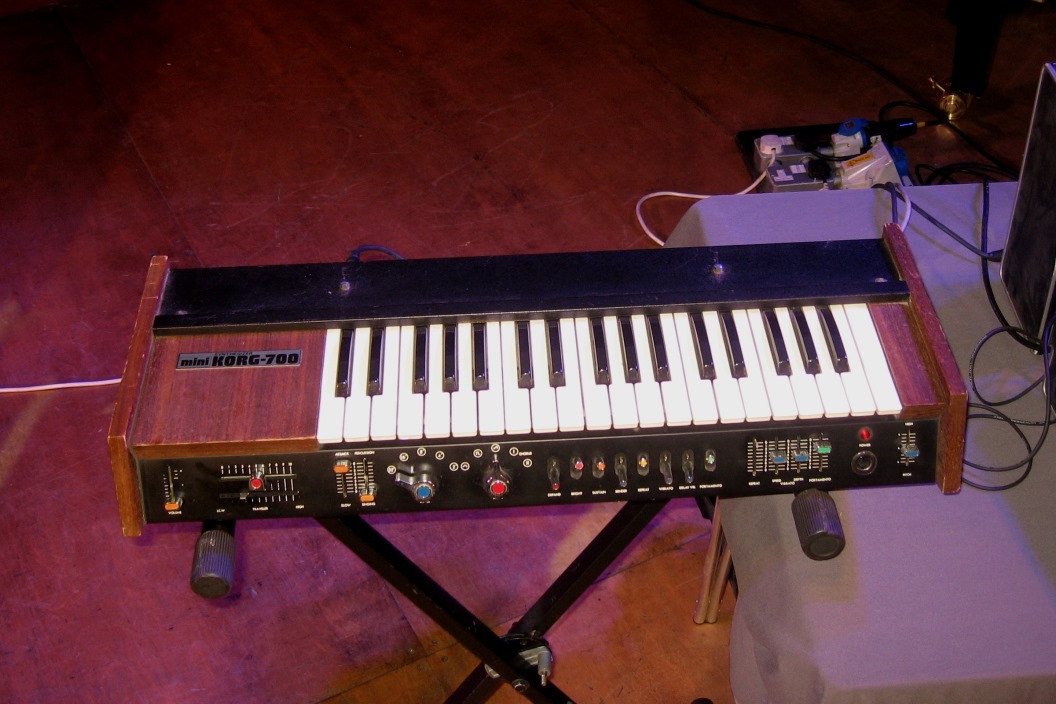
Here’s another card, this is a fluke, a Korg 700s!!
Now you’re talking, you fixed this! So the Korg 700s, it’s the one I’m most fond of as it was the first synth I ever owned, apart from the dual stylus Stylophone I had. I’ve started taking the 700s out on tour again to play ‘Being Boiled’, the audience can’t believe what it sounds like.
It’s a totally different experience to any digital synth. The solidity of the bottom end is incredible and the filters are amazing. It had two oscillators that you could tune against each other or make them interfere using the ring modulator function, plus it’s monophonic of course, which suits me cos I’m sh*t!
The filters are called “travellers” and it’s got really weird colourful switches saying things like “expand”, WTF does that mean? I know what these things do now because I know how synths work but back then, it was mysterious. It had a white noise oscillator, there’s delay and vibrato. That was used in THE FUTURE before THE HUMAN LEAGUE and I’m really fond of it, if it ever got destroyed, I would be heartbroken.
When THE HUMAN LEAGUE played at the original Marquee on Wardour Street in 1978, it was rammed and they couldn’t get any more people in, we thought we were hardcore electro-punk! I found out 6 months ago that some people got turned away because it was full… two of them were David Bowie and Iggy Pop! Fortunately Bowie came to see us later at The Nashville. We opened for Iggy later on the ‘Soldier’ tour when Glen Matlock was in his band.
When THE HUMAN LEAGUE opened for punk bands like SIOUXSIE & THE BANSHEES, THE STRANGLERS and PERE UBU, the audiences were initially confused but they soon came round and turned into our core support in the end. It was different time and people now seem to be more segmented in marketing terms whereas then, it was much more open.
Your ‘Electronically Yours’ With Martyn Ware podcast has gone very well, you’ve done a lot of episodes, has it got bigger than you expected?
Absolutely 100%, I did it really as a distraction over lockdown… I had about 20 or 30 people who would probably do it. I like the podcast medium and listening to audio books while walking around London. I thought “I could do that”; there was nobody really doing anything in this sector of music. The thing I like about podcasts is they are truly international, there were colleagues and friends in American who knew people who might be interested, so one thing leads to another. A friend of mine from Sheffield who was the singer in a band called SOUNDS OF BLACKNESS introduced me to Maurice Hayes who was musical director for Prince, I would never have thought about approaching these people. It’s got a life of its own now.
Are there any artists that you haven’t interviewed yet who you would like on ‘Electronically Yours’?
There’s some I’ve been chasing since the start who have said they’ll do it, but for a number of reasons, it hasn’t happened yet. The main one is Brian Eno who I know, I don’t think my career would have happened without him on every level from Roxy to his ambient stuff to his work with Bowie and Fripp etc. He’s agreed to do it but he’s so busy.
Kate Bush has turned me down for the podcast and BEF but has always been sweet, she said it’s not something she’d do, I think she’s a very delicate flower. There’s another woman Annette Peacock whose 1972 album ‘I’m The One’ I loved, I got into a long dialogue with her and she’s still doing amazing stuff in her late 70s but she wants to combine appearing on the podcast with her next release. I’d like to chat to Cosey Fanni Tutti, she said she’s happy to do it but only when she’s ready.
There’s a few who have turned me down like Kevin Rowland who’s a friend of mine but didn’t fancy doing it… some people aren’t comfortable with autobiographical long form… the other main one is Green Gartside who I’ve worked with and known for 30 years but he’s not responded.
Time for another card, and it is an ARP Axxe…
I’ve not used a lot of ARP stuff in recording terms. Vince Clarke has nearly every ARP synth on earth and duplicates of a lot of them, so I got the chance to play with them… I just think a lot of those synths sound quite similar, what would you say the characteristics of the ARP Axxe were?
The ARP Axxe is a smaller version of the ARP Odyssey, I remember when Billy Currie spoke to me, the thing he loved about the Odyssey over the Minimoog was it had sliders rather than knobs so he could almost play heavy metal on a synthesizer, it was about player controllability…
I was curious to find out what the weapon of choice was for synth-funk bands in the 70s but one day, I stumbled across a video of THE GAP BAND and they had an ARP Pro-DGX. So I started looking into it and the reason why it was the weapon of choice was it had control features like polyphonic aftertouch which other synths didn’t have. A lot of synth basslines from the period had slurs between notes using ribbon controllers, that became the funky bass synth so that’s my ARP story.
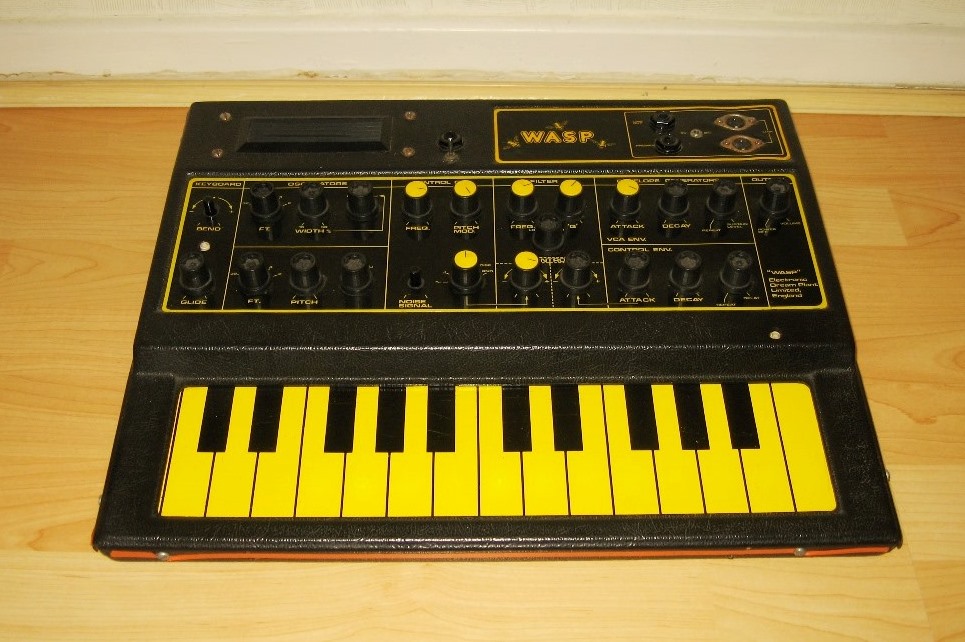
Another card and it’s the EDP Wasp…
I love the Wasp but it’s completely unusable… it’s one of the most beautifully graphic designed synths, but it sounded irritating to me, a bit like its name! It was a bit like a toy, but not in a good way.
Two more cards, this is one you wanted, an EMS Synthi AKS…
Now you’re talking, I really want one of those. If anyone wants to distort my cultural development and sell me one at a reasonable price, I am definitely up for it. I want it as a piece of design but I can’t justify it for the price it’s going for these days. It’s a thing of immense beauty, what do you think?
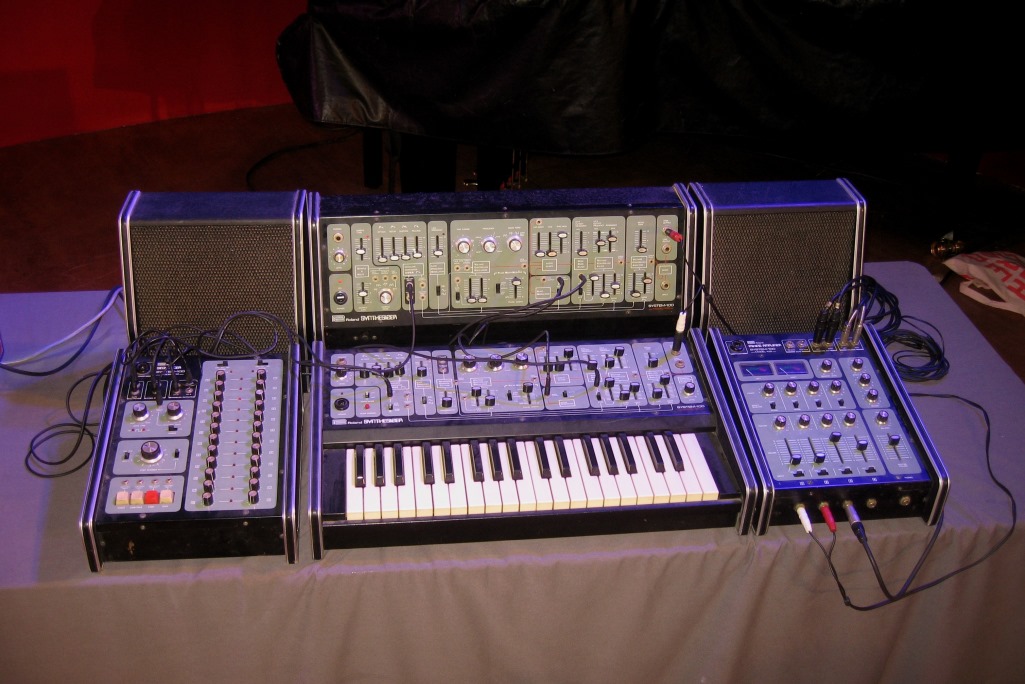
There was one of these at the college studio which had the EMS Polysynthi and the Roland System 100 which was the synth I took to out of all of them… I never got on with the Synthi AKS because I couldn’t get my head around it, I just wanted to make sounds straight away which you could do with the System 100…
Yes, you’ve got to know what you’re doing, the Synthi can be difficult to get it into registration with a keyboard, it’s not a simple matter of plug and play at all, what with that matrix patch bay…
With the System 100, you could almost make something out of nothing, it was like no matter what you did with it, something happened and you could make it sound like what you wanted…
As it says in the manual, “there are no illegal connections…”
So how did you discover the Roland System 100 and make it your next purchase after the Korg 700s?
That’s not true actually, I bought the 700s and Ian bought the System 100 and sequencer at the same time. So those two and a tape machine became our tools to create demos in the early days. I learnt to use it and the System 100 is fantastic as a teaching tool, it’s so clearly laid out and easy to show what happens. When I teach my students on the MA Songwriting and Production about analogue synthesis, I’ve got a digital oscilloscope that I put on the end of the output and it shows the shape of the waveform, the tones are so pure.
But the story behind my System 100 is when I produced ‘I Say I Say I Say’ for ERASURE in 1993, I had been waxing lyrical about the System 100 as Ian had sold his. Vince had one of course and two days before Christmas, there was a knock on the door and there was a bunch of boxes outside. I was thinking “what’s this?” and Vince had bought me a complete System 100 with speakers and everything! I couldn’t believe my eyes, he had been saying to me that I needed to get back to pure electronic music. Apart from being an incredibly generous gesture, it was his way of changing my cultural development back again. It’s a beautiful story.
So what was the production dynamic like between you and Vince for ‘I Say I Say I Say’?
Here’s the story, I’d never met Vince or Andy before but I was a fan and I was contacted one day out of the blue from Mute Records saying Daniel Miller would like to speak with me. I was a big fan of THE NORMAL and SILICON TEENS so next thing I know, Daniel who I had never spoken to before asked if I would produce the next ERASURE record.
It turned out he didn’t realise I did productions and I said “I’ve done Tina Turner and Terence Trent D’Arby!”; Vince said the same thing after I met him in Amsterdam later. I laid out a methodology that I thought would work which was fundamentally old school. Vince just wanted someone to bounce off.
As I read it, him and Andy work remotely, that was certainly the case for ‘I Say I Say I Say’. It’s only when we laid toplines and backing vocals that Andy would come into the studio, most of the time, Vince was on his own. I think he got bored with being on his own and that’s why he wanted different producers. Now Vince KNOWS what he’s doing, production-wise and arrangement-wise but he needed someone as a means of randomising things a bit and to confirm that he’s moving in a different direction.
I remember with Vince when we were taking about this process and he agreed. He said “you know what Martyn, I am my own biggest fan, I just think everything I do is brilliant”… it was so disarmingly honest and it wasn’t anything to do with arrogance at all, he just knew he was the master of his craft because he had all the tools at his disposal to do exactly what he wanted, to create any sound he wanted, impersonate the effect or function of anything from guitars to bass guitars, woodwind to percussion to those aleatoric weird sounds, he could do it all at the drop of a hat. So all he needs is someone to help him organise it.
I contributed some arrangement ideas and record the vocals which he didn’t really want to get involved in, so I was the vocal specialist; I learnt about vocal stacking techniques from Greg Walsh who did ‘The Luxury Gap’, he worked with HEATWAVE and Geoff Emerick who worked with THE BEATLES. These are the dark arts that transform things from average into multi-national hits.
ERASURE had not really had that kind of producer before, in the past it was perhaps kind of more vibey electronics with Flood. There were all great producers, but it was a different approach. On one side I know all about electronics while on the other, I’m more like an old school traditional auteur producer if you like with a 70s vibe… that worked brilliantly with them I thought. Andy has since told me that as far as he’s concerned, the vocals and arrangements on ‘I Say I Say I Say’ are the best that ERASURE have ever done.
What’s your favourite track on ‘I Say I Say I Say’?
I do really like ‘Always’, we worked so hard on that. Right from the outset from the sketch before we fleshed it out and made it really something unique, it sounded like a hit. I was really thrilled when the album went to No1. They are such amazing people to work with, so creative and innovative, they are so self-effacing and open to suggestions, but they also know when the to stop; I know a lot of artists who constantly doubt themselves and aren’t happy even when it’s all done.
The story that sticks with me with Vince is when I went in the studio one day and he asked me what I thought of a track he did overnight. It sounded really good and I suggested 3 or 4 amendments in terms of sound to open out the spectral thing to make it sound bigger. I went to have a cup of tea and when I came back 20 minutes later, he had changed every single element and it was much better. It was everything! Can you imagine, the command that any person has of… he’s got like 50 synths that are all CV or gate connected in his studio, a series on MC4s that he programmes in with numbers and BBC Micro UMI which at that point he used to use as well plus Logic… this is a man who has complete command of his craft.
What are your thoughts on songwriting and production in modern synth music? This site has been criticised for not supporting enough new electronic music… I thought I was just being an old git thinking that songwriting is not as good as it used to be. But over lockdown, I listened to a lot of old stuff to lift me up and it seems to generally be true. Also with production and I don’t know if it’s because of software and DAWs, many artists are not crafting their sound anymore…
I think you’ve hit the nail on the head, I can’t really add very much to that. There are many reasons for it, the workflow is entirely different now, it’s so quick to get something up to a reasonable standard… the temptation is to fall in love with that “reasonable standard”, the old thing would have been falling in love with a cassette demo. But you can take that reasonable standard and just put a topline on it and then its “OK, that’s done”. I think a lot of the time is because they don’t know…
When I teach songwriting at MA standard, there are some super talented individuals in traditional music terms but the vast majority of them who are in their 20s and don’t have the thematic or cultural context that our generation grew up with.
I love contemporary dance music and avant garde, but I’m against mediocrity. My general theory is if it doesn’t evoke any emotion in me, then I’m not that interested. If it’s exciting or people have a unique take on contemporary songwriting or instrumentals or whatever, I’m down with that. My worry is that everything is becoming more homogenised. I think a lot of it is due to following an economic model and that is a self-defeating mechanism ultimately because people chase the tail.
Honestly, some students of mine have told me “Well, I’ve watched lots of YouTube videos and I’ve done what it says and made a song with four chords and rotated it…” – they’re not doing it to be clever or lazy, they just DON’T KNOW! They’ve not studied great songwriting, they’re not paying attention to the stuff that we grew up with by default. We grew up through the main periods of some innovative artists like Kate Bush, David Bowie, Peter Gabriel etc who were always pushing the boundaries.
I’d like to think people like HEAVEN 17 and DEPECHE MODE were doing the same, but the whole landscape shifted in the late 80s towards marketing and then the whole music scene got steamrollered by the dance fraternity. I love dance music but a lot of it is a bit facile I find, it’s just too easy!
In my opinion, dance music ruined everything…
Here’s a story, when I first met Vince in 1992, he was living in a flat in Amsterdam above a small recording studio. There were these friends of his who we said hello to and what they did every day was do incremental variations on house music. At the end of the week, they would do some vinyl white labels and distribute them among the clubs in the city and see what ones were popular. Literally, they would change 10% of it and I was thinking, if this is the future of dance music, then I’m not interested.
Fortunately there are great artists at all points but what I’m saying is that economically, a lot of that oxygen was sucked up by the dance fraternity up to the 2000s, then it was given to the singer / songwriter cohorts who frankly, unless they are very good, are immensely dull. So we are here now, there is some innovative stuff going on, particularly in the hip-hop scene internationally, but it’s a problem.
I do honestly believe there is no shortage of exceptional interesting stuff as much as there ever was, it’s just harder to find, that’s all. Now there is 50 times more stuff out there than there was in the early 80s.
Recently I got a new iPad so as a test case, I thought I’d see if any idiot could knock up a reasonable sounding dance track on GarageBand… I managed it in about an hour!
I’ll tell you a funny story about GarageBand. When my son was 12 and in the Scouts, he thought he’d do some badges and one was “Creativity”. So I asked him what he was going to do and he said he was going to do something on GarageBand. He did it in 2 hours and it sounded as good as a lot of stuff that comes out now. But he was literally just doing “drag and drop” and I was thinking, this is not good. So I explained to him that if you have an easy way of doing something, the likelihood is that you’ll do that. The stuff that makes things special and engagement is the final 10%. But if you are not encouraged to get there, you don’t know what you don’t know. So that’s why we’re at where we’re at.
The final card Martyn, and it is a Multimoog, this came after the Minimoog when they were trying to be more mass market and cheaper…
Yeah, normally when that happens, the components they use aren’t as good so they don’t so sound as good and so on and so forth. Moogs generally sound great with a round bottom end, I’ve often used the virtual Moog Modular and I’ve got used to adjusting things on the screen… I’ve got f*cking hundreds of sounds…
Yes, this was something you talked to William Orbit and Richard X about in your podcast, there’s just far too many options these days… so when you make music now, how much of it is software versus hardware?
It’s mainly software. I do lots of stuff that’s not straightforward pop music like installations, effects and sound design so that isn’t really about performance in the sense of playing a keyboard, it’s more about assembling things that one finds interesting and engaging.
I’ve got a totally different perspective on all this stuff now since I’ve been doing Illustrious with Vince since 2000, I am much less precious about the ingredients, I am more interested in the content.
So what are your hopes and fears for the book, will there be a Volume2?
There will only be a Volume 2 if Volume1 sells *laughs*
It’s 130,000 words, that’s a lot. I’ve never written that much in my life, I never went to university so I didn’t do a dissertation or anything. It’s been really hard work but I can honestly say that I am happy with the book so that’s a tick. I’m happy with the design. I’m happy with the support I’m getting from the publishers Little Brown. I’ve recently had to read the audio book version that will bring it to life even more.
I hope to do a series of signing events and talks associated with the book. I never thought I’d ever had a physical book, it’s quite something to be an author. And I wrote every word apart from the other people’s contributions. There’s no ghost writing, if anybody doesn’t like it, that’s fine. Someone actually said to me “well, I can’t wait for this but I don’t know if I can deal with your lefty views”… err, that’s who I am mate! I’m not telling you what to think, so don’t buy it then, I don’t care! *laughs*
ELECTRICITYCLUB.CO.UK gives its electronic thanks to Martyn Ware
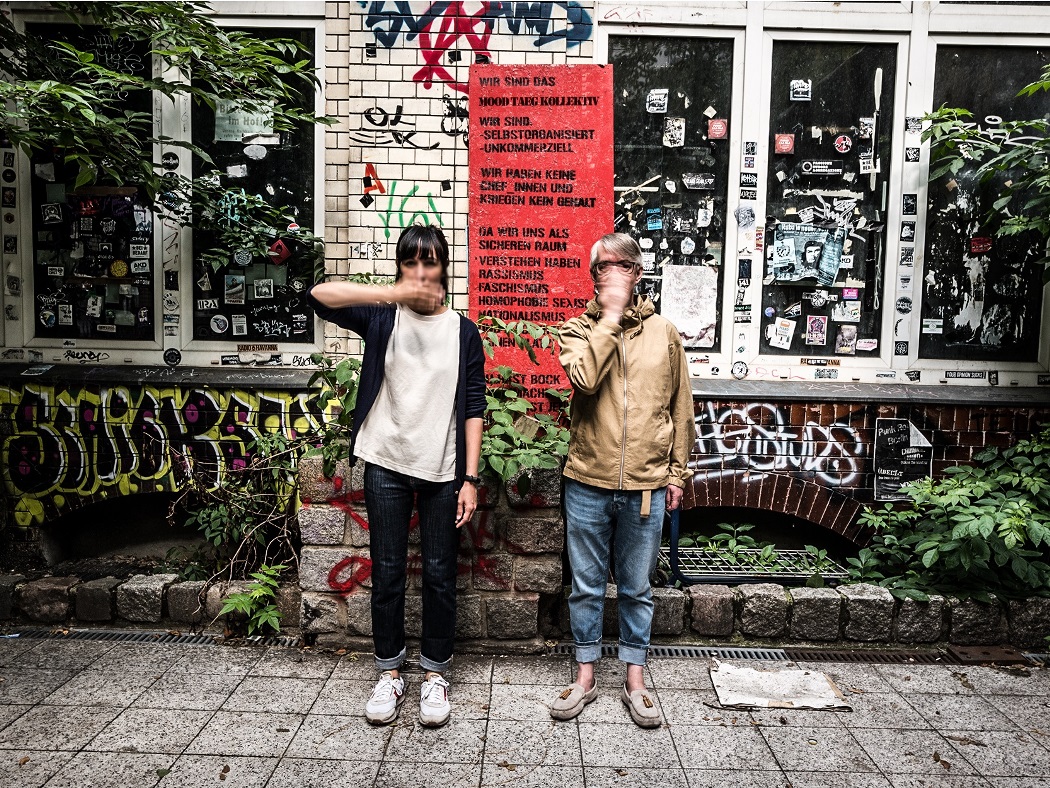
MOOD TAEG are the enigmatic multi-continental / multi-cultural kosmische trio with TDK and K’ko based in Düsseldorf while Lowell Freeman resides in Shanghai.
With two remotely constructed albums ‘Exophora’ and ‘Anaphora’ released on Happy Robots Records to their name, MOOD TAEG are unsurprisingly influenced by NEU! and HARMONIA; from their debut long player, ‘2MR’ was a tribute to Michael Rother.
Their next release journeys down the well-trodden German Road of variations on a theme as KRAFTWERK did with ‘Kometenmelodie’ and NEU! offshoot LA DÜSSELDORF did with ‘Menschen’. Doing as the title suggests, ‘Anaphora Versions’ features in-house and external re-imaginings of tracks from the second MOOD TAEG album.
While the Electric Boogaloo version of ‘Pilomotor Reflex’ sees Lowell Freeman dust off a vintage Roland TR-808 in a homage to Morgan Khan’s pioneering ‘Street Sounds Electro’ compilations of yesteryear, first out of the gate is a DanKe version of ‘Happiness Fragment’ with the ‘Anaphora’ closer now shaped into a comparatively poppier template.
From Germany and China, TDK and Lowell Freeman respectively came together for a quick chat with ELECTRICITYCLUB.CO.UK about their Dundeedorf ethos and five decades of NEU!
What was the idea behind ‘Happiness Fragment’, were there any particular influences behind its concept?
TDK: I’m not sure there was a concept as such but seeing as we don’t have conventional songs with lyrics, we often like to include spoken word samples that reflect our political or social views.
I remember reading Guy DeBord’s ‘Society of the Spectacle’ at university and it seemed to provide a good contrast to the more upbeat, even poppier, reworked version, along with feeling very apt in the social media saturated world we currently live in.
I included the Jimmy Reid (a famous Scottish trade unionist) sample for a couple of reasons. One was that it made a Scottish connection. The other reason was that it referenced a time when political discourse and political education among the working class was the norm and serious political discourse could be seen on mainstream media instead of the media-trained ghouls that exist today.
Lowell: One important concept for me was to try to progress from the first LP in ways that still follow that repetitiveness that we love from bands such as HARMONIA, but also make the tracks subtly evolve and never stay with one element for too long. ‘Happiness Fragment’ is probably the best example of that on ‘Anaphora’. I was also conscious of going for a more upbeat feel, at least in terms of sound. The LP track is also a clear nod to ‘Computerwelt’ in the last section with the pad sounds, chords and voice collage.
This neu DanKe version of ‘Happiness Fragment’ has been reworked to be more accessible?
TDK: As the DanKe suffix suggests, this was reworked by K’ko and myself and it was an attempt to take the longer album version and turn it into a track that would work well in a gig situation, especially considering that as a live band we only have two members compared to the three of the recording band.
Lowell: This DanKE version is mostly a Düsseldorf production, whereas the original has more of a Shanghai sound, so for me it feels fresh and is my favourite track on this ‘Versions’ CD. The added Jimmy Reid spoken word element is important to us and is also rather timely considering what’s happening in the UK with the rail workers and the treatment of all workers really. It will be no surprise to anyone who has heard our stuff that we are 100% behind Trade Unionism and workers having more say in their workplaces.
It’s NEU! 50, so will you be celebrating by going to any of the gigs? If you could choose a track to rework as MOOD TAEG, what would it be?
TDK: As far as we know, the only gig in Germany so far seems to be in Berlin but certainly, if they came to Düsseldorf, we would be there. In terms of choosing a track to rework, some people may say that we already did that with ‘2MR’ which bears more than a passing resemblance to ‘Hallogallo’ (haha!) I guess we would probably choose ‘Isi’ from ‘Neu! 75’ – it’s a very concise distillation of all the great NEU! elements and one of the great album openers.
Lowell: Yeah, anyone who’s listened to our first LP ‘Exophora’ knows ‘2MR’ pays homage to ‘Hallogallo’ so I think we’ve got a rework covered. If I was to do a track live, then yeah ‘Isi’ on ‘Neu! 75’ is a nice wee upbeat number.
ELECTRICITYCLUB.CO.UK gives its cosmic thanks to MOOD TAEG
The DanKe version of ‘Happiness Fragment’ is available on the usual online platforms from 8th July 2022
The EV of Athens-born Elena Charbila, KID MOXIE already has two albums, a soundtrack, numerous EPs and a games commission to her name.
The new album ‘Better Than Electric’ sees KID MOXIE veer to the dark side to explore her love of DEPECHE MODE and THE CURE while also maintaining the dreamier atmospheres showcased on previous releases ‘1888’ and ‘Perfect Shadow’.
Featuring collaborations with FADERHEAD, MAPS and LOST IN STARS, ‘Better Than Electric’ signals a new attitude but retains light within the darkness.
Elena Charbila spoke to ELECTRICITYCLUB.CO.UK from her home in Los Angeles about her latest KID MOXIE adventures, the romanticism of goth and an exciting new project that will be sure to turn heads…
You have said that the phrase ‘Better Than Electric’ has been key to conceiving this work, what do you mean by that?
The first song I did for it, ‘Better Than Electric’ with MAPS was done a couple of years ago. We started bouncing files back and forth. When I put the first synth lines on his melody, it was a pun on being struck by lightning in a way, that it feels “better than electric”. But I didn’t understand what it meant, I just knew the feeling was beautiful, loving and connected, but the phrase kept haunting me. Even after I’d completed the song, I was so in love with the concept, that I wanted it to be what the album was about, where every track has a certain sort of feeling but it doesn’t need to 100% make sense. Everything fell into that folder.
So there isn’t a concept?
I didn’t have a specific sound in mind, the album is like a mix tape that I’ve made for a night drive rather than a cohesive work with the same sonic landscape. Somehow, I felt it didn’t matter as they were all night time songs about love and sex, about Los Angeles and that was the common denominator, it’s not like I used a CS80 for everything, it’s not what I cared about.
The title song with MAPS is not a perhaps an indicator of the sound of the album overall and points to something more Lynchian crossed with Roy Orbison, it’s a like a bridge from your previous work to the darker material on this new album?
I guess so although it’s never been in a conscious way, I didn’t think about it that way.
Although your breathy continental style is still present on the album, there is a harder attitude as evidenced on ‘Shine’ and ‘Unbroken’?
That’s when the Germans came in and they made it harder, ‘Shine’ and ‘Unbroken’ are not my regular dreampop. But I was in Hamburg with FADERHEAD who is known for hard hitting electro and I was like “take me by the hand and take me there”, so collaborating with different people brought different colours. With MAPS, we were so dreamy, it was like we were floating on a cloud but with FADERHEAD and his bass, it just grounded me like… I wasn’t even on earth, it was like in the basement with him.
‘Lost In Time’ is another track with a heavier industrial resonance?
Yeah, I did it for the ‘Cyberpunk 2077’ game, that was one of the songs that was on the cutting board and eventually they decided not to use it. I liked the song so much and it didn’t sound like anything else on the album and so different that I decided to put it on there to see how it lives. It’s definitely the hardest hitting techno one!
How do you think the fans of your dreamier material will take to these harder songs?
I don’t know and I can’t control it, but they sound good to me… for anything we do, if we think about how people are going to react to it, it’s just not a good recipe. I never really think how it’s going to be received, I used to but I don’t think that led me down a good path either personally or professionally. I just know that if it makes me happy and I’m proud of it, that’s all really I can control.
So have you turned into ‘Miss Robot’?
Well, there is some android layers in the album, on ‘Shine’ in particular where there’s a fine line between a female sex robot and grooming somebody *laughs*
If we take ‘Miss Robot’ just as a track, it was me bridging the 80s and the 90s sonically, but if you’re asking about the theme of robots, I am fascinated by it because it’s retro-futuristic. Robots at this point are both retro and futuristic. Their depiction in media is super fun… ‘All Is Full Of Love’ by Björk has an iconic video directed by Chris Cunningham where two female robots are making out the whole entire time… that is fascinating to me, it’s all mechanical and precise yet there’s sensuality in it. So as long as there is sensuality to this robot, yeah, I’m down.
You’ve always shown an appreciation for goth bands and you get to go out to play with the appropriately titled ‘At The End Of The Night’?
Originally, I was thinking of doing a darkwave album, ‘At The End Of The Night’ and ‘Black Flower’ were from that; the album was even going to be called ‘Black Flower’ because I’m obsessed with that dark romanticism which is what I think goth is about in my head. They ended up on the album because I felt it was so 80s as well. During the lockdown, although I’m a horrible guitar player, I was playing it more, studying the sound of THE CURE and implementing it on my songs. That’s how ‘At The End Of The Night’ came about, I wanted to copy THE CURE and BAUHAUS and see what it sounded like with my voice.
You don’t have “dreamgoth”, so I thought, let’s do that! So having elements like the starker guitar and the driving bass with a voice like mine which is more ethereal and sweet would create an interesting sonic sandwich.
I was listening to that imperial era of goth during lockdown as well, what’s intriguing about that period of THE CURE, SIOUXSIE & THE BANSHEES, THE SISTERS OF MERCY and THE MISSION, compared with what people might call modern goth rock, is how melodic it was despite the doom…
I 100% agree, if you think about it, you are not lured into a cave by somebody scary, you’re going to be lured into a cave by somebody attractive… it’s so alluring, the melodies are a vehicle to get you into the darkness and all those bands were genius in doing it that way.
Even BAUHAUS who are not the most melodic out of all of them, I think there is a romance to them that pulls you in, because if it’s all “undead – crucify – let me see you die”, that’s another genre to me… it’s not goth to me, goth is romantic and vampiric, vampires are some of the most romantic figures in literature and cinema. So live and love forever is how I think about goth, or else we are into heavy metal territory and human sacrifices, I’m not into that and I don’t think you are! *laughs*
Talking of heavy metal, what led you to do a cinematic psychedelic synth cover of AC/DC’s ‘Thunderstruck’ with LOST IN STARS? What was your thinking behind the arrangement?
I love covers and I was thinking what one I could do that’s closely associated with male machismo and guitars so that I could strip out all of it and go the other way. ‘Thunderstruck’ to me sounds like teen boy angst like none other, it’s so male and the vocals are so rocking. I wanted a pure antithesis, ‘Thunderstruck’ just felt right. I like that he’s talking about female strippers, so I thought “how f*cking cool would it be for a soft female voice to sing about that? I’d like to hear that so why don’t I do it?”
I get the impression there a lot of liberation and positivity that has come into your life recently, so it’s interesting that you have channelled some more foreboding aesthetics?
It’s doesn’t feel like a conflict to me, because I feel that the darkness which you are perceiving in the videos and music just lives very happily with the sunny side of me, it feels like they are feeding each other. For example, if I don’t feel happy and sunny and free and all that stuff, I cannot really create that dark romantic stuff. My aesthetic is very much in that world and in order for me to pull from that, I need to be feeling great. I’m not one of those artists that work out of their darkness. If I’m feeling depressed, I am handicapped. You’re feeling this darkness and romanticism because I am able to go there without dropping anger in it.
Was ‘Odyssey’ inspired by your Greek heritage at all, it’s also perhaps the song that’s closest to the material on your most recent album proper ‘1888’?
Yes, I never thought about it with regards ‘1888’ because the whole project just felt like a departure without it being a different genre altogether, it’s more of a continuation as ‘1888’ was also a “mixtape” in its way. The title was definitely a reference to my heritage but also to the journey of having to be travelling so far away from home. I was thinking the wonders of that travel that has lasted over 15 years now and the sirens along the way, with people or situations that have taught me and lured me in, some that spat me out and some that put their arms around me.
I’ve never had to talk about it before this but yes, it’s all those things and when a concept like that happens, it definitely feels like word association, a stream of consciousness. So ‘Odyssey’, yes, travel, Odysseus, the siren and that’s how the song happens and freely associating it with more words, more imagery and something concrete to say about it.
‘On A Sunday Night’ is perhaps the most synthwave friendly offering on the album, having been on the fringes of that ‘Drive’ influenced scene, how do you see that musical form progressing?
Synthwave has a special place in my heart in terms of the feelings I have when I hear warm synths. ‘On A Sunday Night’ is one of my 2 or 3 favourite tracks on the album because it does feel very pure and emotive in its theme and sound, it’s very naïve which to me is what I think the 80s and synthwave kind of should be, synthwave is not a sinister genre, it has a nostalgia or retro-futurism… I was around in the 90s and although I was in the 80s for a big chunk, I didn’t actually live it. But I’ve seen images and enough stuff to know that it feels like a magical period.
A friend of mine said about ‘On A Sunday Night’ that it sounded like the 80s but none of the tracks that were written then and I was thinking “that’s exactly what this is”. I wanted to pull from that era which I love so much but filter it through my current sensibilities and aesthetic.
Hip-Hop and Country moves them here in the US but in Europe, synthwave feels way bigger and acts like THE WEEKND and DUA LIPA are bringing in so much synth goodness with their productions that it’s dripping into the mainstream without people really noticing. People respond to synth lines, ‘Blinding Lights’ to me is ‘Take On Me’ by A-HA from the first moment and it feels good, it’s sweet, romantic and jolly, there’s so many layers to it. I don’t know is America is as far ahead as Europe is with synth but it’s being brought in by the big guns, soundtracks and ‘Stranger Things’.
Talking about ‘Stranger Things’, Kate Bush’s ‘Running Up That Hill’ is No1 in the UK and doing very well in the US singles charts…
Kate Bush is one of my all-time favourites, she’s an icon and up there with Roy Orbison who is one of my big influences. The fact that mainstream America and young America is now getting into Kate Bush is so incredible.
What’s interesting is that ‘Running Up That Hill’ is quite arty, it’s not out-and-out pop…
Yeah, it’s not like they’re bringing back ‘Take On Me’, this is an angsty woman-in-chains type of song, so for kids now to love that because it’s on ‘Stranger Things’, I love that!
How do you feel the reception for the ‘Better Than Electric’ album has been?
I’m very happy as a whole, there’s been some good press and the videos have been well received, people seem to get what this is, no-one has said “what the f*ck is this?” although I’m sure someone is saying it somewhere, although I haven’t heard it or read it *laughs*
Basically, I feel pretty good so far but I’m very ambitious and always want more… the more people watch the videos and hear the songs, that makes me happy. Some artists say they don’t care, but I f*cking do, I want this to be big and moving. I want people to be talking about it and listening to it, I didn’t do it to be listening to it with my friends in my living room…
What’s next in the pipeline for you?
I have an album with NINA out later in the year and it’s called ‘Lust Is A Crime’…
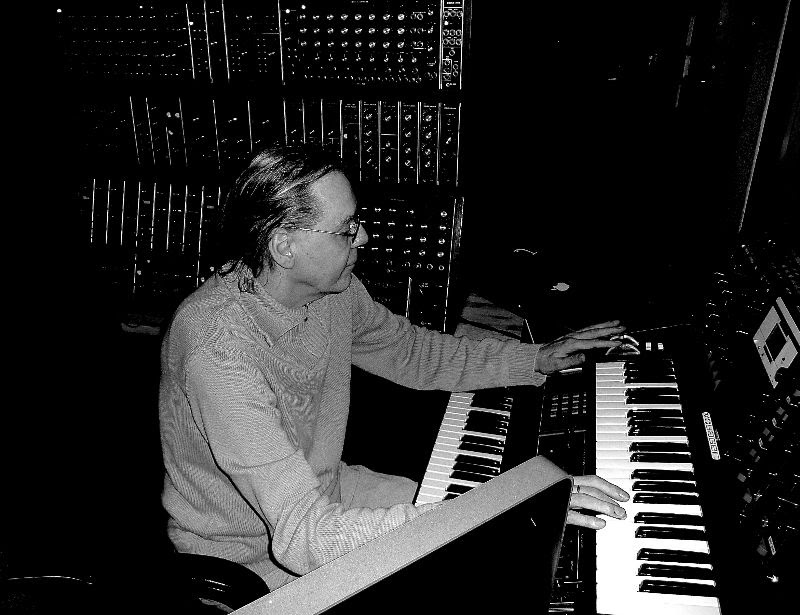
The late German electronic music legend Klaus Schulze sadly passed away on 26th April 2022 at the age of 74 after a long illness.
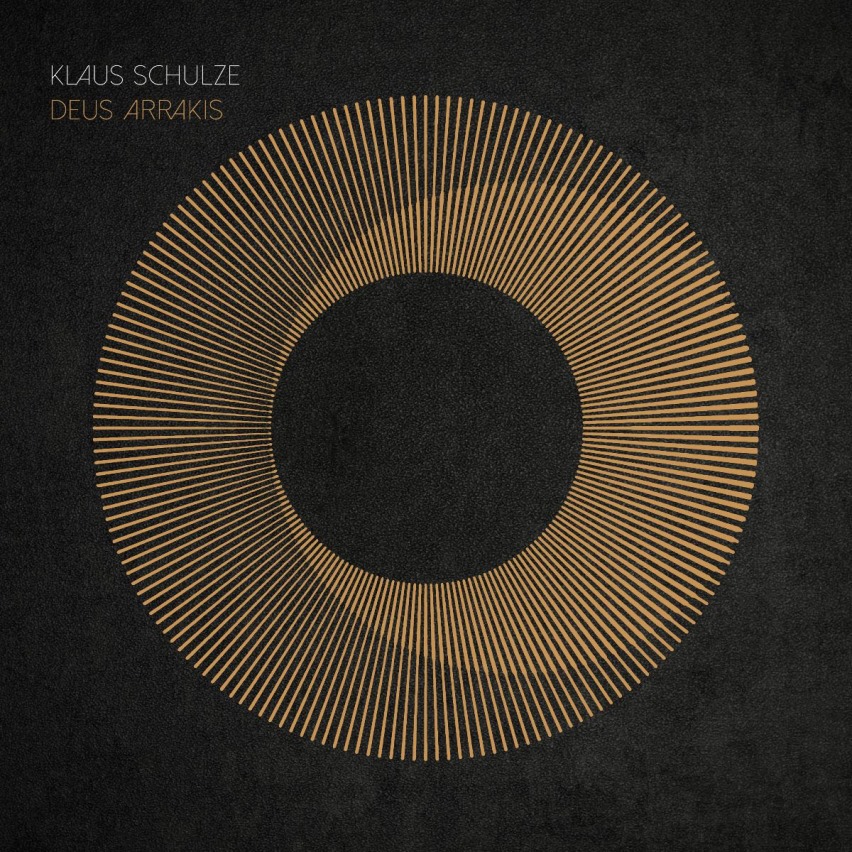
Literally never one to sit still, he left behind a vast portfolio of work. Among his most lauded albums were ‘Timewind’, ‘Moondawn’, ‘Mirage’, ‘X’ and ‘Dune’. The Berlin School veteran was set to release his new album ‘Deus Arrakis’ in Summer 2022 with another musical salute to ‘Dune’ author Frank Herbert.
Featuring three tracks with a combined playing time of more than 77 minutes, ‘Deus Arrakis’ was inspired by his Hans Zimmer collaboration ‘Grains of Sand’ aka ‘Herbert’ for the end credits of the 2021 ‘Dune’ film adaptation.
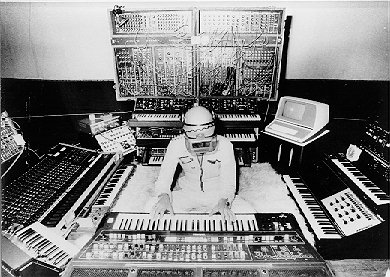
Photo c 1978, Klaus D Mueller, Berlin
Poignantly, Klaus Schulze had said in an interview with Albrecht Plitz for the booklets of his 2004 back catalogue reissues when asked about retirement: “…not until they carry me out of this studio in a box!” – the closing piece on ‘Deus Arrakis’ is called ‘Der Hauch des Lebens’ or as translated into English, “The Breath of Life”.
A one-time member of TANGERINE DEAM and ASH RA TEMPEL before embarking on a solo career in 1972, the advent of synthesizers and sequencers freed him from the constraints of a conventional band.
Taking him on a creative journey into the unknown, Schulze saw synthesizers as an opportunity to develop original tone colours with his improvised compositions often lasting for almost half an hour at a time and rarely less than a quarter. Adopting a playful physical approach that encompassed a minimalist groove whether using analogue modulars, digital samplers or the latest computers, one of his favourite phrases was “It’s not about me, it’s about the music” and this was the case until the very end.
In one of his last ever interviews, ELECTRICITYCLUB.CO.UK was granted a rare audience with Klaus Schulze to talk about his career and the ‘Deus Arrakis’ album. The conversation transcript from 22nd April 2022 has been published in full with the blessing of his management and publicist as a tribute to the great man and his cosmic legacy.
How did ‘Grains of Sand’ with Hans Zimmer come about, was it like a rejuvenation for you?
Photo from kdm archives
Our mutual friend Lisa Gerrard brought Hans and me together – she was working with him at that time from which I had no idea. One day Hans called me and we talked a little bit about Frank Herbert’s ‘Dune’ – we both are huge fans of the books – and the film remake by Denis Villeneuve. Hans was inspired by my music, he liked my albums ‘Dune’ and ‘X’, especially the track ‘Frank Herbert’.
Based on that, he asked me for a co-operation and out came that new Hans Zimmer / Klaus Schulze track ‘Grains Of Sand’ – or ‘Herbert’ as it was titled earlier in the end credits of the film. It was a pleasure to work with Hans – he is not only a great artist and one of the best addresses for film music in the world but also just a very nice guy! And yes, the whole ‘Dune’ thing inspired me – once again 40 years after my first ‘Dune’ album – to plunge into Frank Herbert’s universe and the beautiful pureness of Arrakis’ deserts. I just started playing…
So what concepts did you have in your mind for ‘Deus Arrakis’ to inspire you in composition?
To be correct, when I started playing I did not think of anything to achieve or of a certain direction. I don’t play concept albums – I am way too instinctive and improvising for that! The inspiration for ‘Deus Arrakis’ was a general one; it is always the same, when I start playing I got lost in the soundscapes and chords I love so much.
Before that there had been a longer phase where I was too sick and couldn’t work for months. I certainly took my time with it and it was towards the end of the recording stages that I realized the results were pretty ‘Dune’-ish. That was when I searched my archives and picked the recordings I had left of Wolfgang Tiepold’s cello, which clearly was the perfect match. So even though Hans and Lisa and Denis (Villeneuve) may have kickstarted it, in the end it became clear this was in fact another tribute to Frank Herbert the brilliant creator of the ‘Dune’ universe…
‘Osiris’ from ‘Deus Arrakis’ has a beautiful minimal ambience that evokes the best of your past work, did you return to any of your old equipment for the album?
Oh, the old Moogs and ARPs, my Mellotron and even the Korg PS – they are all long gone. What I actually used from the old days was my trusty EMS Synth A – a great instrument to create pure electronic landscapes with. It does not play concrete notes as it does not even have a keyboard – it is not necessary. But everything else I used is the more modern instruments. And also a lot of my favourite virtual synths from the studio computer.
Would you say it is best to combine vintage analogue instrumentation with computer controllability to plant the seed of that sound without the practical challenges?
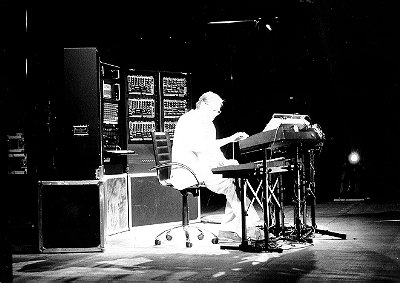
Photo c 1998, Klaus D Mueller, Berlin
For me, absolutely yes! I have spent many years fighting the various technical aspects from so many different machines that I absolutely enjoy turning on everything – and Boom, it’s all there. I certainly would not want to go back to having to tune everything… or patch my way through every single part of an analogue synth.
I can understand if you are a collector and love the old machines, that’s great, but if I want to work, I want to work… and I am not very patient anymore regarding having to wait for a piece of equipment until it’s ready to be played.
Your followers will be pleased that you are still producing half hour pieces of music, was there any temptation to edit more drastically? Or does “movement, depth and randomness” still apply?
The tracks flow as they flow. Just as it should be… that hasn’t changed. Don’t be fooled by the new “single” as the record company calls it. That is not a single. I never do singles… by the time a single is over I haven’t even gone half way through my first intro phase alone… it is just the beginning of a much longer track. Oh yes, there were quite a few discussions with my record company as they wanted a single to promote the album. The shortest track I did still is about 20 minutes or so. So no single.
It is clear that longer tracks have to be cut anyway in order to fit on one vinyl record side – and that already hurts every time. I do not like that at all, that really is why I still love my CDs. The editing down into split parts is up to my engineer… I couldn’t do that. With today’s streaming requirements they have gone to even splitting up all the tracks for streaming because a lot of money is lost if they don’t do that. That is so very annoying… and clearly it does not serve the music at all… which it should in the first place.
What is your current equipment set-up?
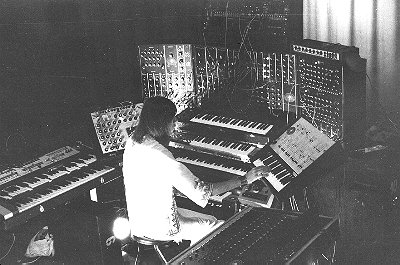
Hardware: Mini and Memorymoogs, 3 x SE 1, EMS Synthi A, PPG Wave. EMU samplers (for all the older libraries), Roland keyboards and expanders (almost all ages), Alesis analogue synths, Access synths, Quasimidi synths. Kawai and Korg expanders. One or two of the more recent synths to try out.
The software synth collection centres around Arturia, Spectrasonics, Steinberg, U-HE and also a lot of smaller and more obscure synth models. All of that goes into my half digital, half analogue Tascam console which uses RME AD/DA hardware to connect to my Mac. Logic Pro still is my favourite DAW – I have lots of MIDI to administer!
Photo c 1976, Klaus D. Mueller, Berlin
Which would you say are your most favourite synthesizers of all time?
Oh… not as easy as it may sound… I guess the good old modular Moog is one of them, as well as the Mini. And the CS80! I still love my EMS Synth and ah, the original Mellotron… well was that a synthesizer after all? Roland’s JD 800 also still is a favourite.
How did you get on with using the first digital era of equipment like the Crumar GDS, PPG Wave 2.2 and Fairlight computer instruments or the Yamaha DX7?
That DX7… never was for me… but the beginning of the digital synth age was very exciting. I remember dragging the GDS and Wave with us on tour was a bit nasty, but I wanted them on stage back then. Always a pleasure when you could load your favourite programmed sound again safely from a floppy disk… and those synths finally never went out of tune again when they got warm! That was a very welcome first!
Fairlight and Wave were first tested in the studio and we got along very well. There were quite a few hiccups in the beginning, especially with the Wave which had its platines upright on end, so we had to take them out and refit them after every transport… but the digital revolution was the start of a new era soundwise and I was keen to try the latest new instruments and the sounds they could create. It sounded totally fresh and new.
Harald Grosskopf has said working with you on ‘Moondawn’ was the highlight of his career, how do you look back on that album?
It was one of those ‘one-night-wonders’ and we really had a good flow together and of course a lot of fun with the Big Moog!
What would be your favourite works from your career and why?
Every album I do is my best – everyone has its time and its own history and circumstances, though there are some albums that are more in my mind than others are! Really, when you work on something it is the latest and best you’ve ever done and so it always is my favourite record. It’s as simple as that. However once a record is finally completed and I hold a CD or vinyl copy in my hands it looks great … but my interest vanishes pretty quickly. It’s always been like that.
In memory of KLAUS SCHULZE 1947 – 2022
With thanks to Matt Benton at Hold Tight and Klaus D Mueller
The 450 page hardback book ’Violins Don’t Grow On Trees – The Life & Work of Klaus Schulze’ by Olaf Lux is available in English and German language editions from https://olaflux.bandcamp.com/
We use cookies to ensure that we give you the best experience on our website. If you continue to use this site we will assume that you are happy with it.









Follow Us!