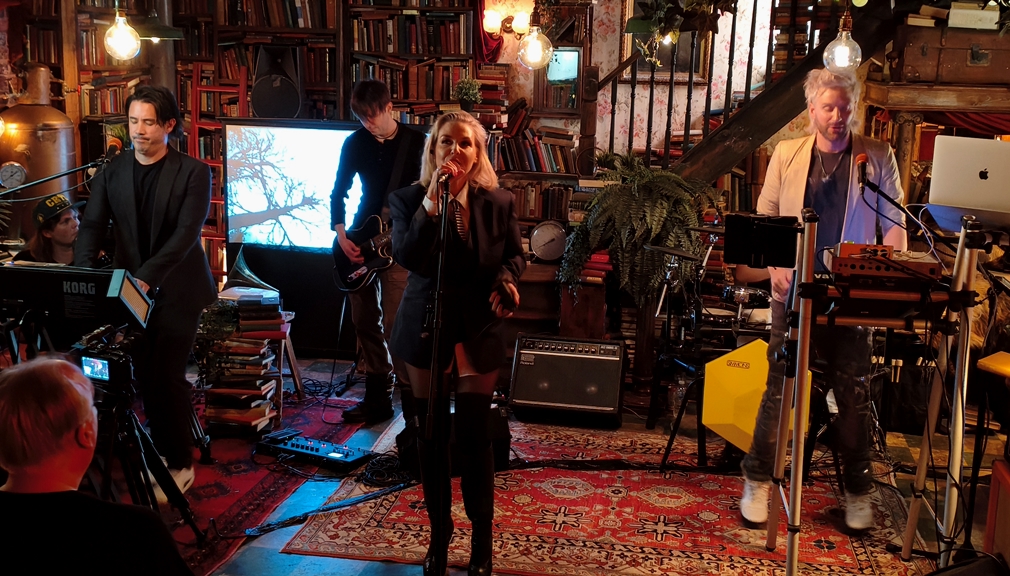
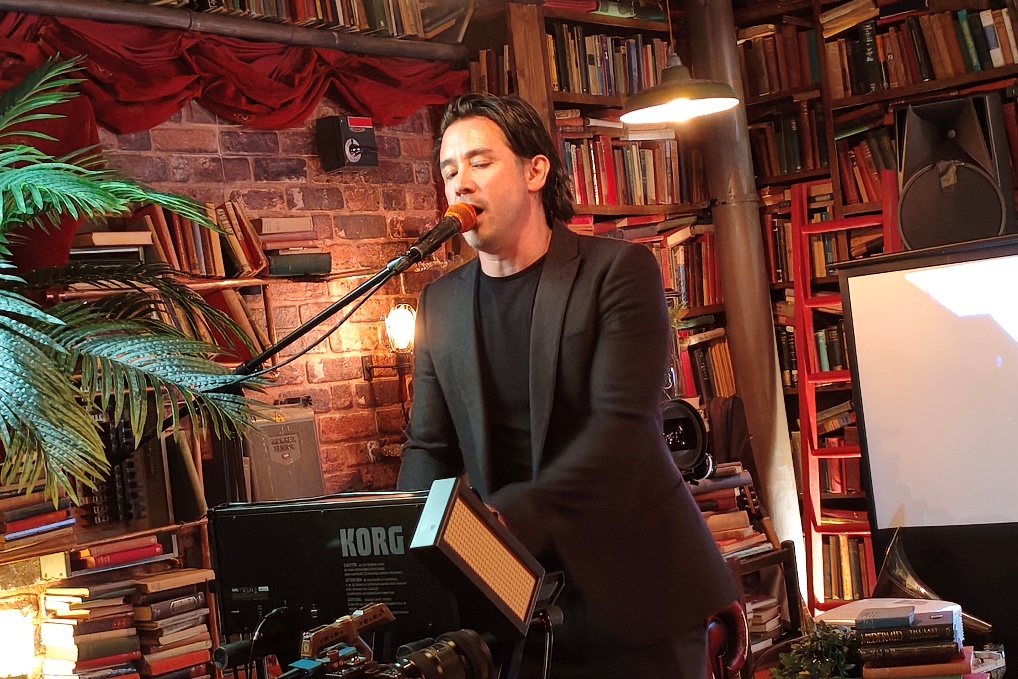
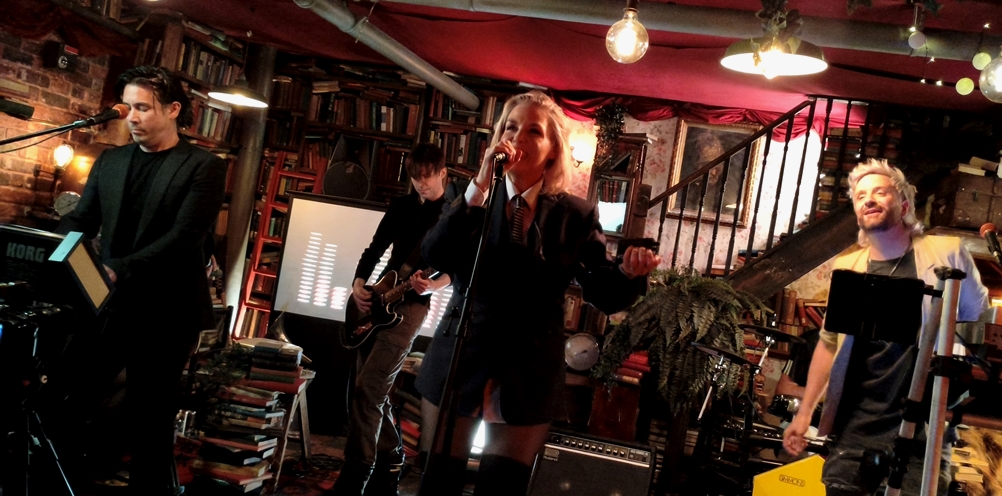
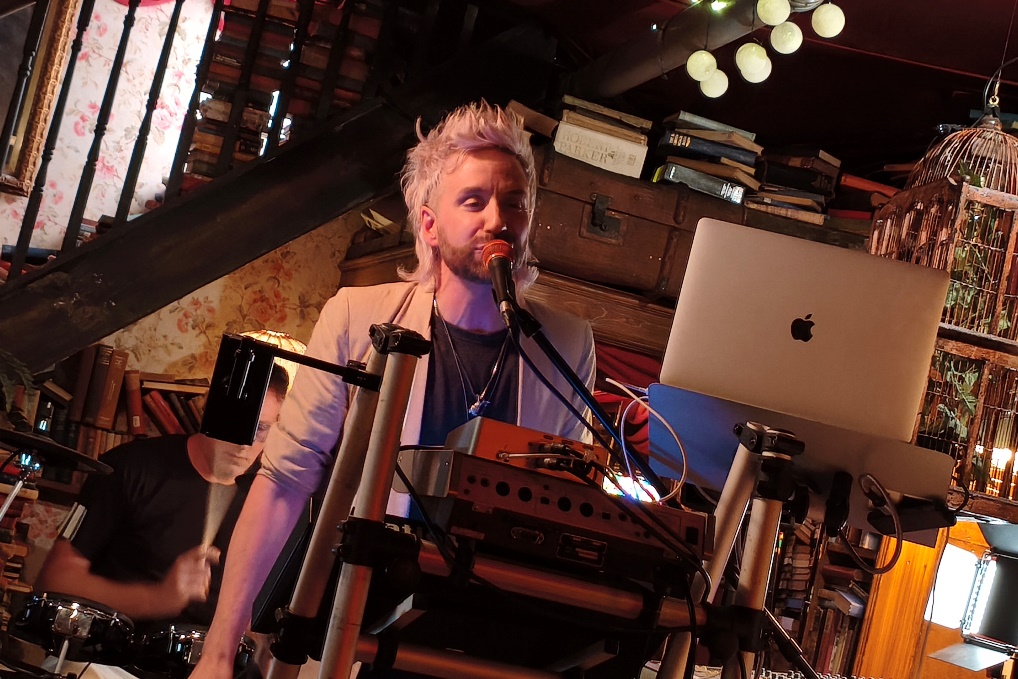
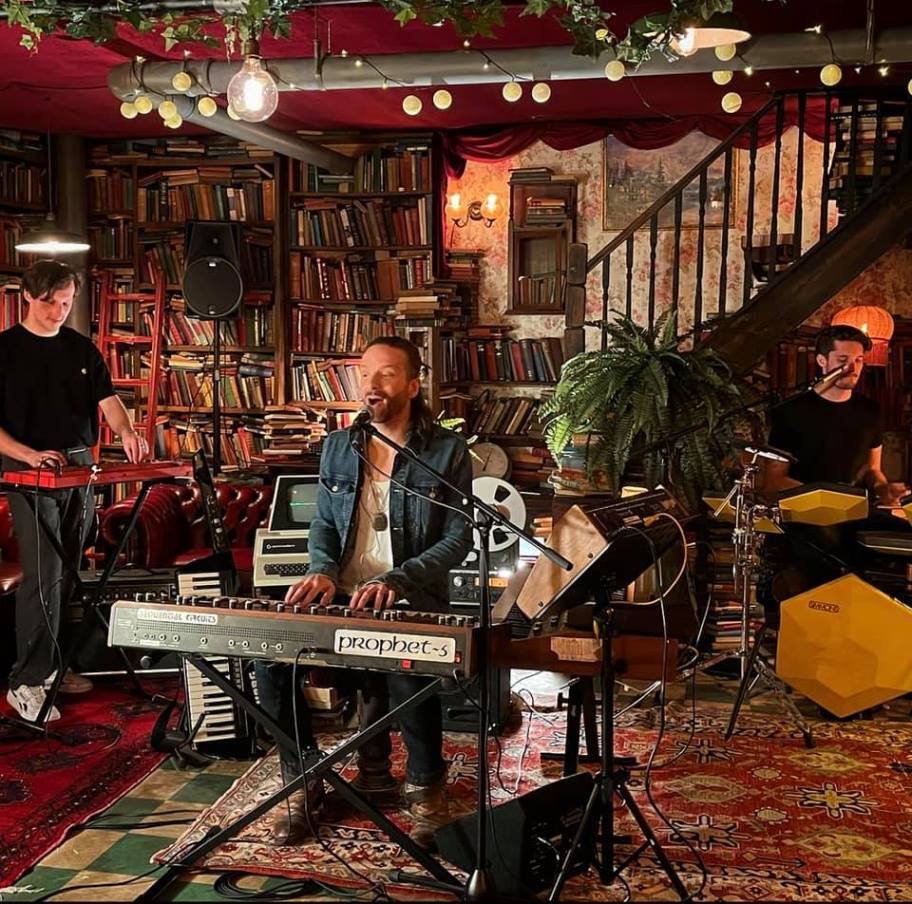
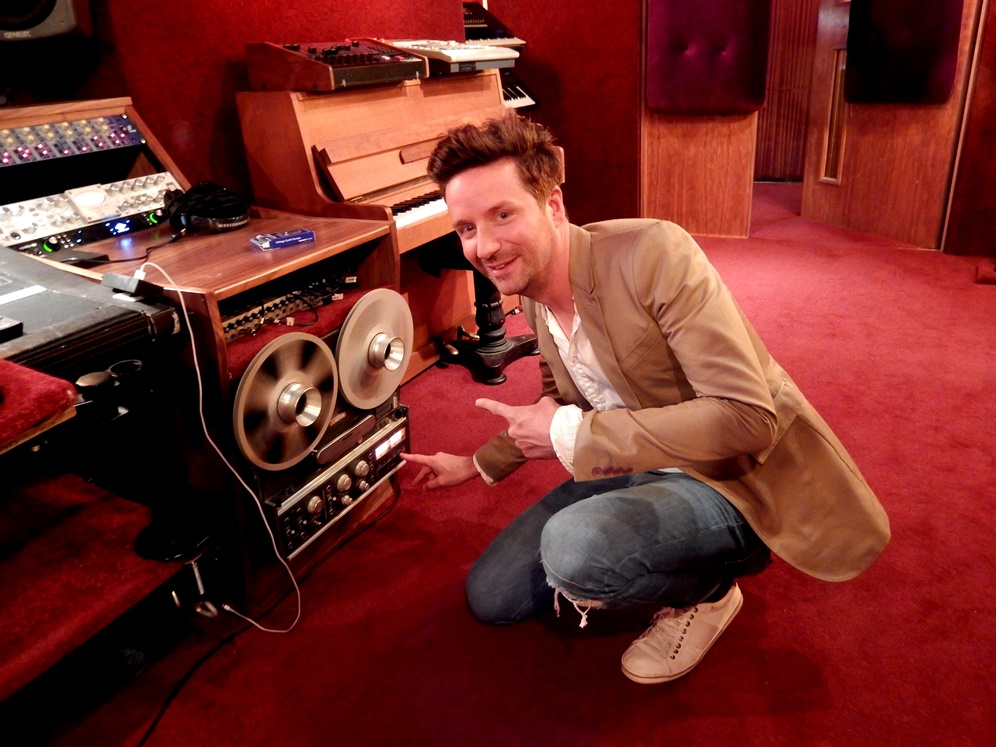
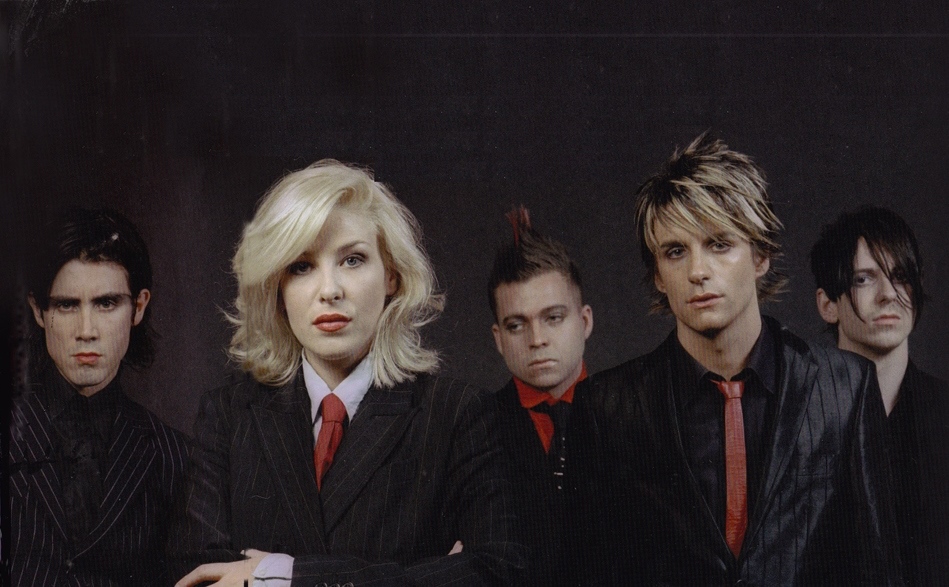
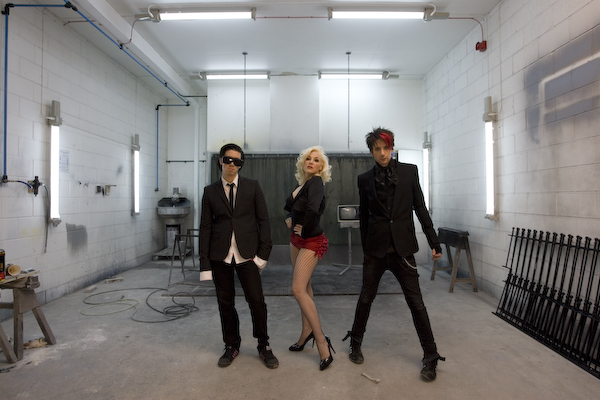
The original line-up of THE MODERN unexpectedly reunited and played a special intimate show to friends and fans at Fiction Studios, a space which is not only used for audio recording but has been the backdrop for numerous TV shows, documentaries and social media reels.
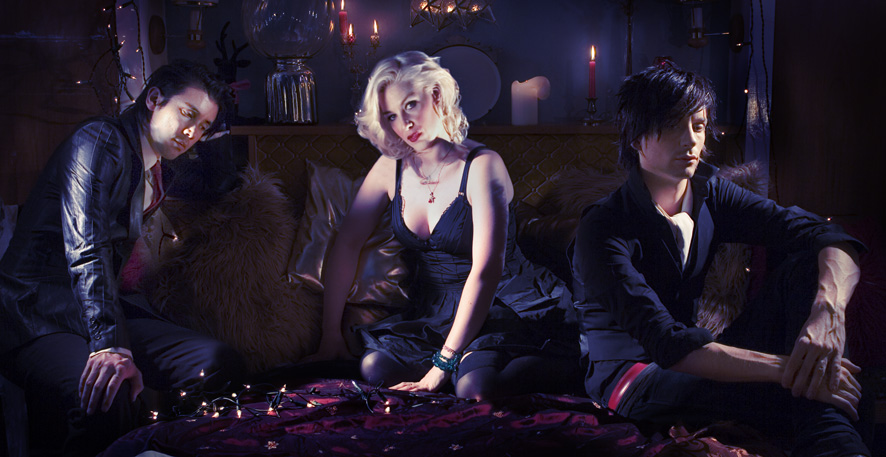
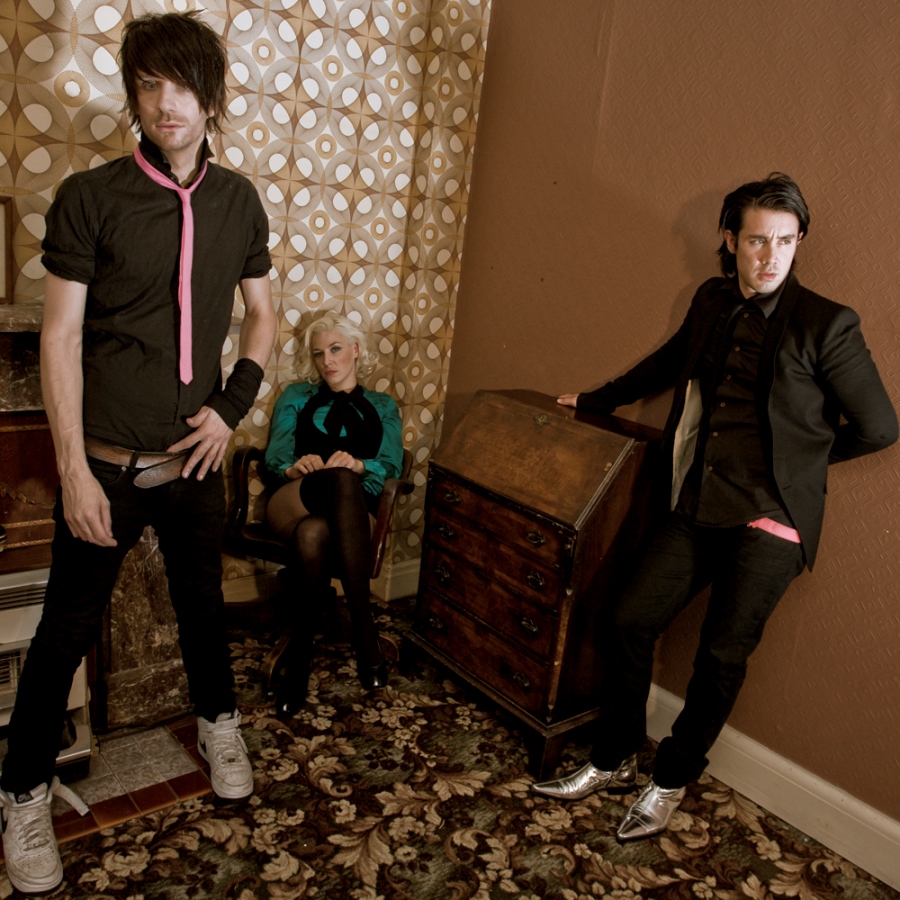
The nucleus of front woman Emma Cooke, with Nathan Cooper and Chi Tudor-Hart on vocals and synths were all present and correct, augmented by guitarist Robert Sanderson who was tempted out of “retirement” to play live again and original drummer Rees Bridges who had left early on to play with DIRTY VEGAS.
Following an independently-issued debut single ‘Suburban Culture’ in 2004, THE MODERN were signed by Mercury Records. With a colourful stage presence and an immediately catchy electronic sound, the next single ‘Jane Falls Down’ made a good impression and reached No35 in the UK singles chart. The band began recording an album under the working title ‘Life In A Modern World’ co-produced by Stephen Hague, best known for his work with OMD, PET SHOP BOYS, THE COMMUNARDS, ERASURE, NEW ORDER and DUBSTAR.
However, after their 2006 single ‘Industry’ was disqualified from the UK singles charts, THE MODERN were dropped by their label and found themselves without a home. Changing their name to MATINEE CLUB, this album finally saw the light of day in late 2007, now retitled ‘Modern Industry’ and issued as a download only by Planet Clique.
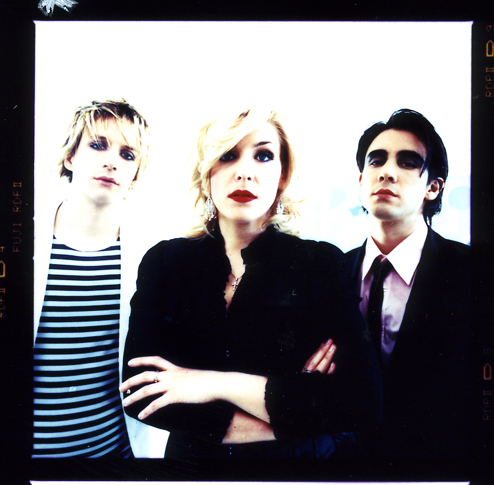
The founding trio of Emma Cooke, Nathan Cooper and Chi Tudor-Hart returned to being called THE MODERN in late 2008 but in mid-2010, Cooper left the group to became KID KASIO while Cooke and Tudor-Hart continued as THE MODERN, eventually releasing a brand new album ‘Revenge’ in 2018. In between ‘Modern Industry’ was reissued under the title ‘Life In A Modern World’ as an album by THE MODERN in 2013 with an expanded tracklisting; this live reunion coincided with the release of a revised 10 track vinyl LP edition of ‘Life In A Modern World’, its first availability in that format.
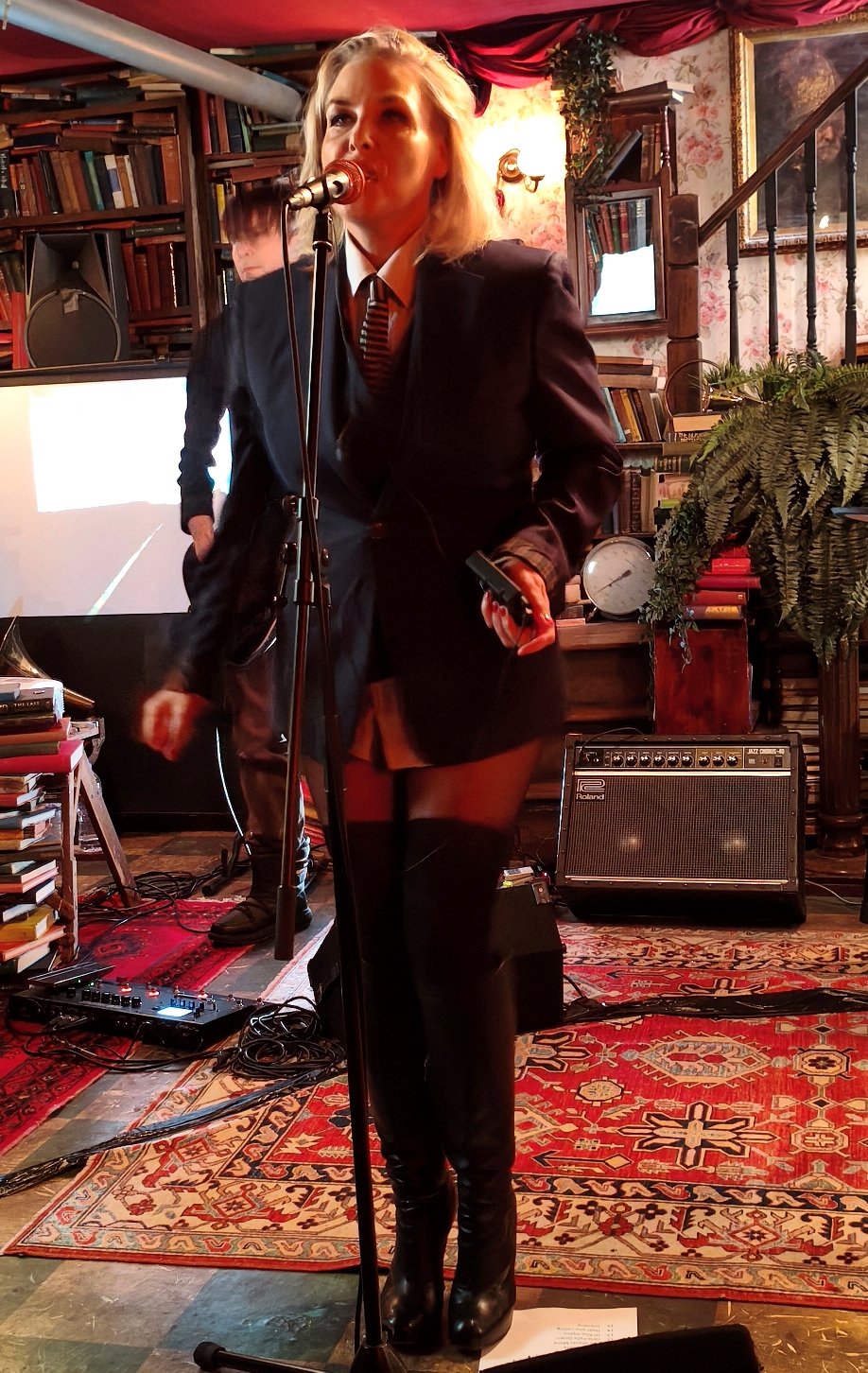
With its characteristic shelves of vintage books and walls of vintage synths, Fiction Studios acted as the perfect homely location for the first performance of this line-up of THE MODERN in 20 years. Certainly among the audience, there was the pleasing air of a school reunion as friends and acquaintances from clubs and gigs of days gone by caught up with each other’s news.
Starting off a bit hesitantly with the sound mix far too low, it was understandable that the quintet might take a few songs to get into their stride, the Emma / Chi / Nathan vocal trioet working its magic and highlighting why THE MODERN were one of the 21st Century synthpop hopes of the period. But it was like riding a horse and before long, it was time to party like it was 2005 as dancing in the audience began, although those in the first two rows had been asked to remained seated as the performance was being filmed!
Still the sexy temptress, Emma Cooke then announced an interlude “because we’re old”! But the break allowed the removal of chairs to guarantee a more active experience as THE MODERN performed the last song they had written in 2006 before being dropped by Mercury and the owning suits in the Universal Music Group; and what a shame that happened because ‘High Rise’ is a cracker recalling ‘The Promise’ by WHEN IN ROME with its repeating synthbass riff and uplifting chorus.
There were more solemn moments of remembrance with Cooper dedicating ‘Goodbye Means Forever’ to his late mother but songs like ‘Seven Oceans’, ‘Closing Door’, ‘Sometimes’, ‘Jane Falls Down’ and ‘Discotheque Français’ kept those already standing to remain on their feet. The enjoyably uplifting evening ended with the hit that got away ‘Industry’; the records state that this was never in the charts!
But rather like the statistic saying Martin Brundle never took part in the 1984 F1 season despite breaking both his legs in practice for the Dallas Grand Prix and today walking with a limp, THE MODERN might still possess the scars from the chair from being pulled from under them back in 2006, but they are back and happy to be playing to a welcoming audience.
What this discreet showcase also showed is that the songs of THE MODERN still stand up and after 20 years, a fair few are far better than the offerings by many modern British synth acts of the past few years. THE MODERN will return to the stage in September… be there and don’t be a ‘Fool In The Name Of Love’.
THE MODERN play The Victoria, 451 Queensbridge Road, Dalston, London E8 3AS on Friday 11th September 2026 – tickets available from https://the-modern.co.uk/live
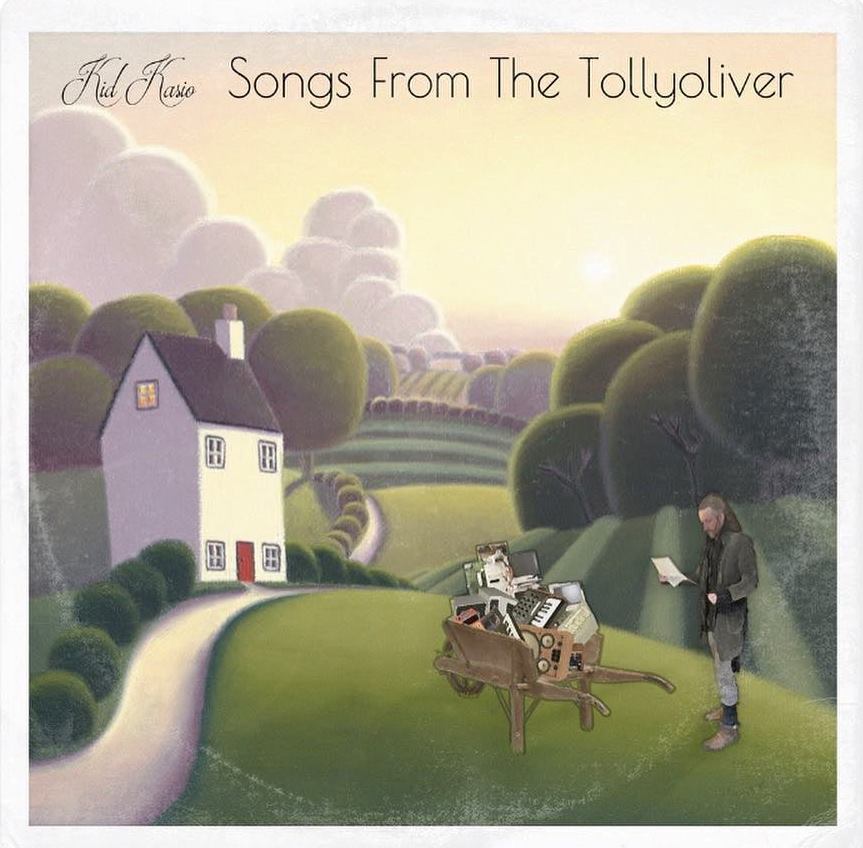
‘Songs From The Tollyoliver’ is the recently issued third album from KID KASIO.
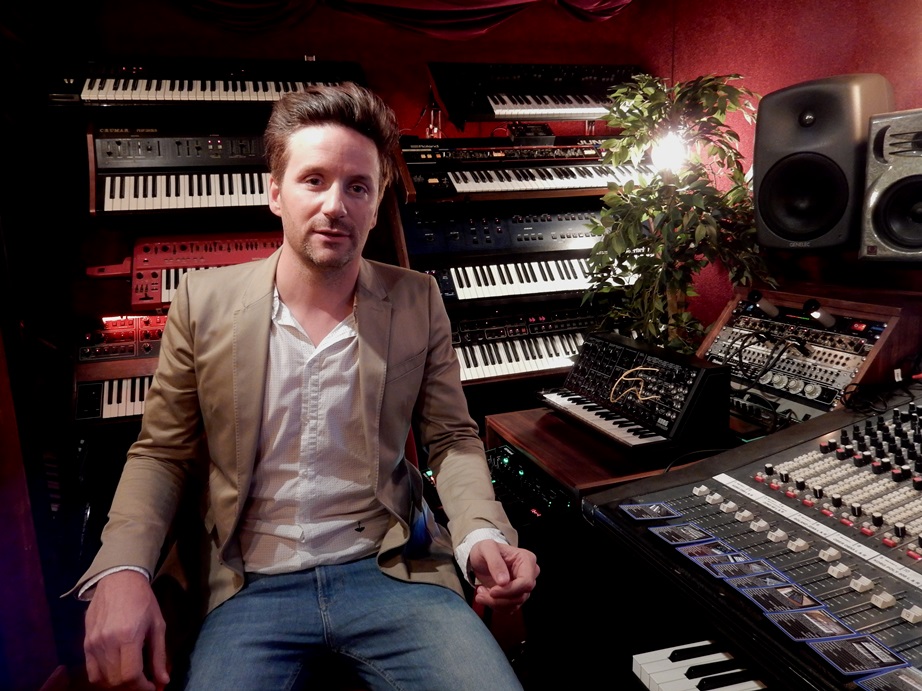
It comes after a period of uncertainty for mainman Nathan Cooper, once of THE MODERN. This experience has resulted in some of his most introspective work yet as KID KASIO but it hasn’t all been doom and gloom. He married his long time sweetheart and despite the possibility of the impressive Fiction Studios complex he co-founded with his brother Dominic closing at one point, he has remained resilient and maintains his enthusiastic pop heart.
Nathan Cooper spoke to ELECTRICITYCLUB.CO.UK about the long gestation period for ‘Songs From The Tollyoliver’ as well as what the future holds for KID KASIO and Fiction Studios…
From its title to its artwork, ‘Songs From The Tollyoliver’ indicates your third album is a mature work, so is this like your Howard Jones ‘One To One’?
I’m not sure it’s purposefully more mature, I certainly didn’t set out to do that. Like my other albums, the gestation period has been ridiculously drawn out. Most of the writing was done between 2016 and 2018, and I originally intended to release it in 2019 but then a load of stuff happened and so then I decided I’d release it in 2020, and we all know what happened then!
I had around 20 songs to choose between, and it seems the more introspective tracks stood the test of time better, while some of the poppier stuff fell by the wayside. There are a couple of more lightweight pop numbers on there still, but the moodier stuff has outnumbered the rest. I think we’ve all been living in fairly dark times over the past year or so, and maybe people gravitate towards that stuff, and can relate to darker music more at the moment. Around 5 of the songs were originally written for a film which was quite dark in its content, so I think that may have skewed the album in that direction too.
You’ve got the luxury of running your fully equipped Fiction Studios in London and being able to record during its downtown, but what’s the reality versus fantasy?
It’s nice you call it a luxury! The reality is, that while I now have my dream job, it’s definitely taken its toll on the time I have to do my own stuff. In fact I’d go so far as to say, had a worldwide pandemic not happened, I may never have found the time to finish this album at all! The great thing about running Fiction Studios is it gives me the opportunity to work with some fantastic new up-and-coming artists, as well as getting the chance to meet some of my idols! Dave Ball from SOFT CELL was in last year, as was Gary Kemp of SPANDAU BALLET.
Working alongside such a variety of artists and producing such a wide range of genres has really opened my horizons, and I think that comes through a bit more on this album. My heart will always be with synthpop though of course! It’s a continuous mystery to me that I don’t get more synthpop and electronic artists to use the space, what with our incredible collection of analogue synths.
Of course, you’ve had the trauma and anxiety of having to uproot Fiction Studios to a new location and then the Covid crisis hitting?
We were told in October 2019 that the landlords wanted to kick us out of our original studio to make room for a gym (I’m sure that’s gone really well for them!) and I honestly thought about giving up. The task just seemed so daunting. The removal and re-building of the entire live area of the space, including a staircase and 6000 books, not to mention the costs involved with soundproofing a new venue and the hassle of rewiring and fitting out a state of the art recording studio. It just seemed like an insurmountable proposition. Thank god we eventually found an amazing new location in what I have to say is one of the most incredible streets in London. We moved in on 1st March 2020 and then about 3 days later a certain virus took hold!!
The one upside was that during the first lockdown, I had time to get the space soundproofed and built exactly how I wanted it, but nothing could have prepared me for the shock that came when we finally opened the doors in June… and no one came!! It was very tough indeed.
Luckily as the year went on things picked up and the kind of work began to change. We’ve had a massive upsurge in bands that haven’t been able to gig for a whole year, coming in and doing filmed live sessions so that’s been really fun. I even managed to get round to doing my own KID KASIO session the other week which was a great chance to showcase some of the new material.
The opening song ‘East Of Eden’ seems to capture a more introspective mood and it seems something was bothering you?
On first listen, the song appears to be written from the perspective of someone in a relationship that’s not working. The protagonist is being hounded by an ex who is showing up at his gigs and causing problems. I think however that it can also be taken less literally. The line “Your name’s not down for a reason, your name’s not down on the door” could be applied to mean a situation where someone is having to push someone away. A friend was in a destructive relationship at the time and the lyrics reflect that kind of situation where someone needs to cut ties with someone because the relationship has become toxic.
I’m happy to report it wasn’t specifically about me! Certainly not at the time I wrote it anyway! I don’t know where the line “you sold my heart East Of Eden” came from, but as soon as it popped into my head, it seemed apparent it was the most important line in the song. In many ways it dictated a direction for much of the rest of the album. I was listening to the ‘Songs from the Big Chair’ album by TEARS FOR FEARS a bit and wanted to recreate that grand expansive sound.
There is more uptempo pop in ‘The Everlasting Flame’ but the approach here is different from your earlier uptempo material, yes there’s the exotic electronically derived colours but there is live bass, sax, piano and more prominent guitar?
I have actually used live bass before. I’ve always loved the mix of live bass and synth bass. Nothing works better than some DX7 bass doubled up with the low end of the Roland SH101 and then some live bass slaps and tops thrown in for excitement. Piano definitely isn’t my normal go to sound for keyboards but I’d been listening to the Nile Rogers produced ‘Why’ by Carly Simon when I was writing that, and there’s some incredible use of piano in that song.
The sax line was originally performed on the DX7 Sitar patch (The same as used on Moroder and Limahl’s ‘Never Ending Story’) but weirdly when I began to mix it, it kind of sounded a bit like a sax line! So I stuck a sax over the top of it, playing the same part and it seemed to work better.
There’s a great guitar solo in the song performed by my friend Benjamin Todd. The inspiration for that actually came from the guitar solo in ‘Together In Electric Dreams’! Which I think may even be a synth guitar?? I’m not entirely sure. But I do love a good guitar solo!
Talking of sax, you have always loved an interpolation and on ‘Vagabonds Theme’, you’ve borrowed a section from DIRE STRAITS ‘Your Latest Trick’ off the ‘Brothers In Arms’ album and sing of “the sound of the saxophone”…
I’ve always loved ‘Your Latest Trick’. It’s just such a great sax riff. There was an emergence of a new genre during 2017-18 called Tropical House, which used lots of great plucky synth sounds and was essentially music made for lying on a beach and sipping a cocktail! I wanted to do something in that style and I just thought that sax line would work so well.
Someone has since said to me the song sounds like the musical equivalent of an Edward Hopper painting, which I really like! It started as something that was supposed to be a summery Balearic type thing and ended up being the story of an alcoholic down and out!
My favourite line is “The band in the corner is counting in as a figure steps up to the stage”, which has strains of another Knopfler classic ‘The Sultans Of Swing’. Except in my song there’s definitely some dry ice on the stage that the saxophonist appears through, which I’m sure didn’t happen on that rainy night in 1978 when Knopfler walked into the White Swan in Deptford and heard “a band playing Dixie double four time“.
The weird thing about this song was that a few months after I wrote it, I was tidying up in the studio, and a book fell off the shelf and landed in front of me, and it was called ‘The Vagabonds Story’!! I swore I had never ever seen this book before! I must’ve somehow taken the title in on a subconscious level… Who knows!
With all those synths at Fiction Studios, were you not tempted to go even more electronic like OMD did on ‘The Punishment Of Luxury’. Which ones did you end up using in the end?
It is always my intention to write a completely electronic album but I get bored easily! I feel like I covered that ground during my time in THE MODERN. I’m actually much more interested now in replicating the period in music in the mid-to-late 80s and early 90s where music was being made entirely on synthesisers but didn’t specifically sound like it was. You had synthesizers like the DX7 and the Roland D-50 making what at the time people thought were great representations of real instruments but in retrospect sound nothing like the instruments they were trying to recreate. They’re certainly of the time and sound great now.
I have a Prophet 5 (rev. 2 for the purist geeks!), a Juno 60, Roland SH101, Crumar Performer, Prophet T8, Oberheim OBXa, Korg DS8 and Yamaha DX7 all are used extensively all over the album, and a Roland Boutique D-05 for those D50 sounds. I think the SH101 is there doing the bass in practically every song. Same for strings and the Crumar Performer. The SH101 is on loan from the very kind Chris Smith from MANHATTAN CLIQUE and the T8 and Oberheim from the lovely Ian Merrylees.
There’s a simple but effective synth solo on ‘Tell Me Why’?
It’s a sound on the Korg DS8 which is not a synth I use an awful lot. I recognised the sound from a James Ingram/Michael McDonald track, ‘Yah Mo Be There’ perhaps? The song was co-written with an artist called JUNO CRISIS who I co-wrote 3 songs on the album with. Like many collabs these days we’ve never actually met! He lives in France and contacted me with some MIDI files. I really understood his reference points and when I listened to his arrangements, I really got a spark of inspiration for songs.
Anyone who knows your previous work might be surprised by the ballad ‘Moved On’, it’s almost Moby-like and there are even some esoteric shades of Brian Eno?
Like a couple of songs on the album, this song started life as a pitch for a film that my brother was in called ‘Miss You Already’. The pitch was that we came up with something that sounded a bit like Moby. It’s kind of about growing up and moving on and losing touch with people.
It was absolutely not going to be on the album until the very last minute, I’d compiled about 20 songs and was asking a few friends what ones they thought should go on the album and my good friend William Robertson who plays keys for me suggested that one. I was gobsmacked at first, because no one had ever paid that song any attention. But weirdly, it seems this is the song that everyone hearing the album is mentioning. I feel like burying it at the end of side one was maybe not the best idea!
It definitely uses a few musical ideas I wouldn’t normally entertain. A very 90s almost breakbeat drum pattern that reminds me of both Moby and Bruce Springsteen’s ‘Streets of Philadelphia’. It also utilises a much heavier sampled type orchestral string pad sound than the thinner disco type string pads I normally use. The song’s greatest asset is the fluid fretless bass line by Glenn Bridges. That makes the song for me, and the baritone guitar part by Benjamin Todd.
‘Always’ is one of the more dancey numbers, a bit like SAINT ETIENNE ‘He’s On The Phone’?
I’m a huge fan of ‘He’s On The Phone’. It’s just a perfect record. I was massively into Euro dance in the mid-90s and living in the UK and particularly London, I felt really outcast from that scene. I felt like SAINT ETIENNE somehow created a really British take on that sound with that particular record. This song again definitely has a 90s feel. I wrote it for my wife and performed it for her for the first time on our wedding day so it means a lot to me that one.
‘Holla Holla’ is an interesting hybrid of styles but is still very you?
I’m glad you said that because I was nervous about putting this on the album. I was worried people would just say “what the f*ck is this?!” I mean it even has a rap on it! But I’m glad it still sounds like me. The lyrics are absolute gibberish. I was trying to capture the essence of a record called ‘Turn Me On’ by Kevin Lyttle which is an interesting record because it sits firmly in the genre of dancehall, but is covered in these completely insane little synth riffs played on what sound like really cheap home Casio keyboards. Yet it was a huge European hit.
I used a fairly crappy synth I’ve got called the Korg Poly 800 for these really cheap synth sounds. It was written when a friend Liam Hansell sent me a carnival drum pattern. It’s a drum part which I would never ever have programmed myself which is great because that will always send me off in a direction I never normally go in. And that is where the best songs usually come from.
What is the solemn closing number ‘Gunshot’ referring to?
A few years ago I suffered a night terrors panic attack type thing. It felt like I had someone pressing down on my chest. It was pretty horrific. I think some of the lyrics deal with that incident. I tried to go much more down a Le Bon type route with the lyrics of that one, where they are much more obscure and symbolic. I can sometimes tune in to that side of my psyche quite easily and other times when I try and do it, I end up with some embarrassing 6th form poetry garbage. I don’t know what the line about being in someone’s room is about. It’s actually quite sinister.
Which are your own favourite numbers on ‘Songs From The Tollyoliver’?
It’s virtually impossible for me to choose at this stage, having been so immersed in it for so long. I like the key changes in ‘Everlasting Flame’. ‘Seventeen’ I think is an important song to me, it’s kind of about growing up and being in a band as a teenager. ‘Sanctuary’ is probably the one I’m most proud of lyrically, and as a song it just sits together well and was written really easily.
How have the past 18 months changed your perspective on music and life in general?
I’ve been lucky in that I never stopped throughout the whole thing. I was driving into town throughout the first lockdown every day, building the studio and I’ve kept busy ever since. I think if I’d had to sit at home throughout the whole thing I would’ve gone completely insane!
I hope if it’s taught us anything, it’s that we can find a more workable solution to the daily rat race 9-to-5 thing, as people work from home and stuff. I think it’s also shown us that the UK government doesn’t seem to have much time for the music industry and the arts, who have really been the losers in all of this.
ELECTRICITYCLUB.CO.UK gives its warmest thanks to KID KASIO
ELECTRICITYCLUB.CO.UK first saw THE MODERN opening for HEAVEN 17 at The Scala in December 2005.
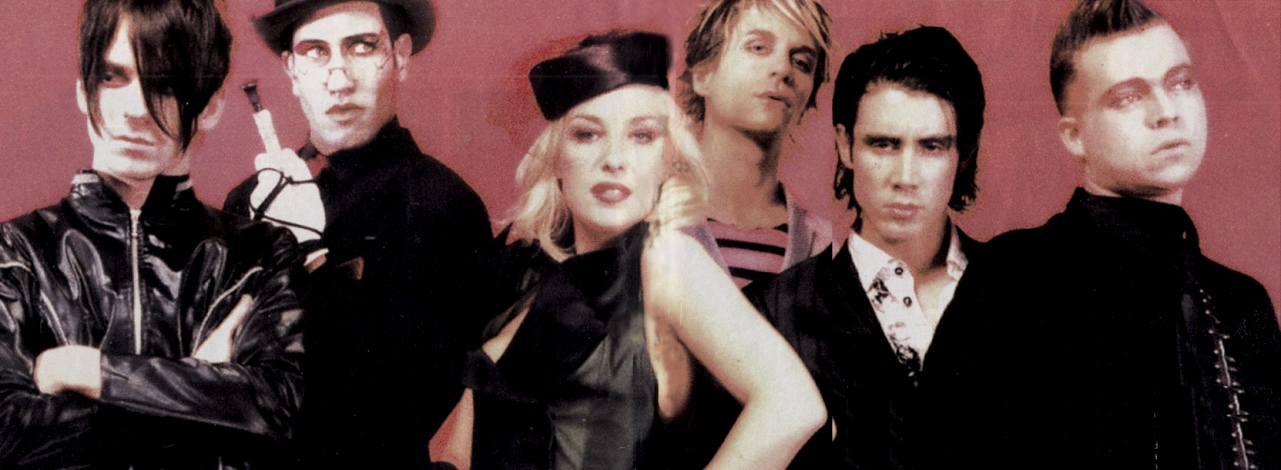
With a colourful stage presence and an immediately catchy sound, they were the one of the new modern synthpop hopes with their debut single ‘Jane Falls Down’ making a good first impression. Comprising of front woman Emma Cooke, with Nathan Cooper and Chi Tudor-Hart on vocals and synths plus Robert Sanderson on guitar and Bob Malkowski on drums, THE MODERN were signed by Mercury Records, home of TEARS FOR FEARS and DEF LEPPARD.
The band began recording an album under the working title ‘Life In A Modern World’ with producer Stephen Hague, best known for his work with OMD, PET SHOP BOYS, THE COMMUNARDS, ERASURE, NEW ORDER and DUBSTAR. However, after their single ‘Industry’ was disqualified from the UK singles charts in early 2006, THE MODERN were dropped by their label and found themselves out on a limb.
Changing their name to MATINEE CLUB, the album finally saw the light of day in late 2007, now retitled ‘Modern Industry’ and issued as a download only by Planet Clique. It also saw a CD release with a revised tracklisting as ‘The Modern LP’ through Ninth Wave Records in the US, while a 2CD special edition by EQ Music Singapore for the South East Asian market in 2009 saw another tracklisting with B-sides and bonus songs added.
Around this time, the founding trio Emma Cooke, Nathan Cooper and Chi Tudor-Hart returned to being called THE MODERN. But in 2010, Cooper bid adieu and became KID KASIO while Cooke and Tudor-Hart continued as THE MODERN, releasing a brand new album ‘Revenge’ in 2018.
In 2013, ‘Modern Industry’ was reissued under the title ‘Life In A Modern World’ as an album by THE MODERN in an expanded tracklisting which largely resembled the South East Asian 2CD edition. In whatever variant, the debut album by THE MODERN often provokes many “what if” debates among electronic pop enthusiasts.
Emma Cooke, Nathan Cooper and Chi Tudor-Hart got together to talk about the joys and the setbacks that came with its making and marketing.
When THE MODERN signed to Mercury, did you more or less get despatched to record an album first, or was it very much in steps?
Nathan: We’d never thought of ourselves as an album band. The whole concept was quite alien to us. Every time we wrote a song it was with the intention of it being a single, so when the label started talking to us in terms of an album, we just always saw it as a collection of singles with no fillers or anything.
Emma: First thing the label wanted was to find a producer. We were happy with Nick Zart but the label wanted someone known. This took longer than we thought as we were also touring.
How did Stephen Hague become involved in producing THE MODERN?
Nathan: Mercury had sent us round the houses with various different producers. We tried a different track with each producer that we had shortlisted with the label.
Chi: Remember Jeremy Wheatley? We tried recording ‘Discotheque Français’ with him. He was a total knob. He got really upset because Bob ate some of his Jelly Babies that were next to the mixing desk that turned out to be his. He didn’t get us at all and he sulked for the rest of the day over his sweets!
Nathan: We’d been dispatched to Sweden to work with Tore Johansen whose work with FRANZ FERDINAND was getting massive airplay at that time. I remember him picking us up from the airport in a battered old Volvo and explaining to us the importance of efficiency, which sounded to me like he just wanted to get us in and out as quickly as he could! The label was obsessing about adding this “indie edge” to the sound, hence FRANZ FERDINAND’s producer, but I was much more interested in chatting to him about his work with ROXETTE which sadly for me he had no interest in discussing! The label had this idea that they wanted us to sound like BLONDIE who of course we all loved, but it became clear quite quickly the live drum sound just wasn’t working for us.
Emma: The sound just didn’t sound big enough for us. Mind you, I quite like listening to his version of ‘Jane Falls Down’ and the vocals on his version were amazing. We then met Stephen Hague and worked with him at Peter Gabriel’s Real World studio. Beautiful place, the studio overlooked a lake with swans swimming around. The start of the session was a disaster as we couldn’t get the drums sounding right. But by the end of the weekend Stephen had ‘Closing Door’ sounding awesome. That nailed it for us to get him to produce the whole album.
Nathan: Rather than record the whole album in Wiltshire, Stephen booked The Strong Rooms in Shoreditch for us to record the album.
Chi: Nick Zart’s production on our demos was so good we got Nick to work on the whole album with us, so really being our 6th member of the band.
Nathan: Stephen was an obvious choice for us. It had dawned on us and the label by this time we were a full on synthpop band and he was the king of that genre, he had worked with all our favourites PET SHOP BOYS, ERASURE, OMD, NEW ORDER.
Stephen Hague worked on ‘Industry’, ‘Jane Falls Down’, ‘Closing Door’, ‘Questions’ and ‘Sometimes’, rather than the whole album, was this down to budget? So how did you go about shortlisting the songs that he would work on?
Chi: No, Stephen produced the whole album. The only track he didn’t do was ‘Suburban Culture’. Matt Jagger, head of Mercury and our champion, hated that track! We loved it so stuck Nick Zart’s version of it on the album anyway.
Emma: Yeah ‘Suburban Culture’ had to be on the album as before we were signed that track was the first song that got radio play on XFM and was always a favourite to play live as it always set the tone.
What was Stephen Hague like to work with, he’s known to be very meticulous with a big focus on vocals?
Nathan: I think our days mixing the album with him in The Strong Rooms in East London were some of my favourites in the band’s history. It really felt like we had taken control and were working with someone who finally understood what we were trying to do. I have only happy memories of those sessions. I do remember being a bit put out when trying to extract some exciting tit bits of information about his early work with OMD, only for him to confess he didn’t really like synthpop and he had fallen into the genre completely inadvertently, and he actually preferred rock!! He actually said that!
Emma: I agree, I loved recording at The Strong Rooms and really felt Stephen Hague understood us, and as a band and really captured our group dynamic in the recordings
Nathan: I do remember the vocals being particularly difficult for me. Emma sailed through hers but I remember having to do the chorus of ‘Jane Falls Down’ about 100 times. It didn’t fill me with confidence either when after take 82, he said over the talkback that my voice reminded him of a foghorn!
Did you know ‘Smash Hits’ nickname for Tony Hadley was “Foghorn”? ?
Nathan: Ok I don’t feel so awful now!
‘Sometimes’ sounded like it could have been one of Stephen Hague’s productions for ERASURE’s album ‘The Innocents’, while ‘Questions’ has this frantic energy, where did this stem from?
Nathan: The majority of the album was songs that had begun life as demos myself, Chi and Emma had written over the previous four years with Nick Zart producing. I think there were four songs on the album which had come about in a totally different way, these were ‘Questions’, ‘Jane Falls Down’, ‘Closing Door’ and ‘Sometimes’.
These came from instrumentals that Robert Sanderson our guitarist had made. Myself, Chi and Emma would go to his tiny bedroom studio and just take turns trying out different vocal top lines and ideas over these backings. Loads of really good stuff came out of those sessions, it was competitive but in a friendly super productive kind of way.
We’d be there sitting on Robert’s bed in this little room and he’d blast the verse out of the speakers and you’d have about 10 minutes to sit there and work out something in your head!! You’d be right in the middle of writing down a killer lyric or humming a melody in your head when someone would obliterate your concentration with a cry of “I’ve got something” and run up to the microphone to record it! It was a really strange way to do things but it really worked!!
I think that’s where the frantic energy on ‘Questions’ comes from. It’s sitting in that room desperately trying to get your idea crystallized onto a piece of paper before someone shouts “I’ve got it!”; the song has two choruses crammed into one song vying for attention!
‘Jane Falls Down’ was mighty, were hopes running on this being THE MODERN’s breakthrough?
Nathan: We all hoped as the first single that it would do well. I remember sitting listening to the chart rundown on Radio1 on a Sunday evening and hearing it was at number 32. None of us in the band had been that happy with the way the video turned out and I think the fact it had charted at all with so little airplay was testament to the song and the people who’d bought the single off the back of the live shows.
‘Industry’ was reminiscent of A FLOCK OF SEAGULLS, did Mike Score’s lawyers come knocking on the door?
Nathan: We knew nothing about this until half way through promotion for the single. We’d just finished a sound check somewhere and had been ushered into a local radio station to do a promotional interview for the single. We were sat there in the radio studio with headphones on and the presenter plays both songs back to back, and then goes live to air and asks us if we copied them on purpose!!! I just remember being completely dumbfounded.
Truth is that this one must be my fault because very early versions of the song had come from a demo I’d recorded. The song had been through loads of transitions since then but the vocal melody in the verse had remained the same. I’d always been a big fan of A FLOCK OF SEAGULLS and had a VHS with ‘The More You Live, The More You Love’ on it. I think these things happen subconsciously sometimes. We thought about dropping it from the set when we supported A FLOCK OF SEAGULLS a few years later, but we went and had a chat with Mike Score and he was completely lovely about it.
What was the story behind ‘Closing Door’? It seemed to become oddly prophetic when it ended up as the B-side of ‘Industry’?
Nathan: This was another one that started as one of Robert’s instrumental demos; I think it was touted as a single for a short while. I think the lyrics might have been vaguely about some decisions we had had to make as a band regarding management etc. I actually think it’s one of the most positive songs on the album. It always went down well live that one.
The events that led to THE MODERN being dropped by Mercury in 2006 and the band morphing into MATINEE CLUB are well documented, but how complete was the album at this point?
Chi: The album was completely done and dusted. Mercury got a new head of label, Jason Iley, and he did not like us. This guy was all that is wrong with the industry. When asked what bands he liked, he answered with a straight face, “Bands that sell”… total tw*t! His efforts went into promoting his new signing Matt Willis. Matt Jagger, who signed us, was ousted, so we no longer had our champion. The chart fiasco happened and the label ghosted us!
How did Planet Clique become interested in releasing what was now the MATINEE CLUB album?
Emma: So when Matt Jagger left Mercury he started a new label under Universal, Europa.
He signed us and paid for us to shoot a video for ‘Discotheque Français’. The idea Matt had with Planet Clique was for them to promote us on the underground dance scene. Europa’s other band was INFERNAL and just had a big hit with ‘From Paris to Berlin’ so I think they liked the idea of ‘Discotheque’ coming out of the clubs like INFERNAL’s track.
Chi: Yeah, then true to our luck Europa went under and Planet Clique then offered to release the album on their label, download only, just to get it out there.
Were there many challenges in acquiring the masters for the album now titled ‘Modern Industry’ for release by Planet Clique?
Chi: Lucian Grange, head of Universal, was very nice about giving over all our masters. He always liked THE MODERN.
‘Discotheque Français’ was solely produced by Nick Zart and was released as the lead single for the album, what was the song inspired by?
Nathan: The original song was written in 2001 under the band name DIRTY BLONDE. We had a studio in Hackney at the time and there was a whole collective of producers and remixers living in this massive old factory called The Sweatshop. A friend in the studio next door to us heard us recording it and asked if they could do a remix.
Once a month there would be these massive parties at The Sweatshop and the remix of the song got played there. Somehow from there Eddie Temple Morris got hold of it and played it on his show on XFM. We released it as a white label, which I had a listen to the other day. It sounds like BUGGLES meets THE TOURISTS!
I think the lyric idea in the chorus had stemmed from the summers me and Chi used to spend at my mum’s place in southern France. The highlight of the holidays would be going to these tiny discos in these French villages and dancing to Eurodance music. The house was in the middle of nowhere in rural south west France and there was one radio station we could pick up called radio NRJ. I used to religiously sit by the ghettoblaster all day long recording these fantastic Eurodance tracks onto cassette, so I’d have them long before they’d be released in the UK. I remember hearing ‘Rhythm Of The Night’ by CORONA about 6 months before it was released over here.
Emma: Actually Eddie Temple Morris got a hold of Ed Solo’s remix of ‘Suburban Culture’. It’s on the 2015 album release, Arts and Craft mix; The Sweatshop lot remixed ‘Suburban’ after the success of ‘Discotheque’.
Stephen Hague did a version of ‘Discotheque’ but it never came together. He admitted never feeling it.
The cover of David Bowie’s ‘Modern Love’ can be considered either very brave or very foolish, what led you to record it? What do you think about it in retrospect?
Chi: God, I foolishly love our cover!
Nathan: There were a couple of covers we’d sometimes do in the live set that always used to go down well. My favourite was ‘Strange Little Girl’ by THE STRANGLERS. We did a really interesting take on that. We also covered ‘Over You’ by ROXY MUSIC and got the chance to record our version with Phil Manzanera playing guitar! Although I’m pretty sure that never saw the light of day.
Another one was ‘Under My Skin’ by Cole Porter, we did this great minimalistic icy electronic version of that. ‘Modern Love’ came about entirely because of the association with the band’s name and a club night we were doing at the time at Filthy McNasty’s in Islington called Modern Love. I’m pretty sure it was Nick Zart’s idea. In hindsight it might have been foolish, I certainly wouldn’t dare take on such a classic now, let alone a Bowie classic but I thought we brought something to it.
Emma: Filthy McNasty’s! Yes, great club night. We did it every fortnight and THE LIBERTINES did the other weeks.
How do you think ‘Modern Industry’ was received when it finally came out in 2007? There was a loss of momentum but how did it affect the band?
Nathan: I think if we’d brought out the album in 2005, it would’ve looked very different. Maybe it would have had ten tracks on it and been a bit more cohesive, but because there was this massive gap by the time it was released, it almost became a kind of retrospective of everything we’d done over the past seven years. It ended a kind of being a “Best Of” in a way.
It was a strange period for physical formats so were you disappointed the album came out as a download only?
Nathan: That was just the way things were going. No-one in their right mind would’ve released a vinyl album in 2007. It was a time of real change and people were still adjusting to it and trying to work it all out. No ‘Smash Hits’, no ‘Top Of The Pops’, we were in a right muddle!
In 2008, you returned to being called THE MODERN again, what were your reasons?
Emma: We changed the name to MATINEE CLUB as Europa were keen to relaunch us, phoenix from the ashes, but we always felt THE MODERN suited us so we just went back to that.
THE MODERN soldiered on for a few years but then the line-up fragmented in 2010?
Chi: Nathan had much more he wanted to do musically and Emma was doing a lot of acting work so KID KASIO was born. Emma and I have carried on and Rees Bridges, our original drummer came back to us after touring with DIRTY VEGAS. We released ‘Revenge’ in 2018, many of the tracks co-written with Nathan.
‘Modern Industry’ was given an expanded reissue as a release by THE MODERN under the new title of ‘Life In A Modern World’ in 2013, what was the thinking behind this?
Chi: Pure laziness. It just took us this long to get the album in its entirety out there.
Looking back, how do you think the album as a whole stands up? Which are your own favourite tracks?
Nathan: I think all of it still stands up well. My favourites on there are ‘Seven Oceans’ and ‘Sometimes’ and I really like ‘Travelogue’ (which is just on the 2013 re-release). It’s a great set of songs and an album that I’m really proud to have been part of.
Emma: I love ‘Sometimes’. The whole album still sounds fresh to me.
Chi: ‘Questions’ and ‘Nothing Special’. I’m so proud of the whole album.
If you had your time in THE MODERN again, how differently would you have done things?
Emma: We should have released the singles and album much faster as back then, there was a real coming back of synth bands like THE BRAVERY, FISCHERSPOONER and GOLDFRAPP but by the time we released it, THE ARCTIC MONKEYS got out there and it all went the way of indie guitar.
Chi: Nothing I’d change. I loved it.
Nathan: Yeah same, I wouldn’t have changed anything. The touring got stressful sometimes but on the whole when I look back, I just think of the fun we had and the great songs that came out of it.
ELECTRICITYCLUB.CO.UK gives its warmest thanks to Emma Cooke, Nathan Cooper and Chi Tudor-Hart
‘Life In A Modern World’ is available now via Pie & Mash Recordings from the usual digital outlets
The video for the final single from KID KASIO’s 2015 ‘Sit & Wait’ album has an interesting back story as mainman Nathan Cooper told ELECTRICITYCLUB.CO.UK:
“Back in 1991, Lewisham Council ran a ‘Search For A Video Star’ competition.
The idea behind the initiative was to provide a platform for young local performers to showcase their talent and foster a sense of community between local musicians and the beleaguered council, who had recently had their arts funding slashed.
The ‘video’ angle set the contest apart from your run of the mill talent showcase, and tied in neatly with the launch of a local cable TV station, which was scheduled for later in the year (it never happened).
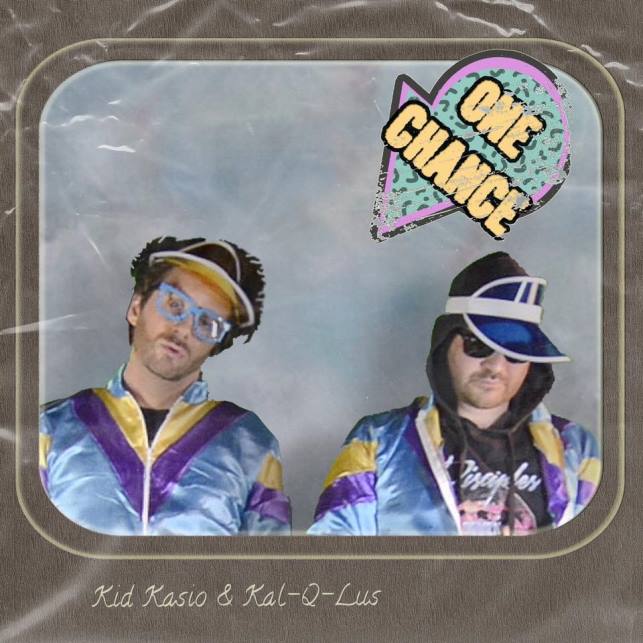
Woolworths had got on board, and a futuristic looking booth was erected in the Riverdale shopping centre and the whole affair advertised in the pages of the local Newshopper. I turned up one sunny summer morning in that July of 1991 with my friend KAL-Q-LUS clutching a cassette demo of a song we had recently recorded.
It took some persuading to let the engineer put our tape into the overdubbing machine, as most people turning up that day had been encouraged to sing over popular hits of the time, but after 20 renditions of RIGHT SAID FRED’s ‘I’m Too Sexy’ and BEVERLY CRAVEN’s ‘Promise Me’, I think he was secretly quite pleased to be hearing something different.”
“We stepped inside the booth and stood in front of the green screen as the sound of our scratchy demo drifted over the speakers. It was a shame that my mum, who had accompanied us on the day, insisted that my young cousin Toby joined us in the booth. In hindsight though it was Toby’s dancing that really stole the show that day.
As we exited the booth we were asked to choose a backdrop for the video that would be super imposed onto the green behind us. We chose a random series of acid house style patterns called something like ‘future rave’ and we headed home excitedly clutching a VHS tape of our masterpiece. The following week the local paper printed a Top 10 of what they deemed were the best performances from the weekend of the booths stay at the Riverdale centre. We didn’t make the Top 10…”
Now some of the facts in this story may not be entirely true… but as the late and much missed Tony Wilson of Factory Records fame once said: “When forced to pick between truth and legend, print the legend”. Directed by Ed Crofts and filmed at the synthtastically equipped Fiction Studios in Central London, this tongue-in-cheek video certainly helps perpetuate this KID KASIO myth.
If you describe your influences as the “softer” side of synthpop and cite Nik Kershaw, Howard Jones, YAZOO, HEAVEN 17, together with ABBA and ELECTRIC LIGHT ORCHESTRA as your inspirations and have been making popular synth music since 1983, the good chance is that your name is Val Solo.
Valdi Solemo started up in Sweden in a Malmö band POP-OUT, before deciding to relocate to Bulgaria to work with some of the cream of local musicians, producing and writing there.
The music hungry sound shifter produced DR. FONKENSTEIN, before coming back home after ten years to join S.P.O.C.K. Now, Val Solo presents his “alone” project, with the exception of remixes from such recognised figures as Johan Baeckström of DAILY PLANET and NASA’s Patrik Henzel in charge of mastering.
‘Songs from Another Time… And Space’ can be best described as a younger brother to the UK’s own KID KASIO, where the prevailing love affair with the synth during its most prolific era is the theme. The album cover features the music magician surrounded by good old vintage cars depicted in black and white, where Val looks into the future, preserving the feel of the times when life was simpler.
If you’re after a sophisticated, masterfully poignant electronica, you won’t find it here. If however, you’re looking for a cheery, uncomplicated and easy listening pieces to take you back in time, ‘Songs From Another Time… And Space’ are for you.
Is it the super vintage ‘Why Would You Tell Me’, the era love affair of ‘Dream Girl (Purple Eyes)’, or the ‘Star Wars’ inspired ‘Party Like A Stormtrooper’ with its synths a la AND ONE, there’s something for everyone here. The latter even bears the musical blueprint of Essex boys MODOVAR.
‘I’m In Space (Cabdriver Dreams)’ is a perfect disco track with its mantric refrain and fun execution in such a way, there’s nothing left to do but let your hair down and party. The opening ‘Why Don’t You Talk To Me’ with its additional three remixes, notably one by Johan Baeckström, is the most accomplished number on the opus, reminiscent of YAZOO and early DEPECHE MODE. Who says synthpop has to be serious… VAL SOLO proves that having fun isn’t a bad thing, especially in the world of today, where we are all bombarded with negativity, politics and dystopian ideas.
Solo’s “solo” is unostentatious, modest and not at all fussy. It’s music for those willing to be transported to much simpler times, with much purer ideas and uncomplicated rhythms.
‘I Believe’ it’s vital to shed the shackles of the ordinary existence and let yourselves go… “let it happen, life is just what you want it to be”.
We use cookies to ensure that we give you the best experience on our website. If you continue to use this site we will assume that you are happy with it.

 as an album by THE MODERN in an expanded tracklisting which largely resembled the South East Asian 2CD edition. In whatever variant, the debut album by THE MODERN often provokes many “what if” debates among electronic pop enthusiasts.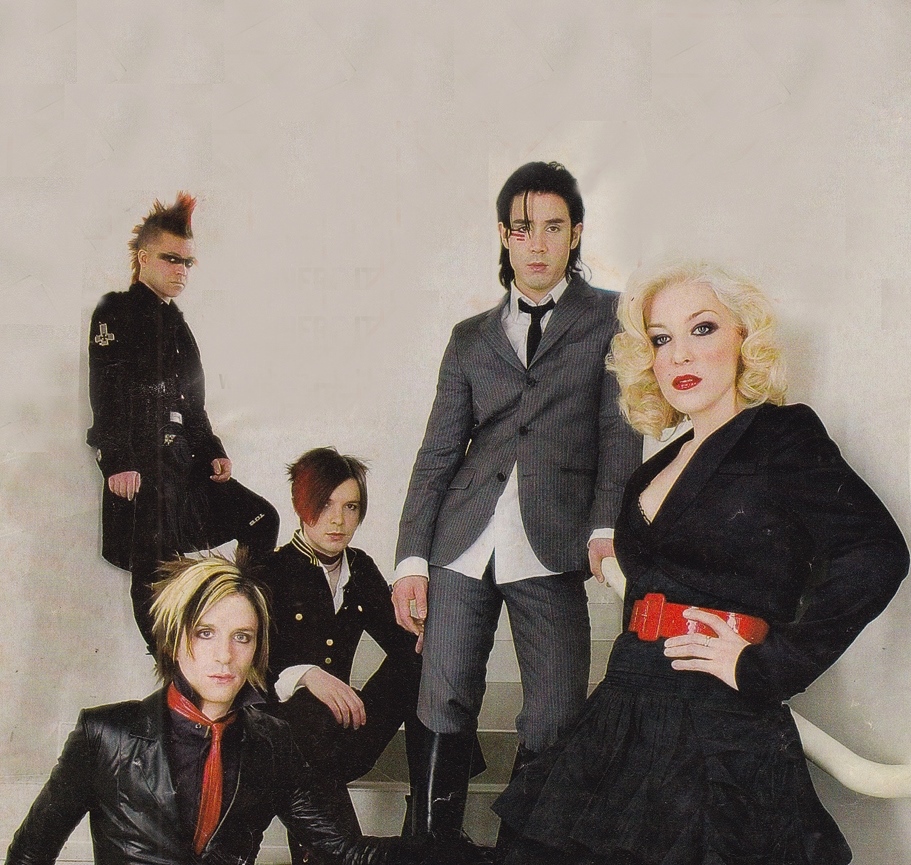
 in 2018, many of the tracks co-written with Nathan.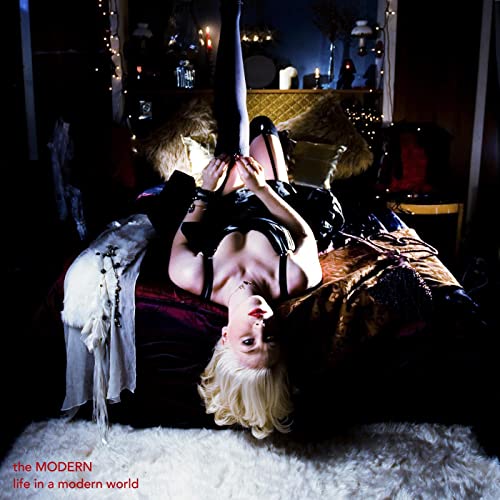
 is from the album
  , both are available via the usual digital platforms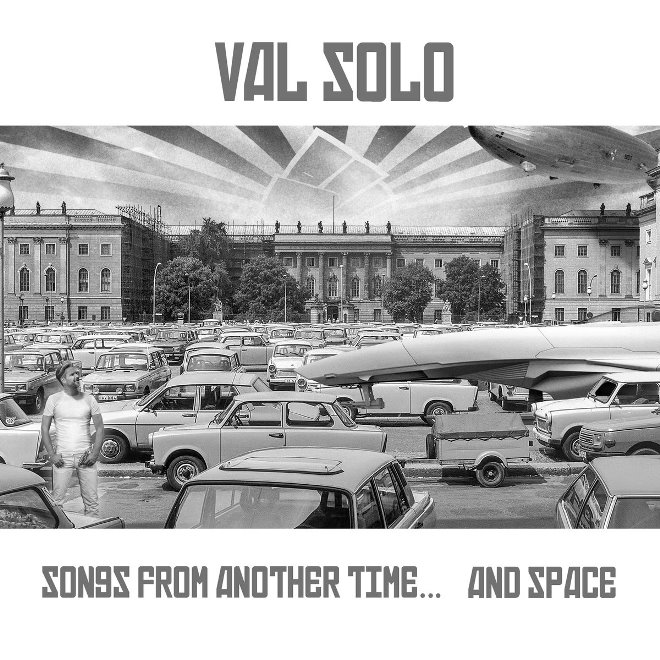
 can be best described as a younger brother to the UK’s own
Follow Us!