Tag: Depeche Mode (Page 14 of 17)

A Short Conversation with BRIAN GRIFFIN

Brian Griffin is the renowned photographer whose work captured the inventive spirit of post-punk and Synth Britannia.

His numerous subjects have included DEPECHE MODE, ULTRAVOX, OMD, SPANDAU BALLET, THE PSYCHEDELIC FURS, TALK TALK, ECHO & THE BUNNYMEN and THE TEARDROP EXPLODES as well as Billy Idol, Howard Jones, John Foxx and Bryan Ferry. Although perhaps not as well known as his contemporary Anton Corbijn, Griffin’s work is no less iconic and some would say, more focussed if far out…

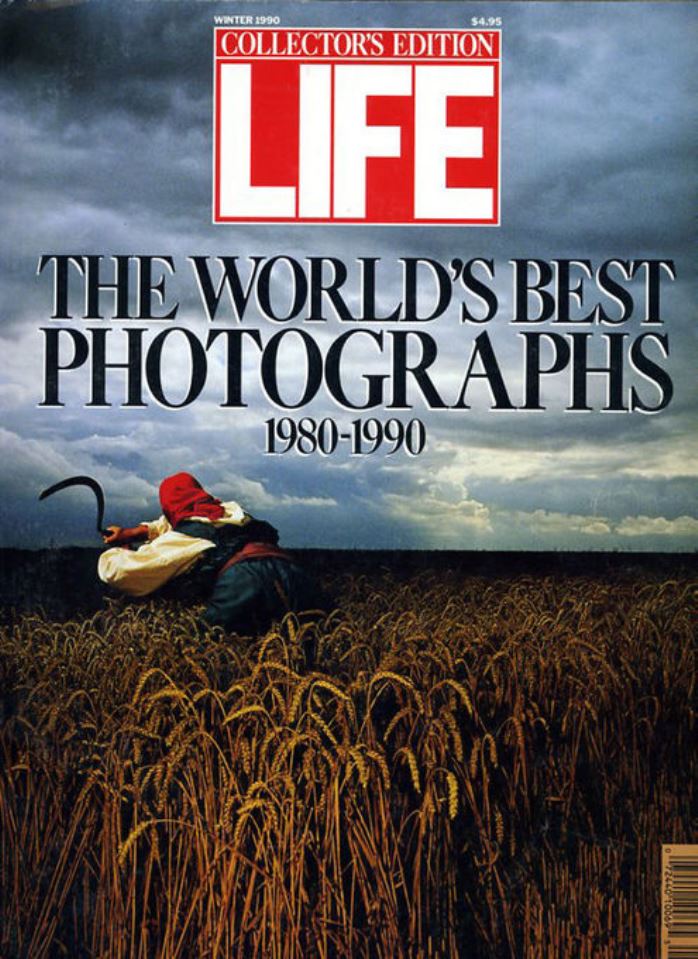
The sleeve of ECHO & THE BUNNYMEN’s ‘Heaven Up There’ which featured his photograph of the band on a windswept Porthcawl Beach in South Wales was voted ‘Best Album Cover’ in the 1980 NME Readers’ Poll, while his image for DEPECHE MODE’s ‘A Broken Frame’ adorned the front cover of Life Magazine’s ‘World’s Best Photographs 1980-1990’ supplement.

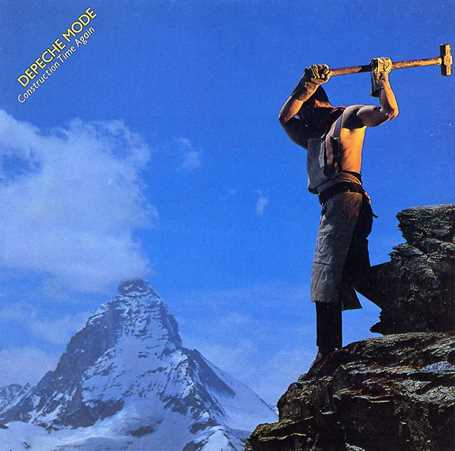
Reflective of Griffin’s interest in socialist iconography which continued into DEPECHE MODE’s next album ‘Construction Time Again’, it projected the band’s musical interregnum without being too blatant. As Dave Gahan said to Richard Skinner on Radio1 at the time “Y’know, we didn’t want to be obvious and have a frame with a bit missing!”

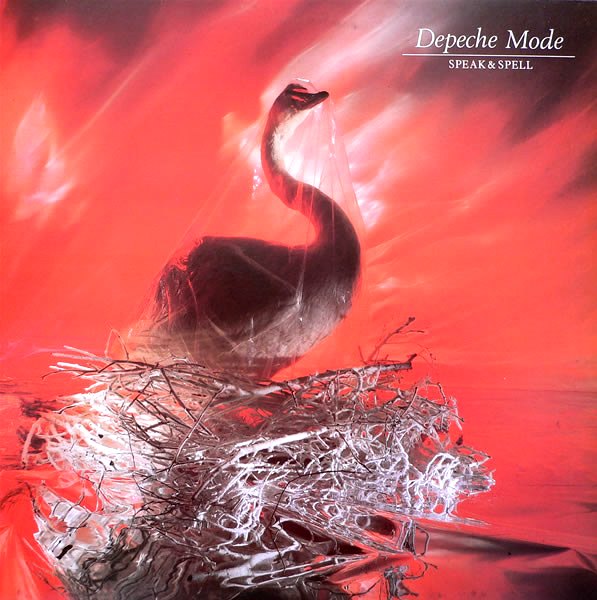
While most of Griffin’s front cover photographs have become part of folklore among music enthusiasts, one that still provokes polarising debate is the sleeve of DEPECHE MODE’s debut ‘Speak & Spell’. Brian Griffin kindly discussed ‘Speak & Spell’, along with assorted anecdotes about his other work and what he would do on a DEPECHE MODE album cover today…

How did you become involved with Mute Records?

My photographic agent David Burnham held the lease on a shop in Seymour Place. Daniel Miller and Mute Records moved in on the ground floor. David Burnham did what agents do and showed Daniel my portfolio, with the rest being history.

What was the brief when you were asked to do the cover photo for DEPECHE MODE’s ‘Speak & Spell’?

From memory it was totally open. Although with the cover featuring a swan that cannot be the case. I personally would love to know what made me come up with that crazy idea.

What were the other concepts you considered before arriving at the swan in a bag pic?

Not doing the cover, because DEPECHE MODE was hardly my favourite band at the time.

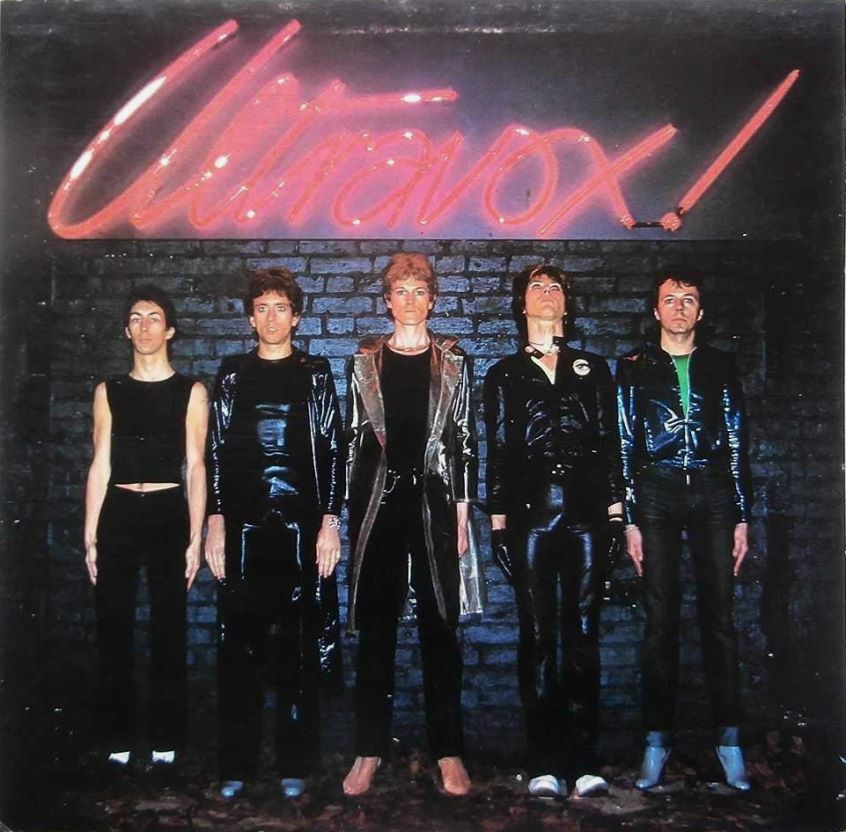
Was using a photo of the band on the front cover of ‘Speak & Spell’ ever an option like had been done with your photo of ULTRAVOX for ‘Vienna’?

Never. A photograph by me was definitely required.

I personally love the ‘Speak & Spell’ sleeve, but it got a mixed reaction including from the band? What do you think of it now?

It’s right out there, but at the time it was regarded as being one of the worst album covers of recent years. I was at the time, certainly in some other space, maybe outer space!!

Did you feel at all aggrieved when the first CD issue of ‘Speak & Spell’ came out with just a small detail of the swan’s head and neck on the artwork?

Designers trying to give original images a modified twist always do my head in. Obviously the designer, whoever he or she is, is a load of crap.

You did all the album cover photos for DEPECHE MODE up to ‘Black Celebration’, which one is your favourite sleeve and why?

The imagery that I produced for both ‘A Broken Frame’ and ‘Construction Time Again’ I’m immensely proud of and to me, they are of equal merit. However the image choice for ‘Construction Time Again’ was poor by the decision makers, there being far better alternative choices.

The iconic photo used on ‘A Broken Frame’ ended up on the cover of Life Magazine’s ‘The World’s Greatest Photographs 1980-1990’ supplement and even on biscuit packaging in Greece. Where did the rumour that the woman in the photo was Daniel Miller in drag come from?

I haven’t heard that one before! It’s certainly not true.

Your worker images for ‘Construction Time Again’ are very interesting. Back in the day, I thought it was studio work superimposed but you and the musclebound model actually went to The Alps!

Yes, my assistant and his brother the model flew to Switzerland and we even took the sledgehammer with us from Rotherhithe London.

You also took portrait photos of DEPECHE MODE as well as artists such as ULTRAVOX, OMD and TALK TALK. How do look back on that whole Synth Britannia era?

At the time I was a great Krautrock fan like Daniel Miller and I found all these English bands not that interesting, although great photographic opportunities. Now I realise I was wrong and narrow-minded, for listening to them today they produced some great stuff.

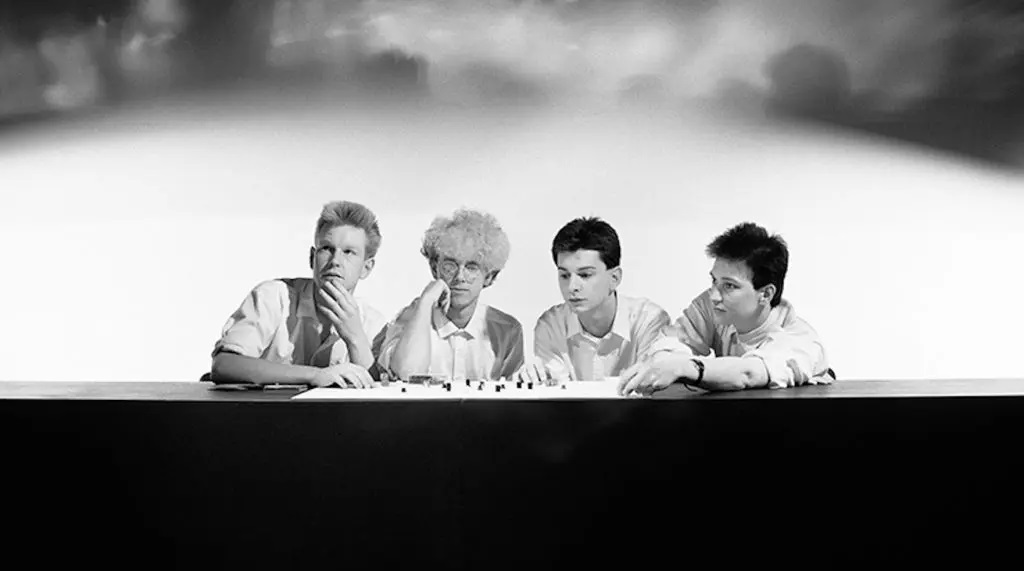
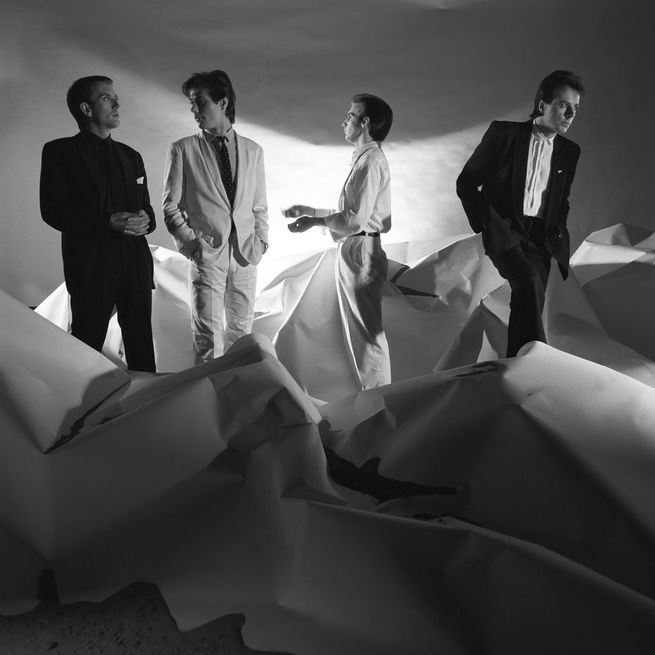
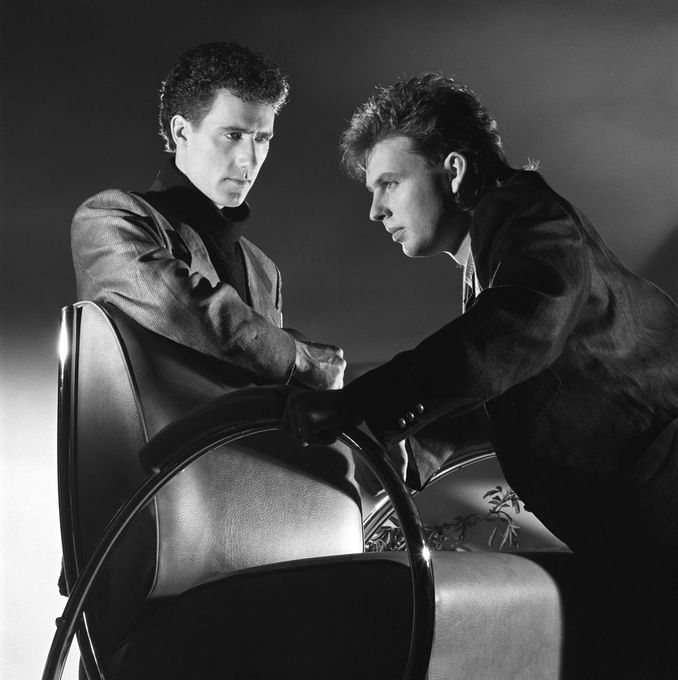
Your portrait photos often featured an interesting use of props ie board games with DEPECHE MODE, a pool table with SPANDAU BALLET, chairs and ropes with OMD?

Back then you had to be so inventive. My studio was full of props from various shoots, with budgets low, we would just create ideas from whatever was at hand.

A number of artists you photographed like DEPECHE MODE, ULTRAVOX and ECHO & THE BUNNYMEN went on to work with Anton Corbijn as well… is that a coincidence?

Not really, for he was always hanging around waiting to pounce. Eventually I lost the bands to him.

You have an online shop that includes prints of your DEPECHE MODE photographs and many others. How did you decide upon which outtakes to put into the public domain and were there any interesting legal processes you had to go through to enable them to be sold?

With regards to the outtakes, they had been buried away 32 to 37 years.

It was now time for the fans to see them. I went through no legal processes, for it is such a positive gesture for everyone involved.

If you were photographing for a DEPECHE MODE album cover today, what sort of imagery would you be looking to use?

I would produce an image that would form a trilogy with ‘A Broken Frame’ and ‘Construction Time Again’.


ELECTRICITYCLUB.CO.UK gives its warmest thanks to Brian Griffin

A selection of Brian Griffin’s iconic photographs can be viewed and purchased from his website at http://www.briangriffin.co.uk/


Text and Interview by Chi Ming Lai
7th May 2014

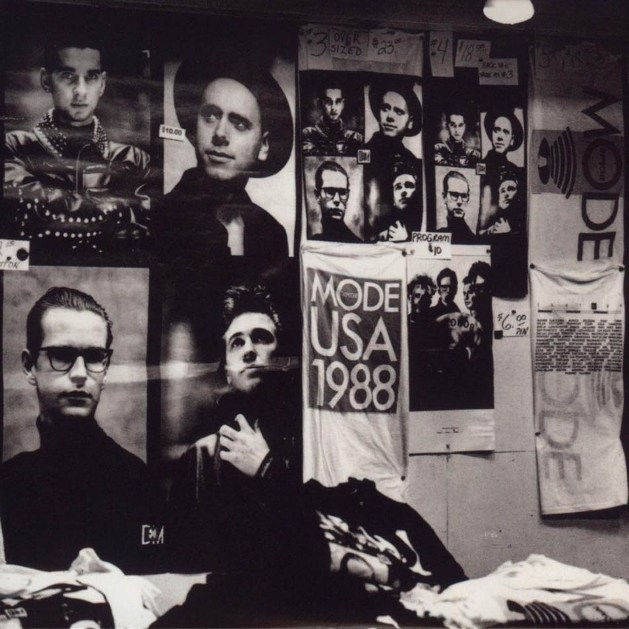
DEPECHE MODE 101 25 Years On: A Short Conversation with ALAN WILDER

It was the document that put DEPECHE MODE into the big league. But while ‘101’ affirmed the Basildon boys’ status into Trans-Atlantic Stadium Monsters, it also symbolised the end of the synth wars…

The battle of Synth Britannia had now been won but with no fight left, the journey had come to an end. And at the post-Live Aid roundabout, DEPECHE MODE had to take a different course to survive and maintain their new found prosperity.

So they got rockier and bluesy to fatten the sound for those huge venues while Dave Gahan’s stage gestures got more provocative and more physical as he had the cover the width of the stage. Even Fletch’s arms aloft gestures became a key part of the bigger show. This ultimately culminated with the pseudo-rock explosion of ‘Songs Of Faith & Devotion’ and its corresponding self-destructive tour. But all that was to come later…

Released 25 years ago in the UK on 13th March 1989, the ‘101’ double album and accompanying film directed by acclaimed filmmaker D A Pennebaker was aimed squarely at telling onlookers-at-large that DEPECHE MODE were no longer those fey synthpoppers in need of a good tailor, but a band with the potential to do battle with U2, who coincidentally had their own film ‘Rattle & Hum’ out in the same year.

While a popular live draw stateside in 1988, DEPECHE MODE had only previously headlined arena sized venues on America’s two coasts. The popularity of British post-punk acts among white American teenagers thanks to the Anglophile soundtracks of John Hughes films like ‘The Breakfast Club’, ‘Pretty In Pink’ and ‘Some Kind Of Wonderful’ was at an all time high. SIMPLE MINDS had nailed a US No1 with ‘Don’t You (Forget About Me)’ from ‘The Breakfast Club’ while OMD had hit the Top5 with ‘If You Leave’ from ‘Pretty In Pink’.

Indeed, Depeche’s American label Sire had attempted to relaunch them in this Hollywood centred environment by having their B-side ‘But Not Tonight’ as the theme to a largely forgotten teen movie ‘Modern Girls’. The song flopped which proved to be a blessing, especially when looking at the later career trajectories of SIMPLE MINDS and OMD following their initial post-John Hughes flushes of success…

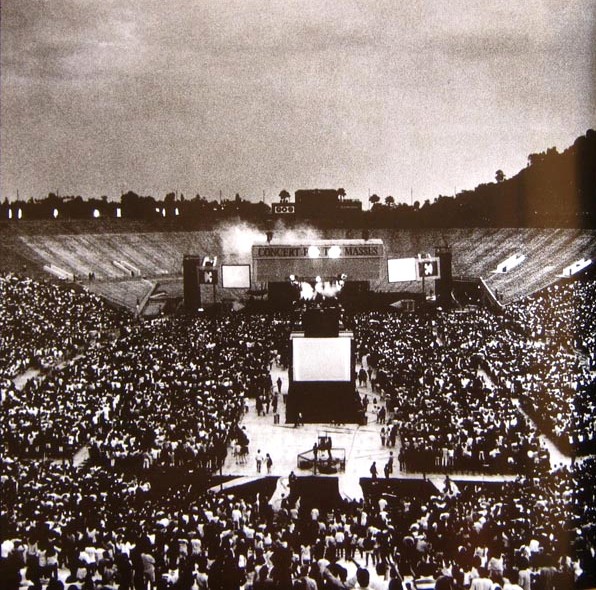
To capitalise on the momentum of increasing US album sales of the album ‘Music For The Masses’ and their most successful American tour yet, they elected to play a ‘Concert for The Masses’ at the 70,000 capacity Pasadena Rose Bowl on 18th June 1988. The 101st and final show of their ‘Music For The Masses’ tour, it was a risky strategy at the time as the band had achieved only one Top 40 single ‘People Are People’ in the US. But the buzz around the band, especially from the listenership of the influential college friendly radio stations such as KROQ indicated that DM’s newly Devoted American fanbase would make the special trip to witness what was effectively their own musical Superbowl.

Recorded around backstage antics and a road trip following a group of fans on their way to the show inter-dispersed with concert footage from various shows, it was to establish DEPECHE MODE as a credible worldwide force, particularly with dissenters in the UK press who had always been resistant and cynical to their worldwide success.

The result of the release of ‘101’ was that even neutrals in the UK, who had bought the odd album or single in the past, were astonished to find synthpop classics such as ‘Everything Counts’ were now being aired to the masses in all the world’s stadiums… at least that was the perception. Jim Kerr of SIMPLE MINDS was quite bemused at their newly acquired status, retrospectively commenting to Word Magazine in 2006: “Who would’ve thought Depeche Mode plink-plonking away would play in stadiums?”

As a profile building exercise for DEPECHE MODE, ‘101’ was a big success but its legacy also had an effect on Mode’s contemporaries. Rather than opening doors, ‘101’ inadvertently shut them to others. Having been Vince Clarke’s original inspiration to take up the synthesizer and eventually launch DEPECHE MODE, main support act OMD could only watch in awe as their apprentices wowed the massive crowds night after night.

It must have been demoralising to Andy McCluskey and Paul Humphreys despite their own, not unsubstantial success in Europe. But in the rush to break America, OMD may have had a Top 5 US single to their name, but they could not (and have never been able to) attract the Devoted loyalty which Messrs Gahan, Gore, Fletcher and Wilder had steadily built and enjoyed. They could only go one way after this and looking back, their split in 1989 was predictable!

Supporting proceedings that night in Pasadena was Thomas Dolby who also had to rethink his own artistic aspirations. Despite a Top5 US hit single to his name, he had his own struggles with pressure for more hits from his various record labels. As a solo act, he could not split with himself but after his 1992 album ‘Astronauts & Heretics’, he effectively retired from the music industry.

Working in Silicon Valley on music integration software for the brave new world of the internet with great success and developing the polyphonic ringtone engine for Nokia along the way, he only returned to music in 2006 and supported DEPECHE MODE again at London’s Hyde Park that same year.

By the time of the more organic but still primarily electro album ‘Violator’, DEPECHE MODE had overtaken all their peers, and this symbolism was highlighted when they played at Dodgers Stadium in August 1990 to conclude the North American leg of the ‘World Violation’ tour. The support act were ELECTRONIC, a supergroup made up of refugees from NEW ORDER and THE SMITHS plus both PET SHOP BOYS thrown in for good measure! Messrs Gahan, Gore, Fletcher and Wilder had now become the UK independent scene’s biggest post-punk success story.

One of the protagonists at the Pasadena Rose Bowl on 18th June 1988 was of course, Alan Wilder. In an exclusive interview for its 25th Anniversary, he kindly answered some questions about ‘101’ and discussed its legacy…

In hindsight, the ‘101’ film, while good for DEPECHE MODE’s profile at the time, appeared to focus on some of the wrong things ie there’s too much footage of the fans on the bus, not enough actual music?

Even though Don Pennebaker had previously made music concert films (David Bowie at Hammersmith Odeon for example), he is primarily a documentary filmmaker. This was appealing to us although it is debatable whether the pre-determined set-up of the group of bus people (collected and auditioned a la ‘Big Brother’) is not an inferior form, as opposed to entering an already existing situation and truly being a fly on the wall. After all, Reality television has little to do with reality.

Once commissioned and given a fairly free reign, Pennebaker looked at his options and decided to make a film about what he considered to be the most (perhaps the only) interesting factors of the DM phenomenon. The fact that Don had not really even heard of the group, let alone any of its music, gave him an outsider’s perspective and he soon realised that he wasn’t likely to glean any pearls of wisdom from the band members. As individuals, we were not deep-thinking angst-driven people with massive world insight. His decision to focus on the fans was probably the right one.

In its defence, it shouldn’t be forgotten that we’ve all been saturated with the kind of voyeurism that Reality TV has spewed forth into our consciousness for more than two decades, but in 1987 this was an unusual and precarious approach. Nobody knew what would transpire or whether it would be of any interest at all.

I’d go as far as to say the idea was somewhat groundbreaking as it clearly pre-dates all that MTV malarky which most people consider to be where the Reality craze got started. Also, the naivety and carefree exuberance with which the bus protagonists go about their adventures has a charm which could probably not be repeated today, given the knowing self-promoting instincts from most who take part in these ventures now, along with the predictable audience consumption, moral judgements and salacious anticipation of all things about to fall apart.

This kind of format has not only become hugely popular but also the centre of heated discussions about tabloidisation, media ethics, privacy and the representation of the real. At the time, I felt short-changed by ‘101’ as I wanted the band itself to be explored more profoundly, preferably by someone who had knowledgeable insight into the music, our working practices and what we (albeit sometimes clumsily and naively) were generally trying to do.

Pennebaker didn’t pretend to understand the band at all – he made no bones about that fact – but, with hindsight, he did manage to make a piece which says something about the era and I think, allied to the fact that it holds no pretentions (unlike some rock docs of the period – err… hummm… ‘Rattle and Hum’), it stands the test of time. Having said that, I find the film at best curious rather than ‘deep’.

The fanbase connection with the band appeared to be what was trying to be highlighted on ‘101’. For example, the crowd has been mixed in very loudly on the live footage and audio whereas a good number of live albums of the time would neutralise the audience noise?

I feel to highlight the fanbase connection was fair enough. After all, this is the real crux of the DM fascination – how “four Walters from Basildon” (to quote an early single review) could form the source of nothing short of a worldwide phenomenon, the nature of which is quite perplexing, way out of proportion for a pop band – a strange, bizarre and enduring religion which has been demonstrated again more recently in Jeremy Deller’s film ‘The Posters Came From The Walls’.

Is that right about the crowd levels? I haven’t listened for a long time to the album but the film soundtrack may be even more that way. Again, I haven’t watched the film for many years and it’s possible that the Pennebaker crew had some extra control over that music-to-crowd balance. My memory though is that we controlled the music mixes and so the album balance would have been the decision of those of us who mixed the tracks.

‘101’ symbolises DEPECHE MODE’s entry to the wider international stage but perhaps also, the end of Synth Britannia as of those support acts who played that day in Pasadena, OMD split up soon after while Thomas Dolby retired from the music industry a few years later. It was as if DM had set a bar that their peers couldn’t hope to reach… any thoughts on that?

I’m not sure that DM’s ‘success’ would have had any negative bearing on other electronic artists. If anything, the expectation of positive reverberations and opening of doors would have been more likely. A lot of it was luck for DM though, coupled with plenty of donkey work touring in the US leading up to the big (and unexpected to such a degree) explosion. It seems the timing was right for that kind of music where genres were being choked by mainstream rock radio as a huge cult level of other music listeners were being shafted.

We benefited from a kind of breaking of the dam which finally gave way, resulting in those stations almost being forced into recognising and playing the newer UK artists of the time – such as The Cure, The Smiths, New Order, DM and many other groups which had been, up until then, considered ‘alternative’ or ‘cult’ in the states. I can’t hazard a guess about the examples you cite or speculate as to why some acts may have failed to capitalise. I do know that there is never a correlation which one should assume between the quality of a band / artist compared to the amount of people who turn up to their concerts. It’s a funny old game…

With that in mind and with DEPECHE MODE established publically with ‘101’ as a ‘stadium act’, had the development into a more organic, rock / bluesy sound to suit those types of venues been a conscious move in order for DM to maintain that position with ‘Violator’ and ‘Songs Of Faith & Devotion’?

Subconsciously there may be an element due to the nature of the venues and larger (more distant) crowds needing to be serviced. Dave, I’m sure, would have welcomed the more ’rocky’ approach to release and enhance his own stage performances. But ‘Violator’ is still a very electronic album when you listen to it now, and its less electronic elements, rather than derived from stadium experiences, were mainly influenced by the wave of hip hop and rap music which permeated the scene at that time. The methods of those artists employing more left-field sampling techniques left a significant mark on both myself and Flood.

We were attracted to the inherent feel of played drum loops for example rather than precisely programmed rhythm from machines or individual drum samples. This ‘looping’ was taken much further with ‘SOFAD’ of course – an album style conceived mainly because we didn’t want to just repeat ‘Violator’ despite its success. That would have been seen as stagnation and some of us at least were very wary of that.

You did not appear in the interviews or commentary for the bonus features on the ‘101’ DVD reissue, why was that?

A surprising amount of pressure was put on me to take part in the ‘director’s commentary’ idea, mainly from Daniel Miller and Pennebaker himself. But I didn’t feel I had some exciting anecdotes or anything particularly insightful to add for the reissue. I’ve never enjoyed the commentary concept – frequently empty and often unnecessarily demystifying (I like to retain something for the imagination). The ‘101’ film is not exactly complicated and doesn’t contain any technical issues which needed explaining either. It speaks for itself.

Even though, on paper, the idea of a group and director ‘talkover’ maybe could have worked – i.e. jogging each other’s memories etc – I just knew that putting four rock band members together in a room to randomly comment would result in silly giggling, talking over each other and the spouting of mainly nonsense. And that filled me with dread.


ELECTRICITYCLUB.CO.UK gives its sincerest thanks to Alan Wilder

The DEPECHE MODE ‘101’ film and uninterrupted Pasadena Rose Bowl concert highlights are available as a 2DVD package via Mute Records. The ‘101’ 2CD live album is still available
For information on Alan Wilder’s RECOIL and his other projects, please visit http://blog.recoil.co.uk/

DEPECHE MODE’s own recollections of that June day in Pasadena can be found at http://archives.depechemode.com/specials/june_18_1988.html


Text and Interview by Chi Ming Lai
Photos by Anton Corbijn
13th March 2014

25 SONGS THAT SHOULD HAVE BEEN SINGLES

The concept of the single in the past has been to present an artist’s most immediate work for mass consumption and appreciation, often as a trailer for an album or compilation.

Like it or not, many acts’ best songs have been released as singles. They often reach an audience who would not normally be interested in the tribulations of a much longer journey.

Looking back throughout pop history, many pinnacles of a group’s career have been exclusively single releases; THE WALKER BROTHERS ‘The Sun Ain’t Gonna Shine Anymore’, THE BEATLES ‘Strawberry Fields Forever’, IAN DURY & THE BLOCKHEADS ‘Hit Me With Your Rhythm Stick’ and THE JAM ‘Going Underground’ are a number of examples.

Today’s culture of individual track downloading now makes virtually every song in existence a single. However, a fair number of recordings which have become standards within live sets and have become a key part of a band’s history have never been accorded a single release. Such were some bands’ standings in their heyday that many were potential hits.

So here are 25 synth friendly songs which ELECTRICITYCLUB.CO.UK felt should have been given singular status. Listing tracks not released as 45s or CD singles in the UK with a limit of one song per artist moniker, they are arranged in chronological and then alphabetical order.


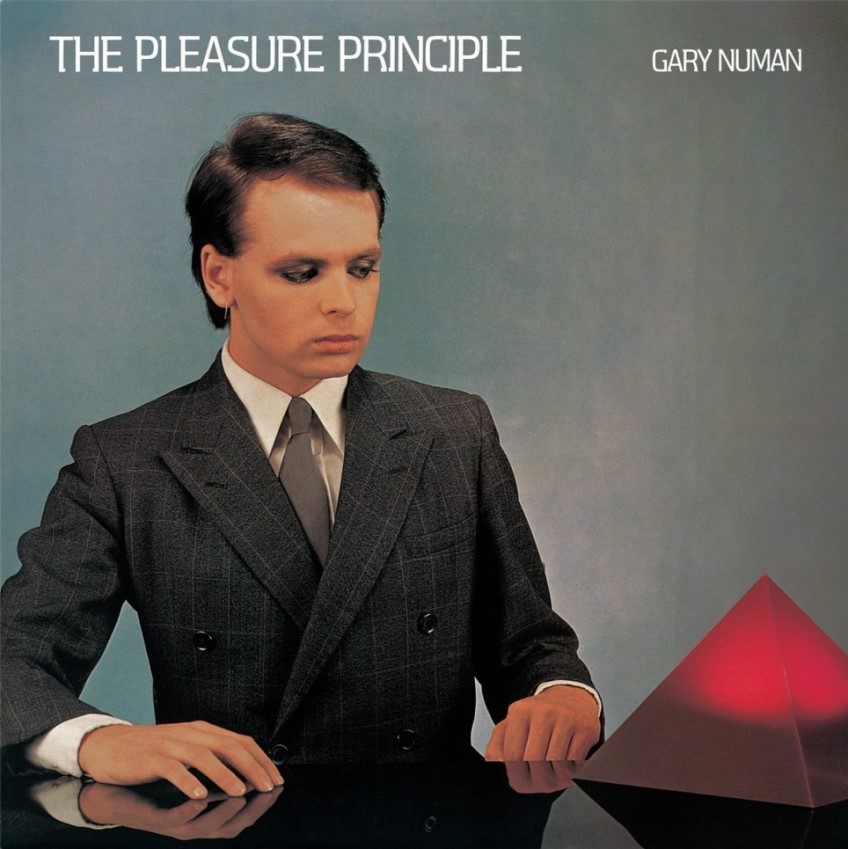
GARY NUMAN Metal (1979)

With Minimoog riffage in abundance, ‘Metal’ would have made a perfect follow-up to ‘Cars’ and in hindsight, been less of a public anti-climax than the brave, but misguided release of ‘Complex’, as great a song as it is. Full of dystopian resignation with references to “liquid engineers” and chilling vox humana courtesy of the Polymoog, ‘Metal’ was Sci-Fi musicality at its best. Even NINE INCH NAILS covered it and nearly 35 years later, it is still part of the Gary Numan live set.

Available on the GARY NUMAN album ‘The Pleasure Principle’ via Beggars Banquet Records

http://www.numan.co.uk/


JOHN FOXX A New Kind Of Man (1980)

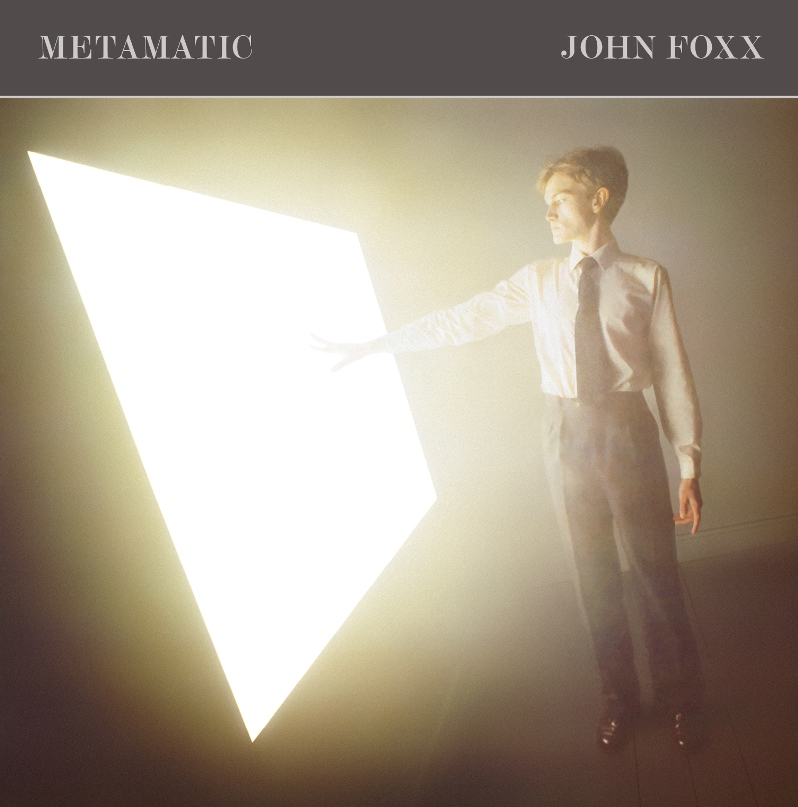
“I want to be a machine” cried JOHN FOXX as far back as 1977 on the first ‘Ultravox!’ album. Starting off side two of ‘Metamatic’, the former Dennis Leigh realised his mechanised JG Ballard inspired electro theories and went up to the next level with ‘A New Kind of Man’. Is it about genetically modified humans or homo superiors? Who knows? But the chilling Elka string machine and frightening detuned synthetics made it a distinctly new kind of song in a brave new world.

Available on the JOHN FOXX album ‘Metamatic’ via Edsel Records

http://www.metamatic.com/


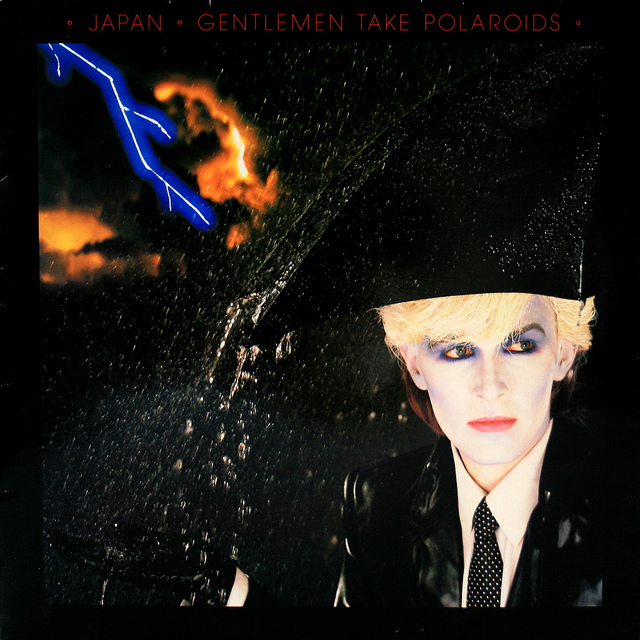
JAPAN Swing (1980)

JAPAN found a refuge at Virgin Records who released their fourth album ‘Gentlemen Take Polaroids’. One of its best numbers was ‘Swing’ which combined David Sylvian’s muzak travelogue with Richard Barbieri’s Oriental synth textures. It was probably one of the last times JAPAN were fully as one. Guitarist Rob Dean made a full contribution before being forced out while the rhythm section of the late Mick Karn and Steve Jansen were amazingly fluid over the drum machine bossa nova.

Available on the JAPAN album ‘Gentlemen Take Polaroids’ via Virgin Records

http://www.nightporter.co.uk/


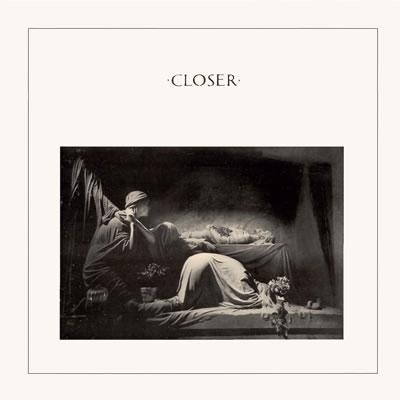
JOY DIVISION Isolation (1980)

OK, so JOY DIVISION never took singles from their albums but what if they had? This would have been a contender. Featuring an ARP Omni and an early version of the Simmons drum synthesizer, ‘Isolation’ was the most electronic track JOY DIVISION ever recorded although Hooky’s bass ensured there was a gritty punk rock edge. When NEW ORDER reformed for the first time in 1998, a drum ‘n’ bass flavoured rework of ‘Isolation’ was part of the live set.

Available on the JOY DIVISION album ‘Closer’ via WEA Records

http://joydivisionofficial.com/


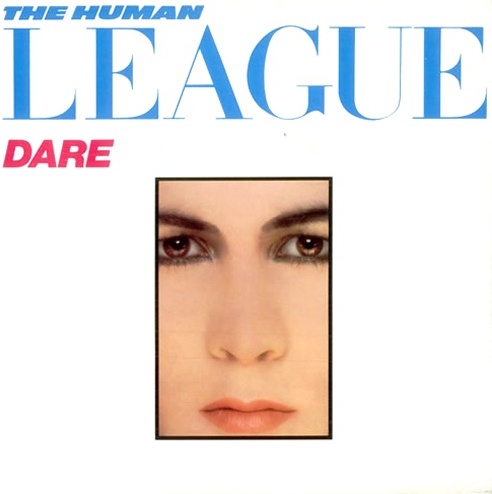
THE HUMAN LEAGUE The Things That Dreams Are Made Of (1981)

Optimistic and aspirational, ‘The Things That Dreams Are Made Of’ is the key song from ‘Dare’ and was a metaphor for THE HUMAN LEAGUE’s then pop ambitions. Gloriously spacious and delightfully catchy, each synthesizer voicing has its place while Phil Oakey gives full justice to Adrian Wright’s shopping list of life’s pleasures to a perfect Linn Drum clap track. It certainly deserves to be played live more often… “New York – ice cream – TV – travel – good times”

Available on THE HUMAN LEAGUE album ‘Dare’ via Virgin Records

http://www.thehumanleague.co.uk/


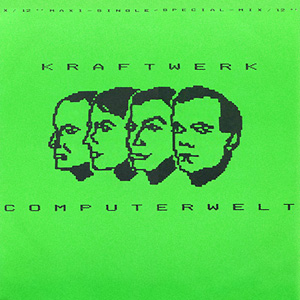
KRAFTWERK Computer World (1981)

Hooky, catchy and futuristic, ‘Computer World’ with its Speak & Spell voices and infectious four note theme was an ideal KRAFTWERK single if ever there was one. However, the perky and novelty laden ‘Pocket Calculator’ was chosen to trail the parent album. It is unlikely ‘Computer World’ could have hit the top of the charts like ‘The Model’ did, but such was the song’s popularity, the native variant got released as a limited run remixed maxi-single in Germany.

Available on the KRAFTWERK album ‘Computer World’ via Mute Records

http://www.kraftwerk.com/


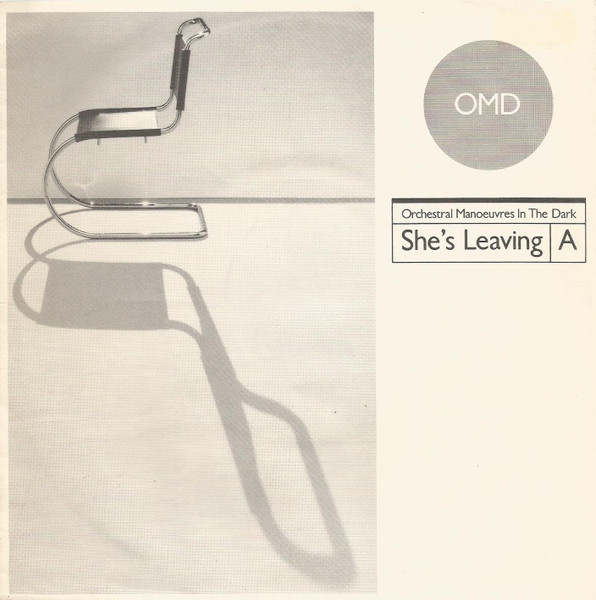
OMD She’s Leaving (1981)

It was a tricky call between ‘She’s Leaving’ and ‘Radio Waves’, but the North-by-North West melancholy of the former won over the upfront Germany Calling salvo of the latter. A wonderful synthetic cross between JOY DIVISION and Paul McCartney, ‘She’s Leaving’ was pencilled in as the fourth single from OMD’s huge selling ‘Architecture & Morality’ but was vetoed by the band.  However, when ‘She’s Leaving’ did come out as a single in the Benelux region, it flopped.

Available on the OMD album ‘Architecture & Morality’ via Virgin Records

http://www.omd-messages.co.uk/


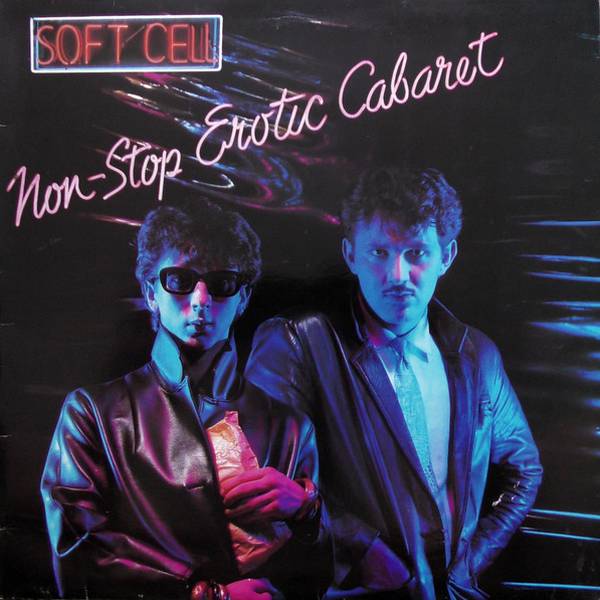
SOFT CELL Secret Life (1981)

As proven by their covers of ‘Tainted Love’, ‘What?’ and later on during their 21st Century comeback ‘The Night’, SOFT CELL always had a love of the UK’s Northern Soul scene. Its influence would seep into their own compositions like ‘Secret Life’. Marc Almond’s narrative on a philanderer’s hypocrisy was an apt reflection of suburban life while Dave Ball’s solid use of keyboards provided a suitably accessible but gritty sub-Tamla soundtrack.

Available on the SOFT CELL album ‘Non-Stop Erotic Cabaret’ via Universal Music

https://www.softcell.co.uk/


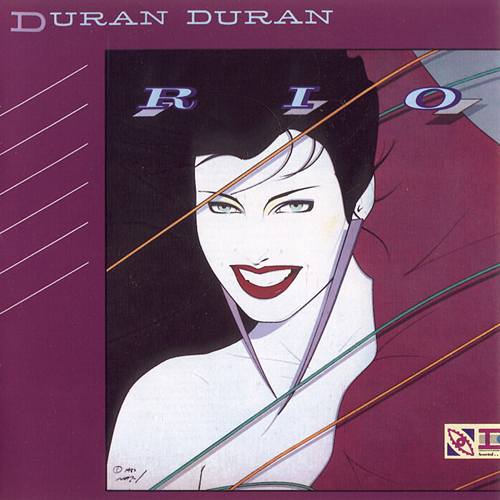
DURAN DURAN New Religion (1982)

The perfect balance between art and pop, ‘New Religion’ was a key highlight from DURAN DURAN’s ‘Rio’ album. “A dialogue between the ego and the alter-ego”, Simon Le Bon’s conflicting schizophrenic voices added tension in the bridges before a classic Duran chorus. With an ambient intro that JAPAN would be proud of, it then moved at breakneck speed through the quintet’s other influences like Bowie, Roxy, Moroder and Chic with speed being the operative word.

Available on the DURAN DURAN album ‘Rio’ via EMI Records

http://www.duranduran.com/


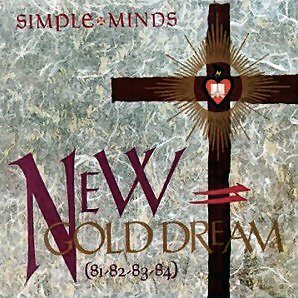
SIMPLE MINDS New Gold Dream (1982)

A huge song with two drummers drumming as well as lashings of Jupiter 8 and a marvellous bass engine, ‘New Gold Dream’ and its parent album highlighted an ambitious streak in SIMPLE MINDS akin to their Virgin label mates THE HUMAN LEAGUE when they released ‘Dare’ the year before. Already six minutes in length, an extended mix was released as a 12 inch single in Italy while as a sample on URSURA’s ‘Open Your Mind’, ‘New Gold Dream’ became a club hit in 1993.

Available on the SIMPLE MINDS album ‘New Gold Dream’ via Virgin Records

http://www.simpleminds.com/


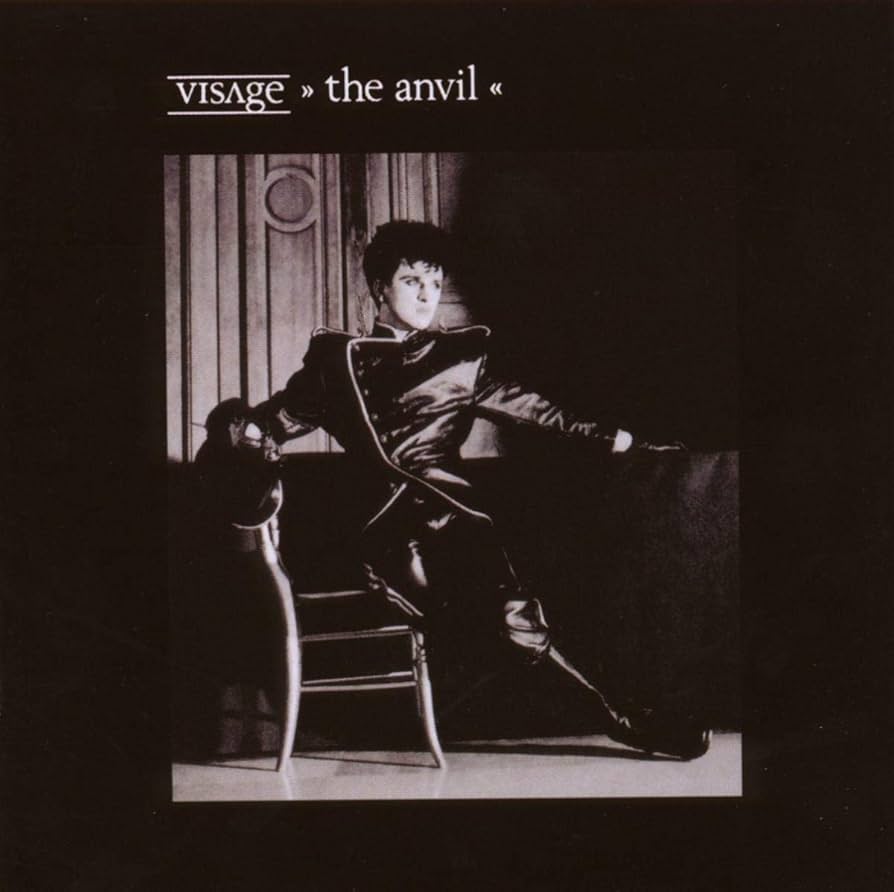
VISAGE The Anvil (1982)

With its heavy metronomic beat sans hi-hats, ‘The Anvil’ was Steve Strange’s tale of a night out in New York’s notorious club of the same name. But that wasn’t all, Billy Currie’s screaming ARP Odyssey and Dave Formula’s brassy synth riff completed the excursion. Rusty Egan said: “For me, ‘The Anvil’ was the lead track, ‘The Anvil’ in German (‘Der Amboss’), the 12-inch remixes, all that which I did with John Luongo was for me, the single. But the record company didn’t support that!”

Available on the VISAGE album ‘The Anvil’ via Cherry Pop

http://www.visage.cc/


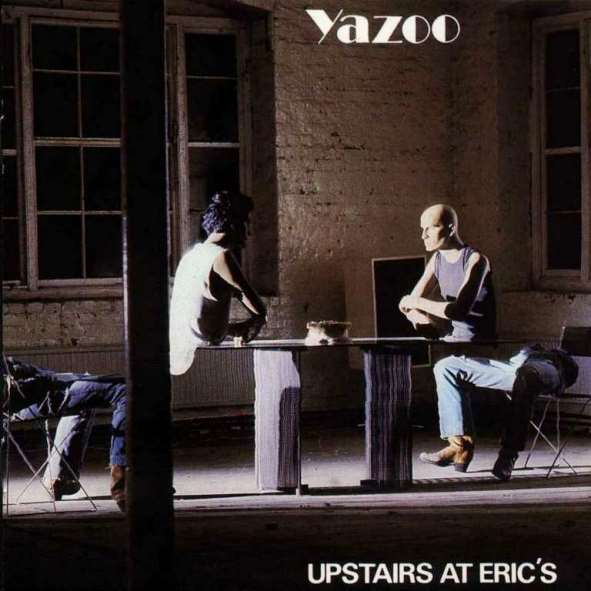
YAZOO Midnight (1982)

Showcasong one of the best Alison Moyet vocals, Vince Clarke’s minimal programmed backing gave her plenty of space to let rip with raw emotion on ‘Midnight’ . Back in those days, Mute Records usually only took two singles from an album so with ‘Only You’ and ‘Don’t Go’ already accorded singular status from ‘Upstairs at Eric’s’, a 45 was never likely. But it sort of belatedly became a single when it was sampled and manipulated by REX THE DOG for ‘Bubblicious’ in 2008.

Available on the YAZOO album ‘Upstairs At Eric’s’ via Mute Records

http://www.yazooinfo.com/


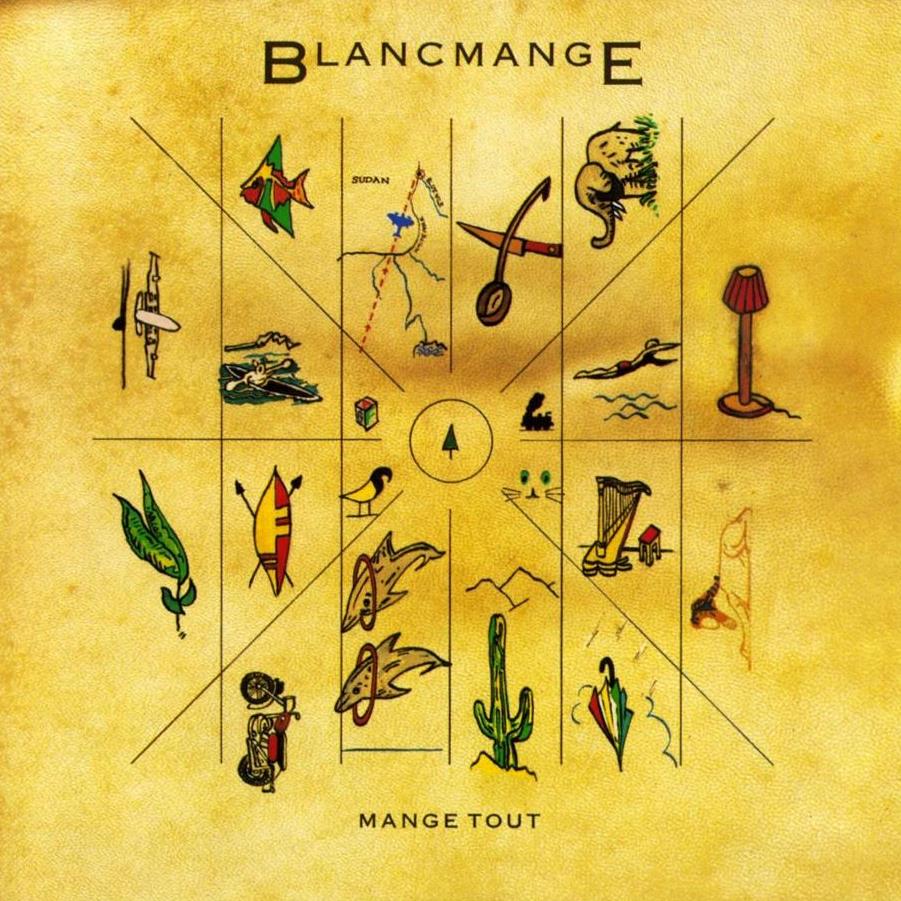
BLANCMANGE Game Above My Head (1983)

Originally the B-side to ‘Waves’, ‘Game Above My Head’ signalled the more disco based direction Neil Arthur and Stephen Luscombe later trod on ‘Blind Vision’ and ‘That’s Love, That It Is’ with American producer John Luongo. Merging the busy Linn Drum patterns that characterised BLANCMANGE’s debut ‘Happy Families’ with a funkier outlook, ‘Game Above My Head’ was included on their second LP ‘Mange Tout’. Today, the song remains a constant in the live set.

Available on the BLANCMANGE album ‘Mange Tout’ via Edsel Records

http://www.blancmange.co.uk/


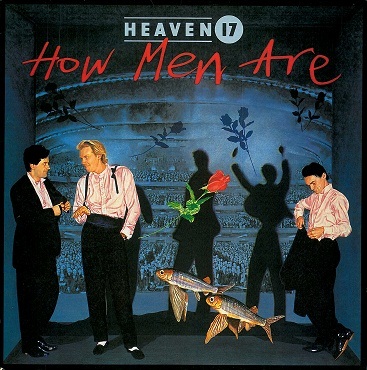
HEAVEN 17 Five Minutes To Midnight (1984)

HEAVEN 17’s most underrated track and referencing The Doomsday Clock, ‘Five Minutes To Midnight’ followed on from ‘Let’s All Make A Bomb’ to highlight the absurdity of Mutually Assured Destruction. Using and abusing the Fairlight CMI, the ‘Protect and Survive’ styled civil defence announcements, deathly whoops and a doomy orchestral crescendo bring a frightening finality as the song suddenly stops… “Hot as a furnace – wing to wing contact! AARGH!”

Available on the HEAVEN 17 album ‘How Men Are’ via Virgin Records

http://www.heaven17.com/


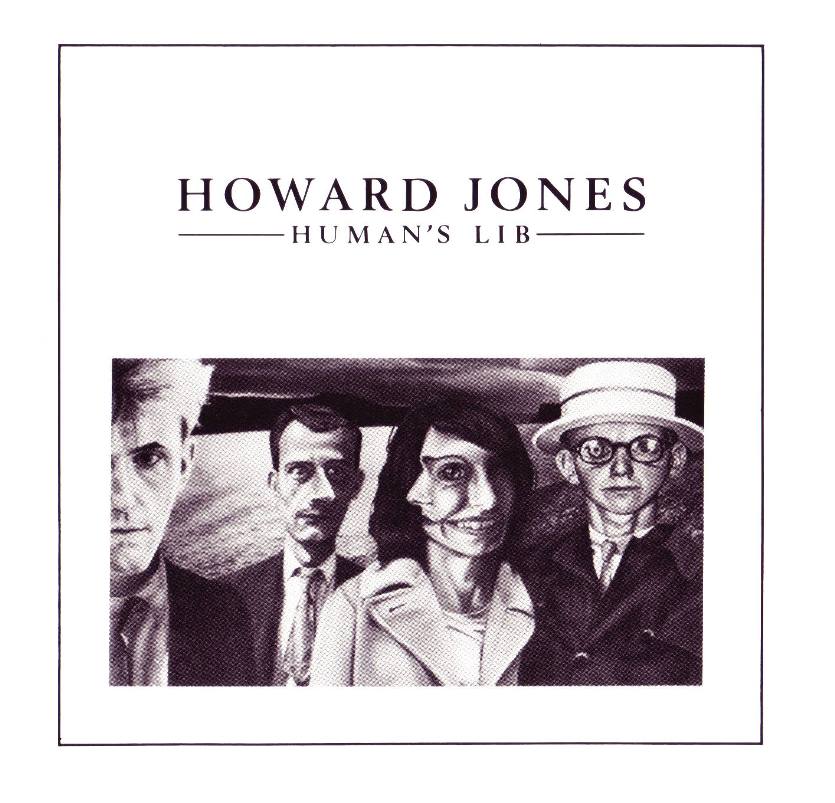
HOWARD JONES Equality (1984)

‘Equality’ exploited new MIDI technology like the Prophet T8 and Yamaha DX7, combining it with a Jupiter 8 and Pro-One; “it was one of those ones that really suited my live rig” said Howard Jones With its poignant human rights message, whether ‘Equality’ would have made a better single than ‘Pearl in the Shell’ is a moot point, but the song was released as a single in South Africa as a commentary about Apartheid.

Available on the HOWARD JONES album ‘Human’s Lib’ via Cherry Red Records

http://www.howardjones.com/


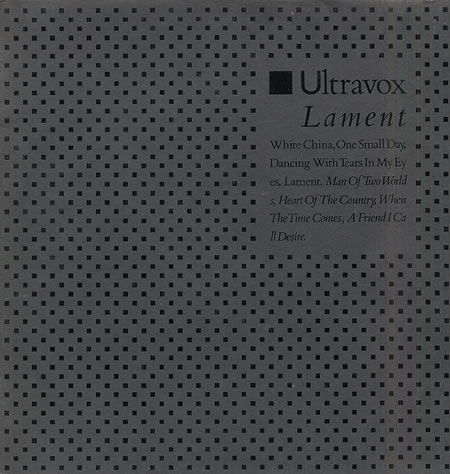
ULTRAVOX White China (1984)

Despite their use of synthesizers, it was rare that ULTRAVOX went the whole sequencer route. They did so with this song about the impending 1997 handover of the British Colony of Hong Kong to Red China. The lyrics captured a sense of pessimism over a bouncy electro disco soundtrack influenced by ‘Blue Monday’. Slated for release as a single in the UK, ‘White China’ had a special extended mix prepared but Chrysalis Records preferred the more obvious ‘Dancing With Tears In My Eyes’.

Available on the ULTRAVOX album ‘Lament’ via EMI Records

http://www.ultravox.org.uk/


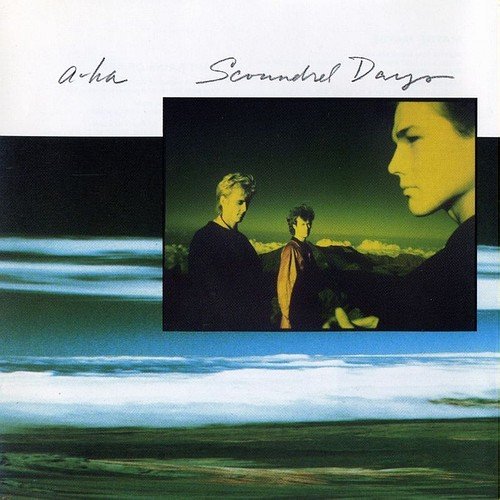
A-HA Scoundrel Days (1986)

A-HA were perceived as a teenybop group in their heyday, but their Nordic melancholic depth was apparent even on their only UK No1 ‘The Sun Always Shines On TV’. “Cut my wrist on a bad thought” is a superb piece of second language expression that no native speaker could have come up with. Morten Harket veers from a semi-spoken growl to a full voice salvo for the terrific chorus while Pål Waaktaar’s twanginess adds some edge to Magne Furuholmen’s glacial synthetic atmospheres.

Available on the A-HA album ‘Scoundrel Days’ via WEA Records

http://a-ha.com/


PET SHOP BOYS Tonight Is Forever (1986)

Mistakenly announced as a new single on ‘The Tube’, ‘Tonight Is Forever’ is one of Neil Tennant and Chris Lowe’s best early compositions. From its blipping intro with an odd starting snare drum to the magnificently euphoric chorus, it captured the excitement of a fleeting romance on a night out in clubland. With its sombre synth brass riff and a wonderful middle eight, it was later covered by Liza Minelli in an orchestral arrangement for her PET SHOP BOYS produced album ‘Results’.

Available on the PET SHOP BOYS album ‘Please’ via EMI Records

http://www.petshopboys.co.uk/


NEW ORDER Mr Disco (1989)

‘Your Silent Face’ may be one of NEW ORDER’s best songs, but it was unlikely to have got radio play as a single with its “why don’t you p*ss off?” quip! Meanwhile, ‘Mr Disco’ was the club friendly Mancunians in their Italo prime, complete with holiday romance lyrics and tongue-in-cheek syndrums. Some fans were dismayed by its resemblance to PET SHOP BOYS, but Bernard Sumner went and founded ELECTRONIC, aided and abetted by Messrs Tennant and Lowe!

Available on the NEW ORDER album ‘Technique’ via WEA Records

http://www.neworder.com/


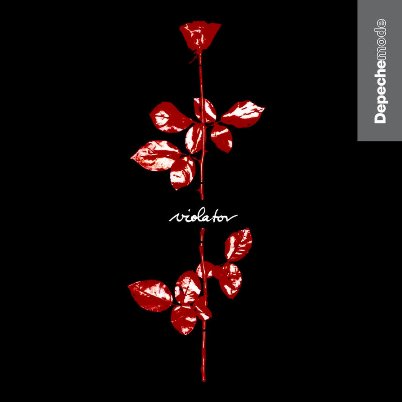
DEPECHE MODE Halo (1990)

One of DEPECHE MODE’s greatest moments, Alan Wilder said: “From memory, the drums were sampled from LED ZEPPELIN’s ‘When the Levee Breaks’ (but secondhand from a rap record)… For the end choruses, there are some string samples which I think were derived from Elgar. One of my techniques is to find sections of classical strings and transpose / stretch these, then add my own samples, in order to formulate new and unusual arrangements”.

Available on the DEPECHE MODE album ‘Violator’ via Mute Records

http://www.depechemode.com/


ELEKTRIC MUSIC Kissing The Machine (1993)

Undoubtedly, ‘Kissing The Machine’ is Andy McCluskey’s finest song without Paul Humphreys as an OMD band mate. It also featured one of Karl Bartos’ greatest melodies. Recorded for his first project after leaving KRAFTWERK, Karl Bartos said “He suggested we do something together and I was up for it… We picked some cassettes and finally I found the opening notes of ‘Kissing The Machine’. A month later he sent me a demo…He wrote the whole song and the lyric and the robo voice” 

Available on the ELEKTRIC MUSIC album ‘Esperanto’ via SPV Records

http://www.karlbartos.com/


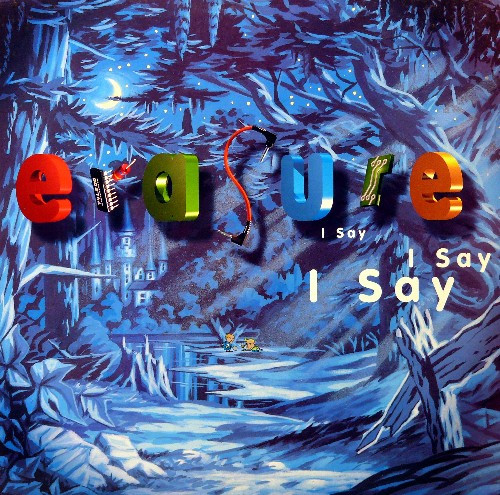
ERASURE Because You’re So Sweet (1994)

The closing track on the ‘I Say I Say I Say’ album produced by HEAVEN 17 and BEF’s Martyn Ware, ‘Because You’re So Sweet’ was a pretty ballad representative of the maturer approach taken by Andy Bell and Vince Clarke for their seventh long player. Featuring ERASURE’s trademark sequences, there was also the self-imposed restriction of no drum machines being used, so that all the album’s percussive templates were created using synths and driven by sequencers.

Available on the ERASURE album ‘I Say I Say I Say’ via Mute Records

http://www.erasureinfo.com/


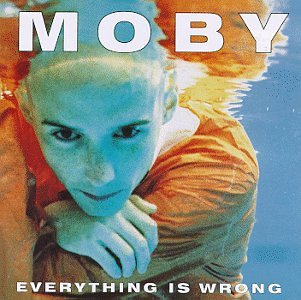
MOBY First Cool Hive (1997)

There were eight singles from 1999’s ‘Play’ but for 1995’s ‘Everything Is Wrong’, Mute Records were more restrained with just five! Surprisingly, this vivid instrumental missed out on singular distribution. One of the highlights from the genre hopping MOBY long player, the looping bass sample of ‘First Cool Hive’ was like an update of ‘Empires & Dance’ era SIMPLE MINDS while female voice samples and beautiful synth strings gave it a mysterious ENIGMA-tic touch.

Available on the MOBY album ‘Everything Is Wrong’ via Mute Records

http://www.moby.com/


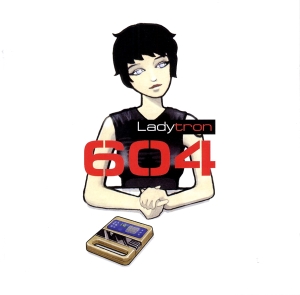
LADYTRON Discotraxx (2001)

‘Mu-tron’ may have opened the LADYTRON  debut album ‘604’ but the pulsating salvo at the start of ‘Discotraxx’ signalled the album’s intent… the return of the synthesizer as an instrument of value and integrity, not as a novelty to mock the past. From the moment Mira Aroyo deadpans in Bulgarian and Helen Marnie’s sweet but resigned voice kicks in about “the boy I know”, a new dawn is heralding for electronic pop.

Available on the LADYTRON album ‘604’ via Nettwerk Records

http://www.ladytron.com/


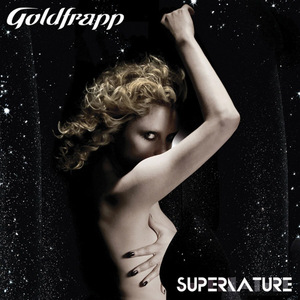
GOLDFRAPP Lovely 2 C U (2005)

The surreal concept was Kate Bush does THE HUMAN LEAGUE on this buzzy percussive extravaganza, one of the more under rated songs in Alison Goldfrapp and Will Gregory’s canon. The sub-TOM TOM CLUB meets PRINCE electrofunk is aided by Charlie Jones’ treated bass runs over the zooming synth hooks and chunky riffs. Interestingly despite its immediacy or maybe because of it, ‘Lovely 2 C U’ has rarely made it into the GOLDFRAPP live set.

Available on the GOLDFRAPP album ‘Supernature’ via Mute Records

http://goldfrapp.com/


Text by Chi Ming Lai
28th February 2014

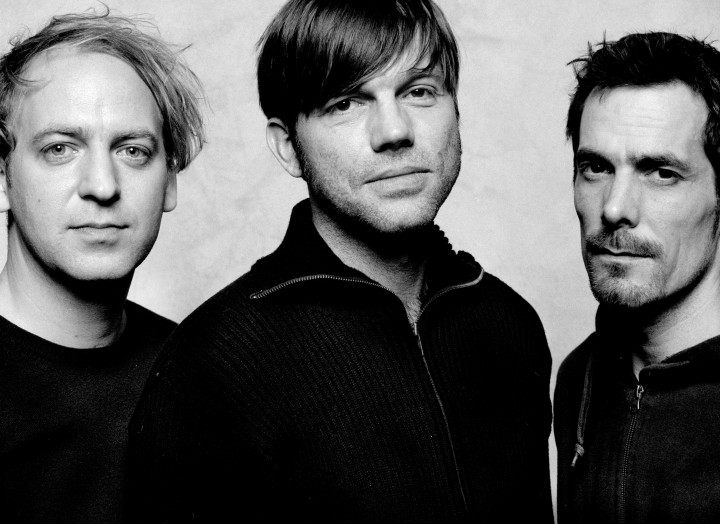
CAMOUFLAGE The Box 1983-2013

Photo by Heike Hilgendorff

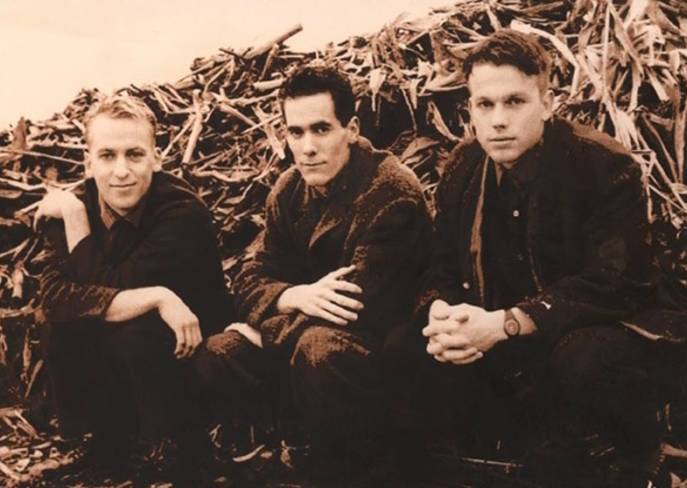
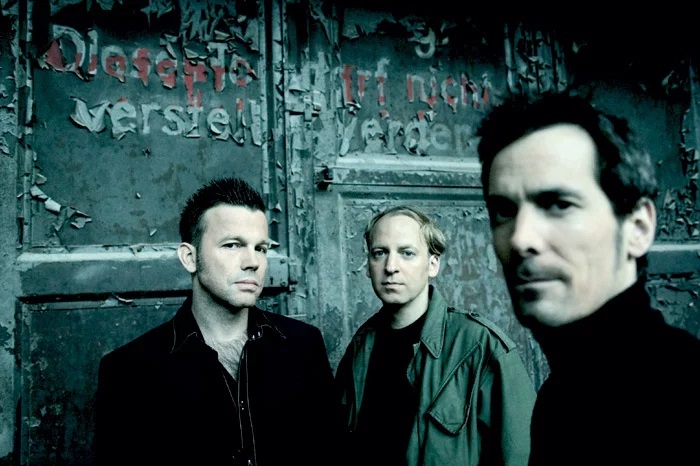
German synthpop veterans CAMOUFLAGE are to release a 10CD boxed set containing all seven of their albums plus archive and rare material tracing their output from 1983 to the present day.

When ELECTRICITYCLUB.CO.UK first heard one of their best known songs ‘The Great Commandment’ in a Hong Kong night club during the summer of 1989, it was mistaken for being a DEPECHE MODE B-side.

After a period of frantically buying DM singles to find this mystery track without any success, it was only several years later while visiting Braunschweig in Germany that ELECTRICITYCLUB.CO.UK learnt that it was actually by this talented trio from Bietigheim-Bissingen. Heiko Maile, Marcus Meyn and Oliver Kreyssig met through a shared interest in KRAFTWERK, ULTRAVOX, YELLOW MAGIC ORCHESTRA and DEPECHE MODE; it was natural they would start making electronic music together.

Naming themselves after a YELLOW MAGIC ORCHESTRA song and taking their template from DEPECHE MODE’s ‘Some Great Reward’, CAMOUFLAGE developed on the industrial flavoured synthpop of ‘Master & Servant’ and ‘People Are People’ which the Basildon boys had all but abandoned from ‘Black Celebration’ onwards.

In today’s world, DEPECHE MODE influenced acts are common place but in 1987, this was highly unusual. But despite first impressions, CAMOUFLAGE had their own style, taking in more traditional melodies in the vein of KRAFTWERK which in turn were rooted to European folk and classical music. Vocally, Marcus Meyn was more like an accented Martin Gore. Preferring to sing in English, their naïve second language charm, both phonetically and lyrically, gave them a cautiously optimistic demeanour compared to the pessimistic realism of DEPECHE MODE.

CAMOUFLAGE’s debut album ‘Voices & Images’ on Metronome Records was an impressive first salvo. As well as ‘The Great Commandment’ (probably the best single DM never recorded), there was the rousingly anthemic ‘Strangers Thoughts’, the epically building ‘That Smiling Face’ and the beautifully fragile ‘Where Has The Childhood Gone’.

One aspect of CAMOUFLAGE that made them quite distinct from DEPECHE MODE was their use of detuned pentatonics as heard on ‘Winner Takes Nothing’. An obvious throwback from their love of YELLOW MAGIC ORCHESTRA, this was to manifest itself into CAMOUFLAGE’s later first phase work as they became less Modal.

With ‘The Great Commandment’ being a hit in Europe and the US (although not in the UK which by now had grown out of synthpop and was in the throws of the acid house revolution), the pressure was on for a follow-up hit. This came in the shape of the more Eurocentric ‘Love Is A Shield’. An even bigger hit in Europe than ‘The Great Commandment’, this co-write with Peter Godwin sounded more BRONSKI BEAT than DEPECHE MODE and further established CAMOUFLAGE’s reputation.

Employing Dan Lacksman of Belgian synth pioneers TELEX as primary producer, the parent long player ‘Methods Of Silence’ included an expanded instrumental palette featuring strings, woodwinds and more real instruments, but was less satisfying overall than ‘Voices & Images’. It also probably suffered from eventual comparison at the time with ‘Violator’, still regarded as one of DEPECHE MODE’s most accomplished albums.
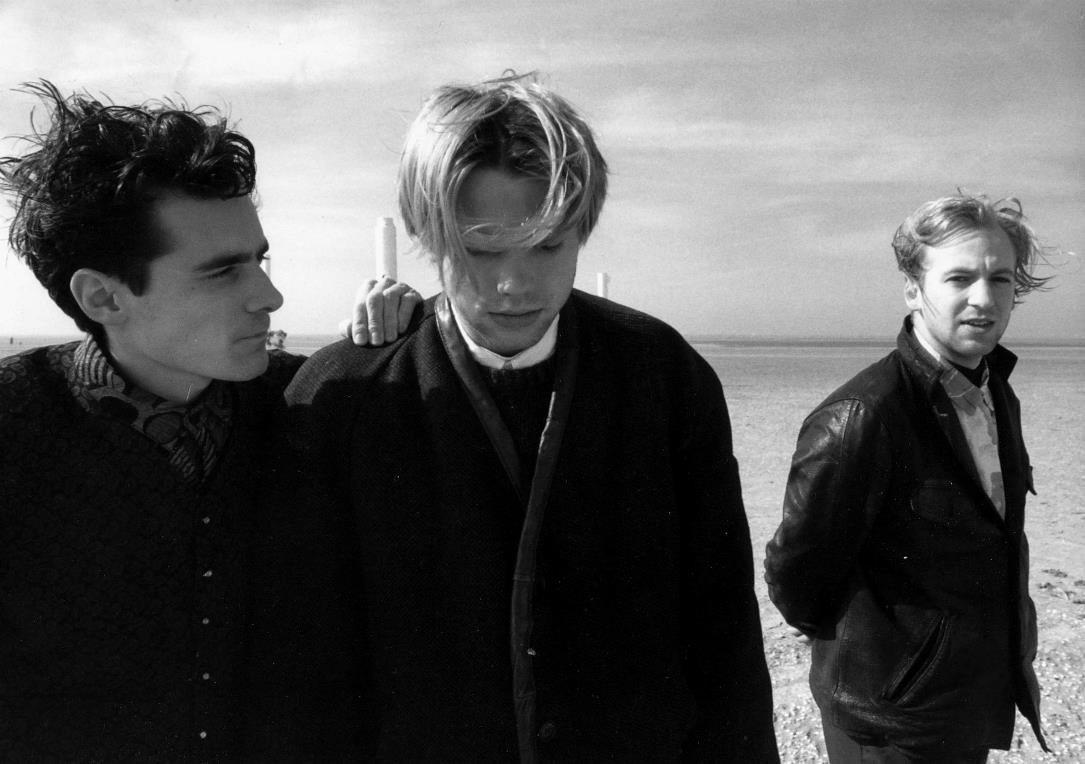
Although the album yielded a further European hit with the oriental sounding ‘One Fine Day’ and the band completed a sold-out tour of Europe, their success proved to be too much for Oliver Kreyssig who left the band for personal reasons.

Photo by Walter Cymbal

The void left the remaining duo of Meyn and Maile to ponder their future direction. Working with DURAN DURAN and HUMAN LEAGUE producer Colin Thurston, they recorded the more conventional ‘Meanwhile’. Featuring live percussion and more guitars, the album was not embraced by CAMOUFLAGE’s fans.

The pair refound their synth roots with the 1992 AREU AREU covers side-project featuring versions of songs by FAD GADGET, HEAVEN 17, DEPECHE MODE and THE CURE. The busman’s holiday led to the return to form of ‘Bodega Bohemia’ in 1993. More focussed and electronic than its predecessor, this was CAMOUFLAGE’s strongest work since ‘Voices & Images’. As well as the marvellously trancey opener ‘Pedestrian’s Adventures’, there was the ‘Violator’-lite of ‘Suspicious Love’ and the epic 9 minute Sylvian-esque drama of ‘In Your Ivory Tower’.

Despite this artistic success, there were tensions with Metronome Records who had concentrated their resources on ACE OF BASE and failed to licence releases for ‘Bodega Bohemia’ outside of Germany.

As a result, the duo signed to BMG via its RCA imprint but 1995’s ‘Spice Crackers’ was unable to revive fortunes due to its esoteric nature, having been sourced from two shelved art based projects. However, the track ‘Kraft’ was one of its more memorable experiments while from the same period, the frantic electro rock ‘n’ roll cover of Moon Martin’s ‘Bad News’ was another highlight.

The duo took a hiatus but in 1999, CAMOUFLAGE announced their comeback with Oliver Kreyssig returning to the fold; they released a new single ‘Thief’. The resultant album ‘Sensor’ was held back until 2003 by assorted delays at parent label Polydor but was well worth the wait.

The lead single ‘Me & You’ with its blistering sub-Numan synth line sounded like what post-‘Violator’ DEPECHE MODE might have sounded like had the band stayed in Berlin and not ventured off to find The Blues! Meanwhile, the catchy ‘Perfect’ was looser but still electronic while ‘I Can’t Feel You’ could only have been a homage to Da Mode and was effectively an uptempo makeover of ‘The Things You Said’ from ‘Music For The Masses’.

Their seventh album ‘Relocated’ was released on SPV Records in 2006 and contained a number of great tracks including ‘We Are Lovers’, ‘Dreaming’ and ‘The Pleasure Remains’ to prove that CAMOUFLAGE were back for good. Since then, CAMOUFLAGE have been touring regularly and the forthcoming ‘Greyscale’ album is soon to be released.

Photo by Klaus Mellenthin

‘The Box 1983-2013’ is a fitting way to draw attention to the back catalogue of CAMOUFLAGE which over 30 years has seen some of the best electronic pop produced from Germany outside of KRAFTWERK. Indeed, their B-side ‘Kling Klang’ and live cover of ‘Computerliebe’ are fine indicators of that lineage.

Within in the box set, there is also the inclusion of the AREU AREU EP plus a version of TALK TALK’s ‘Today’ recorded in 1989 on the ‘Archive#2 Live Recordings’ disc. This wealth of rare archive and concert material will satisfy their loyal following the world over.

Photo by Mathias Bothor

Recommended listening to those new to CAMOUFLAGE:

The Great Commandment
That Smiling Face
Neighbours
Winner Takes Nothing
Strangers Thoughts
Where Has The Childhood Gone
Music For Ballerinas
Love Is A Shield
Kling Klang
Pedestrian’s Adventures
Suspicious Love
In Your Ivory Tower
Bad News
Kraft
Me & You
Perfect
I Can’t Feel You
We Are Lovers
The Pleasure Remains
Dreaming


‘The Box 1983-2013’ is released by Bureau B and Tapete Records on 8th February 2014, limited to 1000 signed and numbered copies

CAMOUFLAGE’s albums such as ‘Voices & Images’, ‘Methods Of Silence’, ‘Bodega Bohemia’, ‘Sensor’ and ‘Relocated’ are available separately via the usual online outlets

For the more cautious purchaser, there is the compilation ‘Rewind :The Best of 95-87’

http://www.camouflage-music.com/en/News

https://www.facebook.com/camouflagemusic

https://twitter.com/CamouflageNews

https://www.instagram.com/camouflagemusic/

https://open.spotify.com/artist/2YTbBGa3Tf2rRPhiJxWoUN


Text by Chi Ming Lai
28th December 2013

2013 END OF YEAR REVIEW

The Correct Use Of VCOs

The year started appropriately enough with an electronic number ‘2013’ by Belgian duo METROLAND.

For the first six or seven months of 2013, it proved to be one of the most productive periods in electronic pop music. Not since the Autumn of 1981 when had so many significant releases coincided. It was strangely quality and quantity, a rare occurance in modern times for music, especially of the synth propelled variety.

That time saw THE HUMAN LEAGUE ‘Dare’, GARY NUMAN ‘Dance’, ULTRAVOX ‘Rage In Eden’, DEPECHE MODE ‘Speak & Spell’, SOFT CELL ‘Non-Stop Erotic Cabaret’, HEAVEN 17 ‘Penthouse & Pavement’, SIMPLE MINDS ‘Sons & Fascination’, NEW ORDER ‘Movement’, JAPAN ‘Tin Drum’ and OMD ‘Architecture & Morality’ all coming out within weeks of each other!

Interestingly from that list, only JAPAN and SOFT CELL are missing as currently performing entities although Marc ALmond himself made a number of concert and theatrical appearances during the year.

OMD got back to their Kling Klang roots with their best album in 30 years entitled ‘English Electric’. Although enthusiasts of the band’s pioneering work were satisfied, fans of OMD’s pop phase were confused as to why Andy McCluskey and Paul Humphreys had recorded an electronic album influenced by KRAFTWERK! This was an indicator of how the band have mutated and been perceived over the years.

But that was nothing compared with DEPECHE MODE whose single ‘Soothe My Soul’ was remixed by ZZ TOP’s Billy F Gibbons… although recognisably reworked, listeners could barely notice the join, thus fully confirming DM’s development into the world’s premiere stadium electro blues combo. Their album ‘Delta Machine’ was a big improvement on 2009’s ‘Sounds Of The Universe’, but it was no ‘English Electric’.

Among the other evergreens with new long players in 2013 were PET SHOP BOYS, BEF and Alison Moyet. Messrs Tennant and Lowe finally worked with the ubiquitous Stuart Price to produce an album that was ‘Electric’ by name and electric by nature. Meanwhile Moyet found her most musically compatible partner since Vince Clarke in Guy Sigsworth for the stunning return to form of ‘the minutes’.

Over at BEF, Martyn Ware assembled his most impressive cast of guest vocalists yet including ERASURE’s Andy Bell and CULTURE CLUB’s Boy George for the third volume of the ‘Music Of Quality & Distinction’ covers series; subtitled ‘Dark’, it featured some of Ware’s most starkly electronic work since he was in THE HUMAN LEAGUE.

Another welcome return came from electronic disco pioneer Giorgio Moroder. The icon is now 73 years old yet with his stomping track ‘Racer’, he proved could mix it with all the young pretenders. Indeed, his autobiographical contribution to DAFT PUNK’s tribute ‘Giorgio By Moroder’ reflected the respect and admiration he holds within the dance world.

Although only a few years younger, KRAFTWERK’s Ralf Hütter showed no real signs of moving his iconic brand forward despite the 3D spectacle of ‘Der Katalog 1 2 3 4 5 6 7 8’ live retrospectives in Düsseldorf, London, Tokyo and Sydney. With the various hosting art spaces still seeing their ticketing systems collapse, was this really just an elaborate publicity stunt? After all, how many heritage acts get on the news for sending websites into meltdown?

It certainly didn’t do KRAFTWERK any harm as a headlining slot at Latitude Festival and its resultant BBC TV coverage proved. However, new material was still not forthcoming but such is the demand that several unscrupulous eBay dealers in Russia were passing off CD-Rs of three tracks from METROLAND’s 2012 album ‘Mind The Gap’ as KRAFTWERK demos! Meanwhile, former colleague Karl Bartos exorcised his Kling Klang ghost with ‘Off The Record’, a collection of his unreleased KRAFTWERK-era compositions which made a fine companion to OMD’s ‘English Electric’; his upcoming 2014 world tour is eagerly anticipated.

ULTRAVOX opened for SIMPLE MINDS but with Midge Ure spending most of the year doing the rounds with solo acoustic gigs, their synth lynchpin Billy Currie released his ninth solo offering ‘Balletic Transcend’. Meanwhile in a revival of a project that both had been involved in, a fragmented VISAGE unleashed their first album in nearly 30 years to a mixed reception.

With just Steve Strange remaining from the original line-up, ‘Hearts & Knives’ was essentially a solo project. There were heated exchanges on social networks between Strange and his estranged Blitz Club partner Rusty Egan about misappropriated royalties and the validity of the reconfigured brand. Whatever, the raw video recording of the new VISAGE performing ‘Fade To Grey’ live at London’s Hoxton Bar and Kitchen stood as possibly the most embarrassing moment of the year.

Artists who made their name during Electroclash such as ADULT. and MISS KITTIN made welcome returns in 2013 while also from that era, LADYTRON’s Helen Marnie released her first solo offering ‘Crystal World’ crowd funded via Pledge Music. It was a novel but effective way of securing a promotional budget that involved fans in the process by offering exclusive updates and an opportunity to purchase exclusive memorabilia. In MARNIE’s case, items on sale ranged from hand written lyric sheets to her Mini-Cooper and a bikini!

Meanwhile, former SNEAKER PIMPS sparring partners IAMX and Kelli Ali also went down the Pledge Music route, pointing the way forward to a music industry future without interference from record label middle men. But the failure of several crowd funding campaigns proved the model was not for everyone.

The Britpop era was not particularly known for its use of electronics but two acts who did indulge, REPUBLICA and DUBSTAR, made formal comebacks on the live circuit in 2013. Seeded from around the same time, Bristol’s MESH made possibly their best album yet in ‘Automation Baby’. Celebrating 30 years in the business, techno icon WESTBAM assembled a diverse cast including Iggy Pop, Lil’ Wayne, Hugh Cornwall, Bernard Sumner and Richard Butler for an intriguing set called ‘Götterstrasse’. It was the surprise electronic release of the year.

There were also sophomore albums from LITTLE BOOTS, HURTS and AUSTRA which all drew muted responses from fans following their well received debuts; the promising spark had been present in all three acts appeared to have faded although each album had strong highlights. But there were impressive debuts in 2013 by GHOST CAPSULES, COLLINS and MODOVAR; and all this happened before the summer had started!

On the more guitar driven end of the spectrum, NIGHT ENGINE pursued an art rock aesthetic that would have made Berlin-era DAVID BOWIE proud. And of course, The Dame himself returned with ‘The Next Day’ headed by the touchingly reflective ‘Where Are We Now?’. Adopting a more post-punk attitude, GIRL ONE & THE GREASE GUNS showed how battered synths, clanky guitars and motorik drums could still come together in perfect harmony while maintaining an air of mystery.

Meanwhile, WHITE LIES continued their New wave odyssey into how THE TEARDROP EXPLODES would have sounded had Julian Cope not got upset by BLANCMANGE’s ‘Happy Families’; they even borrowed a snatch of ‘Fade To Grey’ for the title track of their third album ‘Big TV’. This was despite the mainstream music media’s attempt to downplay their use of synths although the band countered that by declaring TEARS FOR FEARS, TALK TALK and THE BLUE NILE as kindred spirits rather than INTERPOL or EDITORS.

The second half of the year brought the much anticipated debut from CHVRCHES entitled ‘The Bones Of What You Believe’. The trio have moved the goalposts as far as modern synthpop is concerned but they were not without their flaws such as the inexplicable decision to use dreary indie-styled male lead vocals on a pair of tracks. But despite this, with sold out club tours, gigs supporting DEPECHE MODE in Europe and the might of Virgin Records behind them, world domination surely beckons and with it, a new raised profile for the synthesizer overall.

Virgin Records themselves celebrated 40 years in the business with a series of London concerts and its legacy in electronic music was represented by CHVRCHES, HEAVEN 17, SCRITTI POLITTI and SIMPLE MINDS. Although the label is now owned by the Universal Corporation (having been under the control of EMI since 1992), its colourful history remains associated with the championing of new and unconventional music forms during its fledgling years.

And in a diversion from music, one-time Virgin signee Thomas Dolby produced and directed ‘The Invisible Lighthouse’, a documentary on a monument local to his childhood home. In a novel style of presentation, the film went on a tour accompanied by a live narration and soundtrack from TMDR with some of his songs dispersed in between.

Gary Numan’s long delayed ‘Splinter (Songs From A Broken Mind)’ finally became a reality. A move to LA relaxed him to the point where he was posting his holiday photos on Twitter! Musically though, he was as intense as ever but luckily, ‘Splinter’ was not the one dimensional riff monster that had been threatened and contained some of his best work in over ten years. Interestingly NINE INCH NAILS, who have been a major influence on Numan and vice versa, also returned after a period of absence with ‘Hesitation Marks’.

Over at Mute, there was another Sorcerer versus Apprentice battle when GOLDFRAPP and Polly Scattergood both released new records in the same month. Now no longer on Mute but very much still part of the extended family, MOBY released the impressive ‘Innocents’ which didn’t tinker too much with his well established formula and included a great collaboration with Wayne Coyne of FLAMING LIPS that sounded like Gary Numan in a Pentecostal church!

In 2013, North America appeared to be turning into a new haven for synth talent. There was LA pop duo NIGHT CLUB while also based in the region, SOFT METALS continued their Detroit Techno inspired progression with ‘Lenses’. Slightly eastwards, Texan based FEATHERS made an impressive statement with their debut long player ‘If All Now Here’; a European tour supporting DEPECHE MODE in January 2014 was fine recognition of their talent.

Fellow Texans ELEVEN:ELEVEN finally got their debut album ‘Through The Veil’ out too. New Yorkers HOLY GHOST! sprung the enjoyable electronic disco of ‘Dynamics’ while also from the area, AU REVOIR SIMONE returned with their fourth album ‘Move In Spectrums’ after an extended break.

But one slow burning combo were Canada’s TR/ST; led by the enigmatic and moody Robert Alfons, at times he sounded like a young LEONARD COHEN updating the sleazy demeanour of SOFT CELL. They toured extensively and garnered some more well deserved attention for their grower of a debut ‘Trst’ which actually came out back in January 2012!

However, all the good work was undone by a ticket lottery fiasco for an end of year London gig in which unsuccessful applicants were not notified until three hours before the concert, this despite communications to the contrary telling people to arrive at the door with ID. In this ever more challenging music industry, artists have to be innovative with promotion. But restricting availability and tricking fans into what was effectively a marketing scam for a larger London concert in May 2014 only alienated audiences.

Like in previous years, Europe was again a centre of creativity. Athens based synth maidens MARSHEAUX were back with their maturer fourth album ‘Inhale’. Meanwhile, their production team FOTONOVELA gathered DUBSTAR’s Sarah Blackwood, MIRRORS’ James New, KID MOXIE and SECTION 25’s Bethany Cassidy for ‘A Ton Of Love’ while riding on a crest of a wave from ‘Helen Of Troy’, their acclaimed collaboration with OMD. The song ‘Our Sorrow’ featuring James New turned out to be particularly poignant as after a year of minimal activity, MIRRORS called it a day.

From their Berlin HQ, NOBLESSE OBLIGE delivered an ‘Affair Of The Heart’ with its stark funereal cover of ‘Hotel California’ while Slovenian trio TORUL impressed audiences opening for MESH. Still fiercely independent and uncompromising, THE KNIFE divided opinion with their performance art presentation of their experimental double opus ‘Shaking The Habitual’. From Demark, TRENTEMØLLER delivered his third album ‘Lost’, an adventurous blend of real and electronic instruments that more than proved his suitability as a future prospective DEPECHE MODE producer.

With the critical acclaim still resonant for her 2012 album ‘Highwire Poetry’, Karin Park continued to tour the world but found time to co-write Norway’s Eurovision entry ‘I Feed You My Love’. Sung by Margaret Beger and leftfield by pure pop standards, it came a respectable fourth but predictably, the UK gave it nul points! Following their wonderful eponymous debut album in 2012, SIN COS TAN swiftly followed it up with the more organic but still synth friendly ‘Afterlife’.

Never one to sit still, the duo’s Jori Hulkkonen also released an EP ‘European Splendour’ with John Foxx which sounded every bit as good as its title. Foxx didn’t sit still either and collaborated with THE BELBURY CIRCLE while also curating a covers EP of his own songs featuring GAZELLE TWIN and I SPEAK MACHINE. Back in the UK, ANALOG ANGEL, AUTOMATIC WRITINGGAPTOOTH and MAPS flew the flag for the domestic scene.

But best of the local crew though were VILE ELECTRODES; they snagged a prestigious support tour with OMD in Germany where the local crowds connected with Anais Neon and Martin Swan’s analogue electricity and opened for John Foxx in Brighton on their return. Their long awaited debut LP ‘The future through a lens’ did not disappoint and from it, the closer ‘Deep Red’ was easily the best OMD song that Humphreys and McCluskey never recorded.

As with last year, attempts were made within the industry to centralise electronic pop and dance music. But as the cancellation of the Playground Festival due to poor ticket sales proved, the two factions do not mix. Scheduled to appear on the Saturday, despite the technological influence of Gary Numan, John Foxx and Wolfgang Flür on the dance scene, the fans of those artists generally loathe the lifestyle and attitude of club culture.

Most just want to see the headline act and go home… the idea of paying an extra premium on the ticket price for a couple of DJs tagged on the see out the early hours of the morning simply doesn’t appeal! And those who are there for the DJs and larging it certainly aren’t interested in live bands. The sooner promoters and record labels realise that electronic pop and dance music are NOT the same thing, the better. That said, it was a difficult time for live events generally with a number of name acts playing to half full venues.

Elsewhere, the music press were on the backfoot with rumours that the once mighty Q Magazine and NME were in trouble. But lazy journalism and lack of adventure by both were as much to blame as any proliferation of the internet or smart technology. That aside, 2013 was a superb year where the music spoke for itself. Many of the veterans gave the best up-and-coming artists a real run for their money. And while the amount of new electronic music was at an all time high and the finest exponents rewarded with assorted high-profile opportunities as a result, a number of lesser accomplished acts suffered from the comparison with the best.

Helen Marnie said: “I think it’s great that electronic music is on a high right now but it’s so saturated as well. Everyone’s going it’s great cos it’s electronic and I’m like ‘I’m not so sure’… but there’s lots of good stuff”. In fact, the standard was so high in 2013 that some of the acts who ELECTRICITYCLUB.CO.UK featured in 2012 probably wouldn’t have got a look in this year. From those who sounded like the middling bands featured on the Janice Long Show circa 1985 to 21st Century synthpop reincarnations of HUE & CRY, the volume of music available in many ways made it quite easy to distinguish the excellent from the pleasant but ordinary material that was, as the dreaded ‘Say Nothing Auntie Of Landfill Indie’ Jo Whiley would say, “alright”!

ELECTRICITYCLUB.CO.UK accepts the continuing mission to maintain a degree of quality control in 2014 as it has done since its inception. As @TheRobMo put it on Twitter: “gatekeepers / tastemakers… it’s what we go to you for”. Meanwhile on the site’s Facebook, regular reader Brian O’Malley correctly added: “Not all synth music is great, and not all guitar music is rubbish”.

But the final word on 2013 must go to BEF and Glenn Gregory (or HEAVEN 17 if you prefer) via their electronic cover of an Ervin Drake song made famous by Ol’ Blue Eyes: “And it poured sweet and clear… it was a very good year”


ELECTRICITYCLUB.CO.UK Contributor Listings of 2013

PAUL BODDY

Best Album: MAPS Vicissitude
Best Song: MAPS Built To Last (Free School Remix)
Best Gig: ALISON MOYET at London Royal Festival Hall
Best Video: HOLY GHOST! Dumb Disco Ideas
Most Promising New Act: JUVENILES


STEVE GRAY

Best Album: CHVRCHES The Bones Of What You Believe
Best Song: MARGARET BERGER I Feed You My Love
Best Gig: BAS 2013
Best Video: IAMX I Come With Knives
Most Promising New Act: TORUL


CHI MING LAI

Best Album: OMD English Electric
Best Song: FOTONOVELA feat MIRRORS Our Sorrow
Best Gig: OMD + VILE ELECTRODES at Cologne E-Werk
Best Video: FEATHERS Land Of The Innocent
Most Promising New Act: FEATHERS


SOPHIE NILSSON

Best Album: ALISON MOYET the minutes
Best Song: SPACEBUOY Breathe
Best Gig: DEPECHE MODE at Copenhagen Parken
Best Video: DEPECHE MODE Soothe My Soul
Most Promising New Act: CHVRCHES


RICHARD PRICE

Best Album: PET SHOP BOYS Electric
Best Song: OMD Dresden
Best Gig: KARIN PARK at The Lexington
Best Video: MONARCHY featuring DITA VON TEESE Disintegration
Most Promising New Act: CHVRCHES


Text by Chi Ming Lai
12th December 2013

« Older posts Newer posts »