“I don’t like country & western, I don’t like rock music… I don’t like rockabilly! I don’t like much really do I? But what I do like, I love passionately!!”: CHRIS LOWE
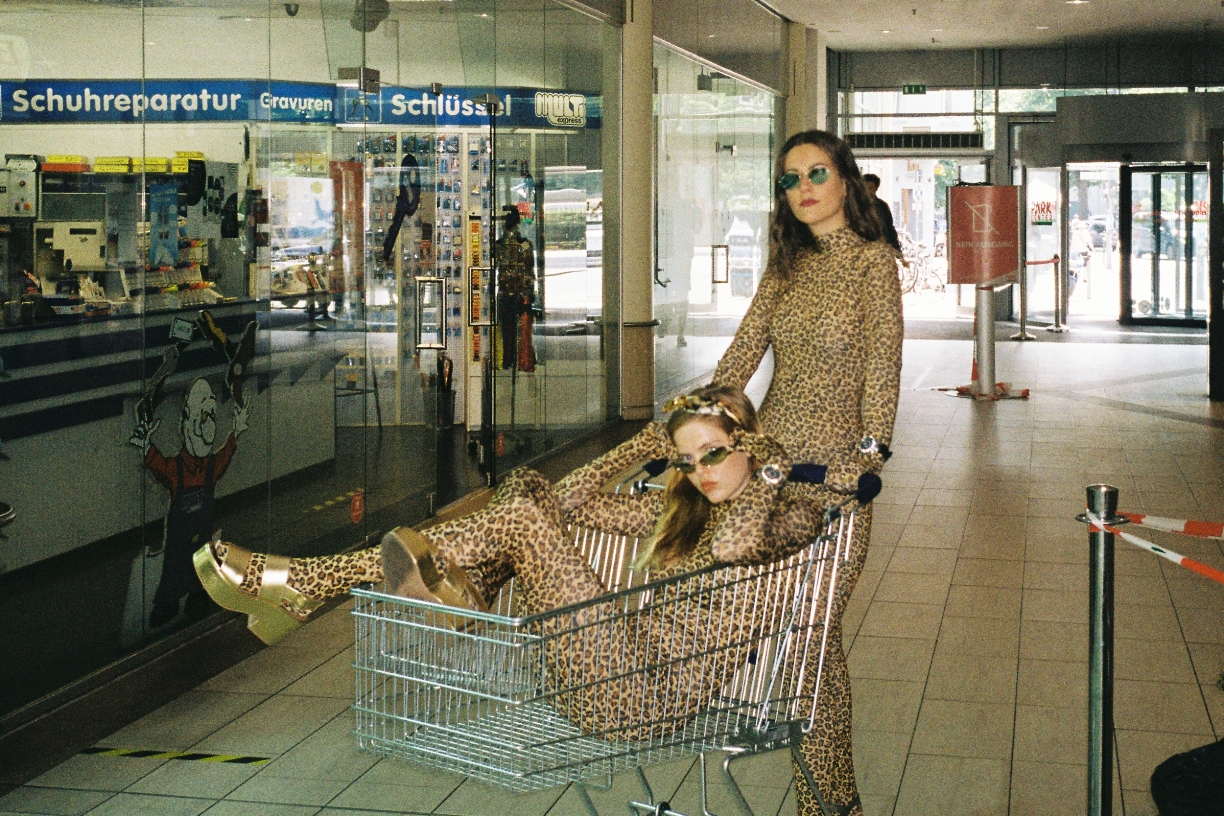
While the work of FARAO and SPECIAL-K can be more artful, considered and melancholic to most ears, the two ladies respectfully behind those projects, Kari Jahnsen and Katrín Helga Andrésdóttir, provide a bit of sunshine in these stranger times by having some cheeky fun as ULTRAFLEX.
Originally commissioned as a live concept, Jahnsen and Andrésdóttir have combined Olympic Nordic skiing, Soviet fitness videos and electronic disco to come up with a pop group that fashionista Lotta Volkova would surely have manufactured had she wanted to become a music Svengali. Perhaps unusually for a band, the pair met when Andrésdóttir’s father dated Jahnsen’s mother. ULTRAFLEX have described their debut album as “an ode to exercise, loaded with sex metaphors badly disguised as sports descriptions”. It is fair to say that the duo have an appetite for seduction.
It all begins with an electro-sexy declaration to ‘Get Fit’, but the girls state that “the message is for you to interpret, is it a critique on the societal pressure to be fit – or a motivational anthem, or perhaps both?”
Asking listeners to “1-2-3-BREATHE!”, ‘Work Out Tonight’ plays with some funky energetic synthbass and disco machine rhythms with lashings of cowbell before climaxing with a saucy dialogue between a man Jae Tyler and a woman as he accidental wanders into her dressing room…
Pitch shifting their vocals for effect and adding slinky sax from Tumi Árnason, the primarily instrumental ‘Papaya’ possesses a sun-kissed groove. Meanwhile ‘Never Forget My Baby’ is more laid back, sitting on a hypnotic off-beat with a gorgeous dual vocal expressing desire as a vintage digital slapped bass solo occupies the middle eight. The digital slapped bass returns on ‘Man U Sheets’ which then get switched to a squelchier variant as the girls get all breathy and sweaty like a Nordic MARSHEAUX gone electro jazz funk with all the vibey trimmings.
Inspired by TV sports montages, ‘Olympic Sweat’ was ULTRAFLEX’s calling card and remains as exquisite as when it premiered in the summer, a dreamy instrumental blend of PET SHOP BOYS, NEW ORDER and SIN COS TAN.
Coming over like Australian duo CONFIDENCE MAN’s ‘Try Your Luck’, the self-explanatory ‘Full of Lust’ is all girly come-ons and amorous panting, playfully raising temperatures while Jahnsen and Andrésdóttir go all LISA LISA & CULT JAM in the catchy chorus. The very Japanese Citypop soundscape betrays the song’s origins which ULTRAFLEX told ELECTRICITYCLUB.CO.UK “started when we made an electro version of our favourite Norwegian children’s song ‘Sure Sivert’ by Maj Britt Andersen. With her permission, we were allowed to use the melody from the original song as a synth solo that now comes in at the end”.
Closing with ‘Secret Lover’ by spinning off percussively into another funky synthbass backdrop recalling MANTRONIX, ULTRAFLEX said of their creative dynamic: “We are both workaholics who appreciate a good laugh and a lot of sarcasm. Kari is the beatmaker and synth master while Katrin delivers the poetic sass and visual excellence. Together we make the synthiverse and melodic framework. With our common goal being to have as much fun as possible, we’ve succeeded from day one. Yes, we both felt the need to stop being miserable and do something fun for a change.”
The debut ULTRAFLEX album is a wonderfully joyous listening experience which proves a lot of amusement can be had while still maintaining an artistic integrity.
Deliciously coy with naughty exercise double entendres, the partnership of Kari Jahnsen and Katrín Helga Andrésdóttir cannot help but draw smiles. It is just the tonic needed right now as a very strange and tense 2020 draws to a conclusion.
“You and me v tomorrow, living off joy and sorrow and the dreaming in our eyes, we keep our dreams alive…”
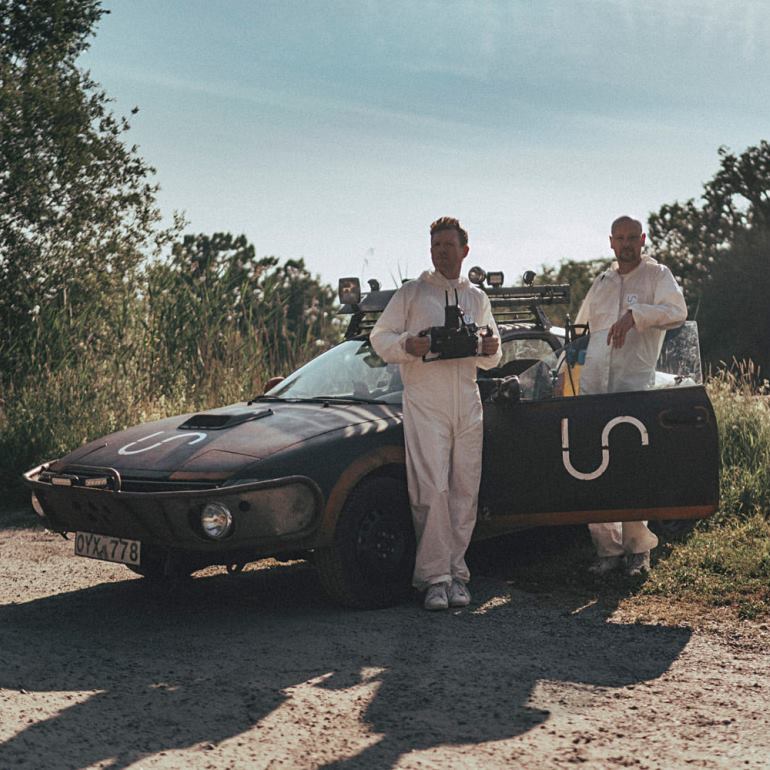
If there was a musical duo who visually symbolise the dystopian paranoia of the world pandemic crisis, then it is the protective boiler suit donning UNIFY SEPARATE.
Formally known as US, the Scottish Swedish pairing of Andrew Montgomery from GENEVA and Leo Josefsson of LOWE impressed with their 2019 debut album ‘First Contact’ which successfully combined the soaring vocal aspects of Britpop with the melodic melancholy of Nordic synth.
UNIFY SEPARATE have released their first single of 2020, the magnificently striking statement of ‘Solitude & I’. Like DEPECHE MODE meeting MUSE before building with some mighty synth arpeggios, it morphs from a drum ‘n’ bass lilt into a blistering mutant attack.
The tense self-directed video filmed by Tobias Andersson looks like it could be a scene from ‘The Crazies’ or ‘Chernobyl’. It sees our heroes on decontamination duty, driving their Gothically modified Toyota Celica called Angelica to a desolate forest quarry. Resigned to the disaster that has occurred, it all acts as poignant symbolism that the world is running out of time…
From the new album is due out in mid-2021, ‘Solitude & I’ is a natural progression of the Stockholm-based duo’s material on ‘First Contact’ with Montgomery not letting up with his Jeff Buckley inspired vocal delivery, reflecting the isolation and uncertain future many are currently feeling as “There’s nobody out there, no-one but you and I”.
Anthemic, uplifting and optimistic, it is UNIFY SEPARATE’s in-your-face manifesto on never giving up on your dreams.
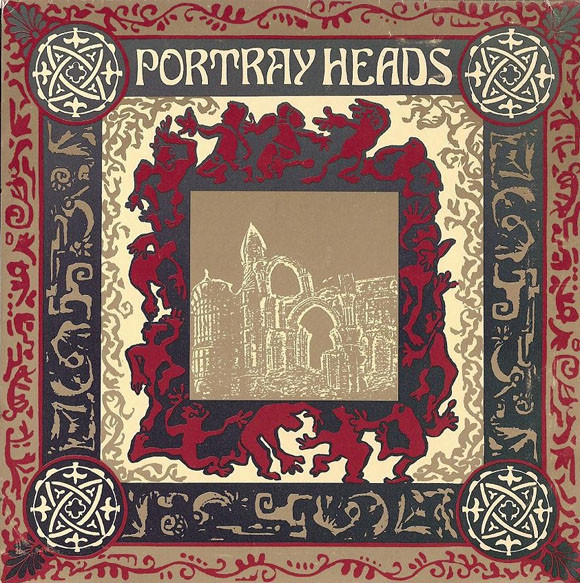
PORTRAY HEADS were from Matsuyama in Japan and their music is largely unknown, apart from in the collections of die-hard minimal synth enthusiasts.
The musical core of PORTRAY HEADS were Tohru Tomita and Mikiharu Doi who had solo bedroom project called ONANIE BAZOOKA, while the band began with Ayumi Tokunaga on lead vocals.
They only ever had two releases in their day, with the foundations of their myth and legend in underground electronic music built around a superb debut single ‘Elaborate Dummy’, issued rather obscurely on flexi-disc in 1985 by the now defunct Kageroh Records.
PORTRAY HEADS deserve their place in the synth pantheon for ‘Elaborate Dummy’ if nothing else, an exquisitely European sounding tune that was almost Gallic in tone with pulsating synths and electronic crashes, augmented by a spacey cacophony of bleeps and swirls.
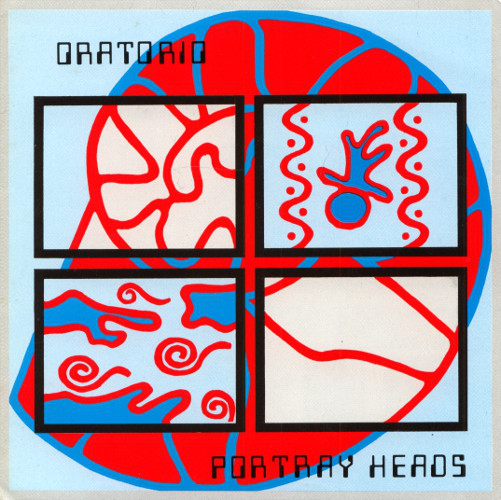
However, after ‘Elaborate Dummy’ was unleashed in Japan, Ayumi Tokunaga left PORTRAY HEADS and Yumi Ochi was recruited. Her more contralto delivery suited the reconfigured combo’s darker direction which they were heading in after the comparatively synthpop approach of ‘Elaborate Dummy’. Three tracks were released as the self-released cassette ‘Oratorio’ in 1986.
PORTRAY HEADS were based in a conservative and isolated city on an island many miles from the bright lights of Tokyo, so opportunities to perform live were rare and eventually they disbanded, never to be heard of again until now.
Minimal Wave Records and Bitter Lake Recordings together have compiled the five previously released tracks by PORTRAY HEADS and thanks to the two labels tracing Tohru Tomita, have appended them with demos featuring both Ayumi Tokunaga and Yumi Ochi (including five previously unheard songs) for a double vinyl LP collection.
It all begins naturally with ‘Elaborate Dummy’ and this cult classic is worth the purchase price alone, sounding better than ever, now remastered for solid vinyl and digital. But another jewel is ‘Watch Your Scope!’ which was the B-side and a perfect partner with its glorious arpeggios and analogue keys coming together in the quirky vein of MATHEMATICS MODERNES or VIENNA.
Following the departure of Ayumi Tokunaga, material from ‘Oratorio’ like ‘夢を夢に’ was more austere, thanks to Tohru Tomita’s use of bass guitar and the deeper tones of Yumi Ochi who opted for her vocal expression to be in Japanese. The highlight though was ‘浮かぶ·迷う·漂’う’, a fabulous exercise in art industrial coming over like IPPU DO meeting SPK during their Sinan Leong fronted phase.
Despite the title, ‘Industrial Eye’ was less so in approach, but still took on a doomy demeanour with an unsettlement that was undeniably less immediate than the Ayumi Tokunaga voiced period. Although eventually pressed on 7” vinyl, ‘Oratorio’ was more lo-fi, sounding like it was struggling to jump off its source tape and for many, this will be the appeal and charm listening in 2020, although others may find this aspect more challenging .
Appended with unreleased material featuring both vocalists, from the Ayumi Tokunaga period, the percolating ‘舞い上がれ’ still sounds French despite being in Japanese and although the electronic backdrop is appealing and exhibits potential, the live percussive clatter from fourth member Tatsuyuki Okiura proves to be a distraction. There’s also an Ayumi Tokunaga fronted demo of ‘Industrial Eye’ which adopts a higher pitched vocal range.
Meanwhile, ‘操り人形’ features a gloriously out-of-tune synth solo and the Middle Eastern flavoured ‘Generation Stor’ captures an interesting use of drum machine distortion on the kick to form a mutant bassline.
Although there are the typical octave shift driven dark disco experiments of the era, there were already indications of a move into the more leftfield territory of the Yumi Ochi phase, which is represented by three alternate versions of other tracks already on the compendium, all of which display the heavy melancholic resonances captured on ‘Oratorio’.
One noticeable observation is PORTRAY HEADS had much in common with the independent European electronic music from the Cold War era. After all, Japan had China, North Korea and the Soviet Union all within close proximity and those tensions were more than reflected.
35 years on, PORTRAY HEADS deserve recognition for their creative efforts alongside the big city projects like YELLOW MAGIC ORCHESTRA and their Alfa Records cohorts in the development of Japanese electronic pop. For their opening salvo of ‘Elaborate Dummy’ and ‘Watch Your Scope!’, PORTRAY HEADS are up there with the best of post-punk synth.
This release by Minimal Wave and Bitter Lake Recordings goes some way in providing another part of the jigsaw. While the sound quality is variable and actually got worse as the band moved into a form of proto-darkwave, what was not in doubt is their electronic punk spirit, even though it was short-lived.
Originally released on 20th November 1980, the deluxe cassette compilation ‘From Brussels With Love’ celebrates its 40th Anniversary.
Writing for NME, Paul Morley said at the time: “The arrival of this thin tape from Belgium provides a reminder – without really trying, without being obvious – that pop is the modern poetry, is the sharpest, shiniest collection of experiences, is always something new”.
It was the first proper music release on Les Disques du Crépuscule, a boutique Belgian label that emerged from Factory Benelux.
FBN was the European Low Countries wing of the iconic Manchester label that at the time was the home to JOY DIVISION, A CERTAIN RATIO, THE DURUTTI COLUMN and SECTION 25. It had primarily been set-up as an outlet for spare tracks by Factory Records acts and one of its later notable releases in Autumn 1981 was the 12 inch remix of NEW ORDER’s ‘Everything’s Gone Green’ which featured the non-album songs ‘Mesh’ and ‘Cries & Whispers’ on the B-side.
But from its inception with direction from head office, the Obscure Records influenced Les Disques du Crépuscule was to be a separate entity despite being run by the same Factory Benelux founding team of Michel Duval and Annik Honoré; the pair had established the Plan K venue in Brussels which hosted two JOY DIVISION concerts to establish the Manchester link.
‘From Brussels With Love’ was notable for featuring the first released recording by the three surviving members of JOY DIVISION following the sad passing of Ian Curtis before they adopted the name NEW ORDER; ‘Haystack’ was a collaboration with Leicester-born singer-songwriter Kevin Hewick. Conceived as a concert journal and curated by Duval, Honoré and radio show host / composer Wim Mertens, as well as a range of international avant-garde and new wave music, it contained modern classical work from Gavin Bryars and a then-unknown Michael Nyman.
There were also spoken segments including a poetry reading from THE SKIDS’ Ricard Jobson plus interviews with Brian Eno and Jeanne Moreau; the latter featured a beautiful piano background by Claude Coppens to accompany the words of the notable French actress, thus producing an art piece in its own right.
‘From Brussels With Love’ was diverse, varying from exquisite ivory pieces like ‘Children On The Hill’ by Harold Budd to ‘The Music Room’, a Frippish guitar noise experiment from JOY DIVISION producer Martin Hannett accompanied by a drum machine.
But of interest to electronic music enthusiasts were three exclusive jingles by John Foxx and an early rhythm machine backed take on ‘Airwaves’ by Thomas Dolby. Meanwhile from Europe, there was the doomy synth laden post punk on ‘Cat’ by THE NAMES and the quirky electronic Neue Deutsche Welle of DER PLAN’s ‘Mein Freunde’.
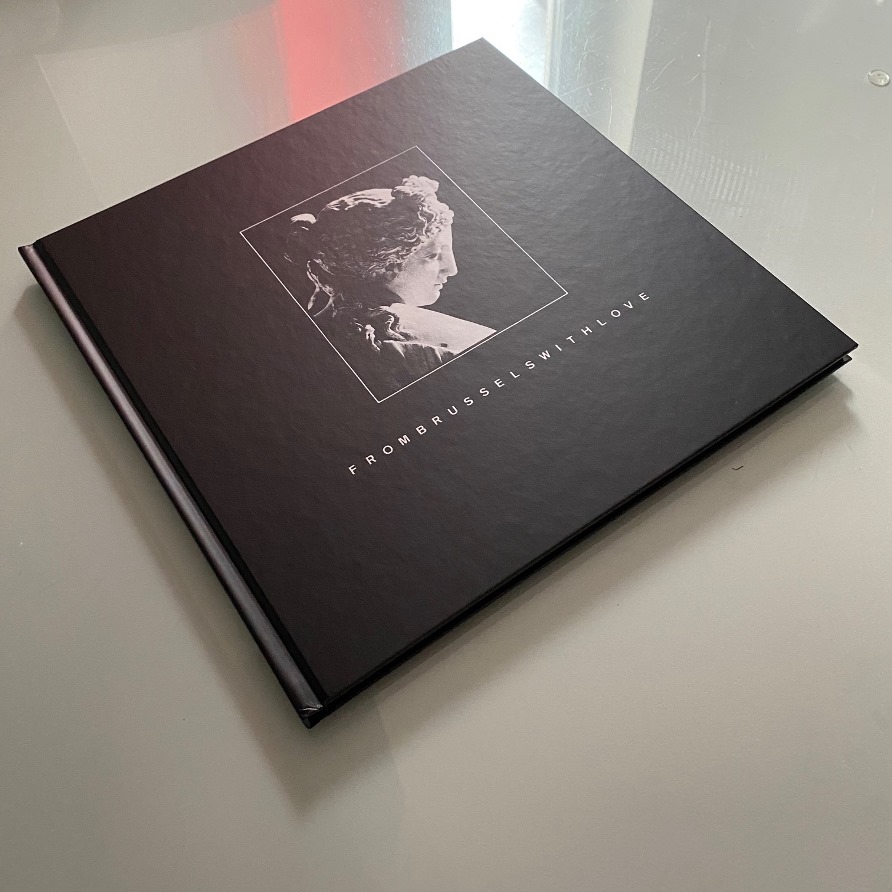
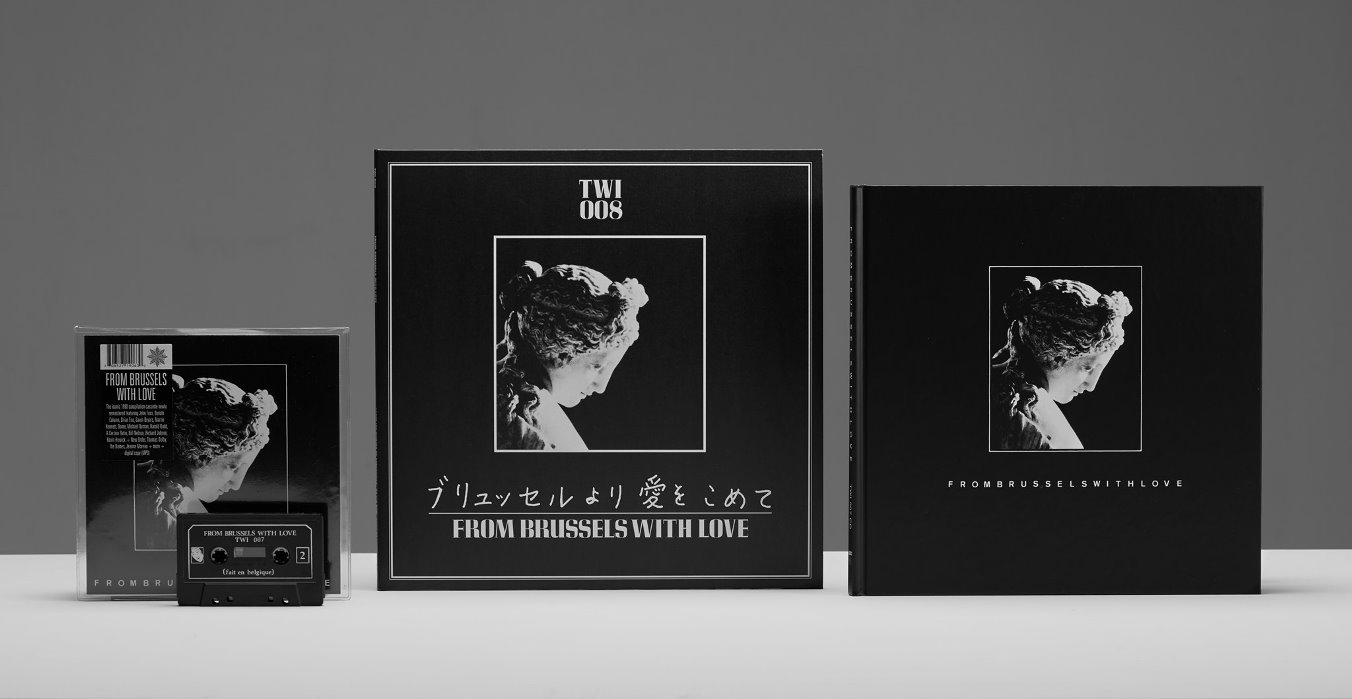
To celebrate its 40th Anniversary, ‘From Brussels With Love’ has been reissued as a lavish 10” x 10” 60 page hardback earbook with rare images, posters, sleeve designs and memorabilia, plus a detailed history of the Crépuscule label between 1979 and 1984. The audio features not only the 21 tracks from on the original cassette in 1980 on one CD, but a bonus collection of 18 related tracks from the period on a second CD including those contributions unable to be included due to space considerations.
For John Foxx completists, this set will be essential as it includes two more jingles from the former ULTRAVOX front man, as well as his superb garage robo-funk instrumental ‘Mr No’.
Among the other musical highlights are Bill Nelson’s ‘Dada Guitare’, a Far Eastern flavoured instrumental of glorious E-bow and THE DURUTTI COLUMN’s beautiful ‘For Belgian Friends’, composed by Vini Reilly in honour of Michel Duval and Annik Honoré. Produced by Martin Hannett, his technologically processed techniques made Reilly’s dominant piano sound like textured synthetic strings, complimenting his sparing melodic guitar and the crisp percussion of Donald Johnson.
Also produced by Martin Hannett and another welcome inclusion in the ‘From Brussels With Love’ appendix is THE NAMES ‘Nightshift’ with its chilling synth embellishing the archetypical arty post-punk miserablism of the period. Another Belgian band POLYPHONIC SIZE make an appearance with ‘Nagasaki Mon Amour’, an intriguing minimal tribute to ULTRAVOX with its detached Gallic delivery over buzzing synths and icy string machines produced by Jean-Jacques Burnel of THE STRANGLERS.
Of interest to PROPAGANDA fans will be JOSEF K’s frenetically paced ‘Sorry For Laughing’ which was covered on ‘A Secret Wish’; their front man Paul Haig went on release a number of EPs and albums via Les Disques du Crépuscule including the acclaimed ‘Rhythm Of Life’ and ‘The Warp Of Pure Fun’.
Over four decades on, the catalogue of Les Disques du Crépuscule included artists like Anna Domino, Isabelle Antena, Alan Rankine, Winston Tong, Blaine L Reininger, John Cale, Helen Marnie and Zeus B Held as well as bands such as TUEXDOMOON, MARINE, CABARET VOLTAIRE, MIKADO, THE PALE FOUNTAINS, ULTRAMARINE, MARSHEAUX and LES PANTIES.
Sophisticated and exhibiting a tasteful visual aesthetic, Les Disques du Crépuscule established itself as a cosmopolitan and culturally significant artistic outlet with a distinct identity that outlasted its parent company Factory Records. ‘From Brussels With Love’ was the start of a story that continues today.
It is also reissued as a limited edition facsimile cassette package in PVC wallet and gatefold double LP set featuring first disc in black vinyl and the second in white; both come with a download key
Dave Bessell is a musician who specialises in ambient electronica, but additionally wears several other hats; from doing session work for major bands, being part of NODE and also a solo recording act for Ian Boddy’s DiN label.
Bessell’s latest work is a collaboration with ISHQ and is unique in that it is the first full length ambient album to have a Virtual Reality component to it. Dave Bessell kindly spoke about his new album, previous musical projects and the importance of Bandcamp in what are extremely challenging times for those working in the arts / music industry.
What is your background in electronic music production?
Well I’m a guitarist with delusions of being a keyboard player! I started off with the guitar as a teenager but straight away, I began experimenting with getting more than the usual sounds from it. I would often try to imitate the sound of some of the electronic stuff that was beginning to emerge at the time from the Krautrock scene.
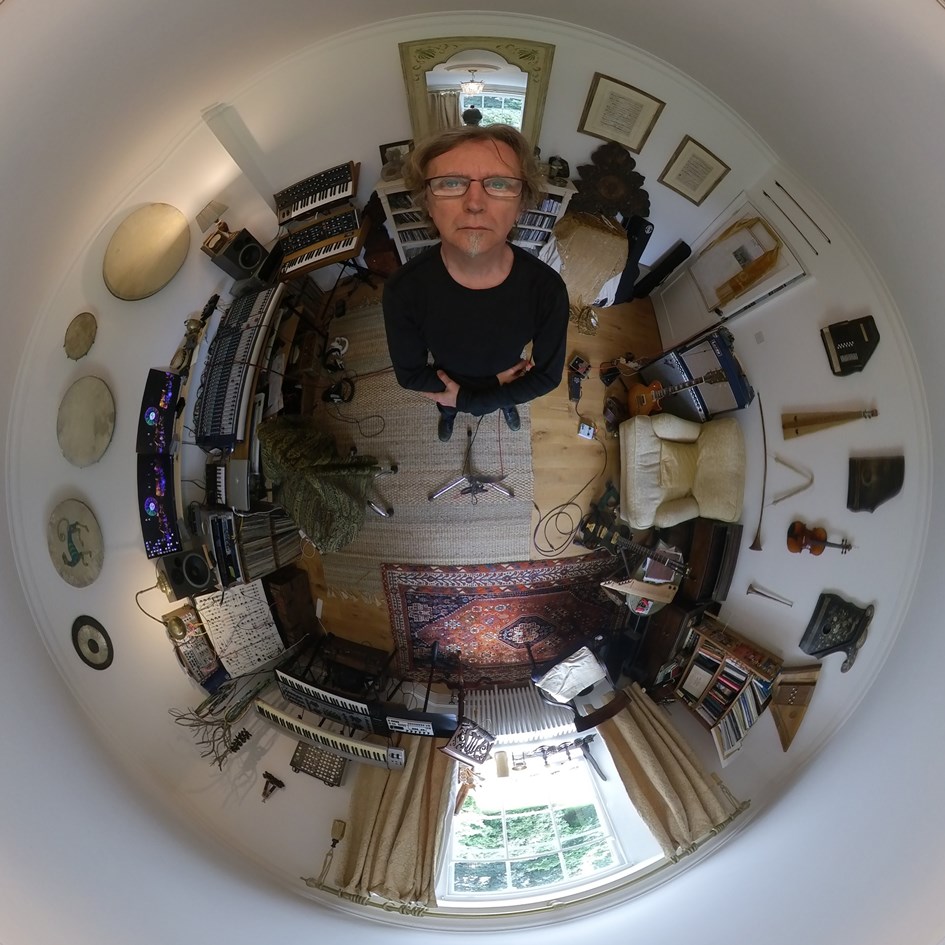
Over the years I found various outlets for that approach with different bands and some sessions for other people. I also studied orchestration at the Royal College of Music and that has a big influence on how I approach electronics too. Gradually I accumulated a variety of analogue hardware alongside the guitar and that is increasingly what I’m known for in more recent years.
Who were your most formative influences musically and why?
The first piece of ‘electronic’ music that I can recall really having an impact was ‘Telstar’ by THE TORNADOS. The opening few seconds of abstract electronic sound is genius and that really opened my ears. Even though I was just a child when I heard it, it opened a door in my imagination that I went through years later.
The next influence that really caught my attention was ‘The Rite of Spring’ by Stravinsky which a friend of my father’s played to me; heavy metal for orchestra! Apart from that my next door neighbour used to play me THE BEATLES when I was very young and I remember liking them although I only had a child’s understanding of what I was hearing. As time went on the influences began to pile up, too many to mention here. In a way I’m influenced by everything I hear and I listen widely across a lot of genres.
You have done session work with both SUEDE and KILLING JOKE, how is the experience of being brought in almost as a ‘temporary’ member of a band to add to an album?
I quite like working to a brief and it’s fun to help good artists achieve their vision. That’s partly why I do a lot of musical collaborations too. There is always something to be learned in those kind of situations. I think having your own solo projects where you can fully express your individual musical personality makes it much easier to relax in a session situation. It gives a clear divide between personal expression and helping someone else to shine.
When I did a bit of keyboard programming for KILLING JOKE, mainly on their ‘Pandemonium’ album, it was particularly fascinating as I was already a long standing fan. To sit in on their recording and songwriting sessions and observe their creative process at work was educational! Working with Jaz Coleman on the keyboard sounds taught me some interesting things about what to look for when designing a synth sound too.
In 2014 you contributed to ‘The Oxford Handbook Of Interactive Audio’ where you did a chapter called ‘Blurring Boundaries: Trends & Implications in Audio Production Software Developments’, have you noticed any specific improvements or trends in software / hardware-based electronic music production since then?
I have an alternative life as a music academic and that kind of writing comes from the academic world. The main noticeable development since that article was the resurgence of analogue hardware and the whole Eurorack scene. Not something I particularly expected but welcome nonetheless. I almost always prefer the sound of analogue hardware and back in 1995 when those tools were still deeply unfashionable, NODE were one of the few who were working in that way.
I guess if you are unfashionable for long enough and you stick to your guns, then eventually the world comes round to your point of view! Having said that, the sound of digital has improved a lot and now has a viable audio character of its own. I recently placed an order for the Osmose keyboard which is still in development. The combination of innovative expressive keyboard and high quality digital sound engine with physical modelling hits a sweet spot for me. As a guitarist I always wanted to do vibrato on the keys!
You are probably best known for your work with the electronic ‘supergroup’ NODE alongside Flood, Mel Wesson and Ed Buller. ELECTRICITYCLUB.CO.UK was lucky to be present at your Royal College of Music show in 2015. How was the experience of performing this show?
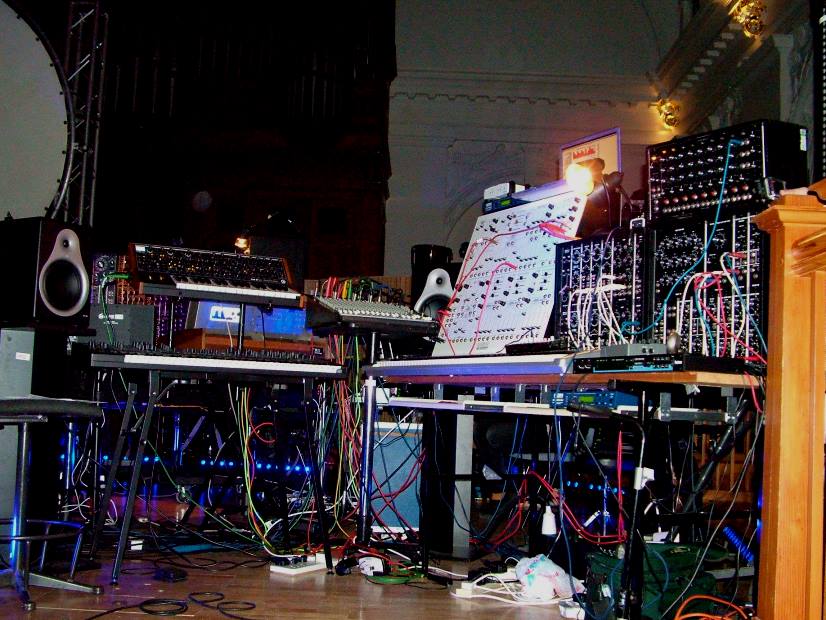
The preparation for the show was a lot of work – moving all that vintage gear and then setting it up and getting it to work again was a major task!
However we had the time and space to do it properly and when it came to the actual performance, it was pure joy. I mean how could you not have fun with all those toys to play with! The PA from Flare audio was very nice too which really helps with that kind of textural music. A little bit strange being back in my old ‘school’ playing a gig.
Did any piece of vintage gear ‘misbehave’ itself on the night?
Ha ha yes of course! My favourite was when Flood’s Oberheim decided to die while he was playing it during the gig. It started sounding increasingly ill and then kind of croaked to a halt entirely. Of course Flood went with it and carried on playing until it croaked its last. We included it in the live album – if you have sharp ears, you may be able to pick out a warbly wavering reedy distorted kind of sound which becomes increasingly unstable then stutters to a halt entirely.
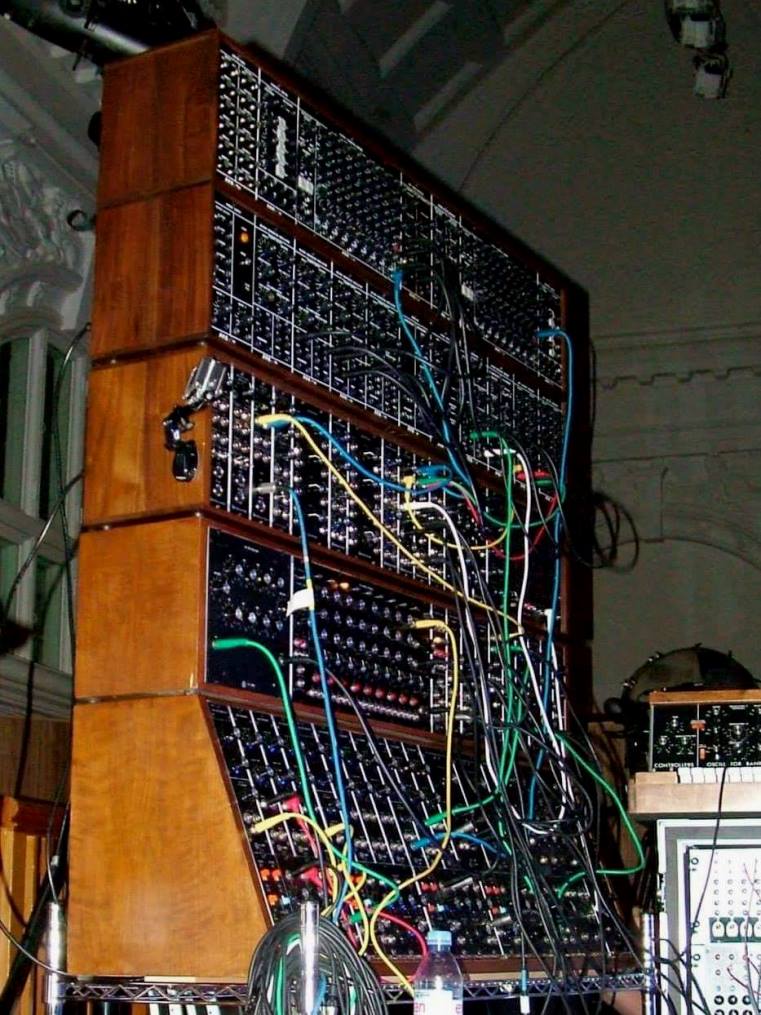
We had some issues with Ed’s Moog modular in the rehearsals for the gig. During the performance we had the backs off his cabinets with a technician poised with soldering iron just in case – fortunately the big Moog lived to fight another day.
ELECTRICITYCLUB.CO.UK noticed a certain Nick Rhodes in the audience that night (he was also keen to scope out the gear you had on stage), were you aware he was a fan?
I think most keyboard or electronics people would have an interest in what we were trying to do that night. I wasn’t particularly aware of Nick being there but I know a few other high profile people take an interest in NODE. Hans Zimmer for example.
Are there any more plans to collaborate together?
NODE is a very occasional project because everyone involved has a lot of other commitments. So I won’t say it will never happen again but we have no plans right now.
The BluRay of the Royal College of Music performance has only just been released, why did this take so long to come to fruition?
As anyone who has followed NODE knows it operates to a different time scale than everything else! It took something like seventeen years between the first and second albums for example. So actually the BluRay was relatively quick for us. We never intend for everything to take so long but then someone goes out for a sandwich and comes back fifteen years later – so timescales get stretched!
Your new album with artist ISHQ has just been released and has been described as evoking “The sound of Aliens landing in an English meadow”. How close a description do you think that is?
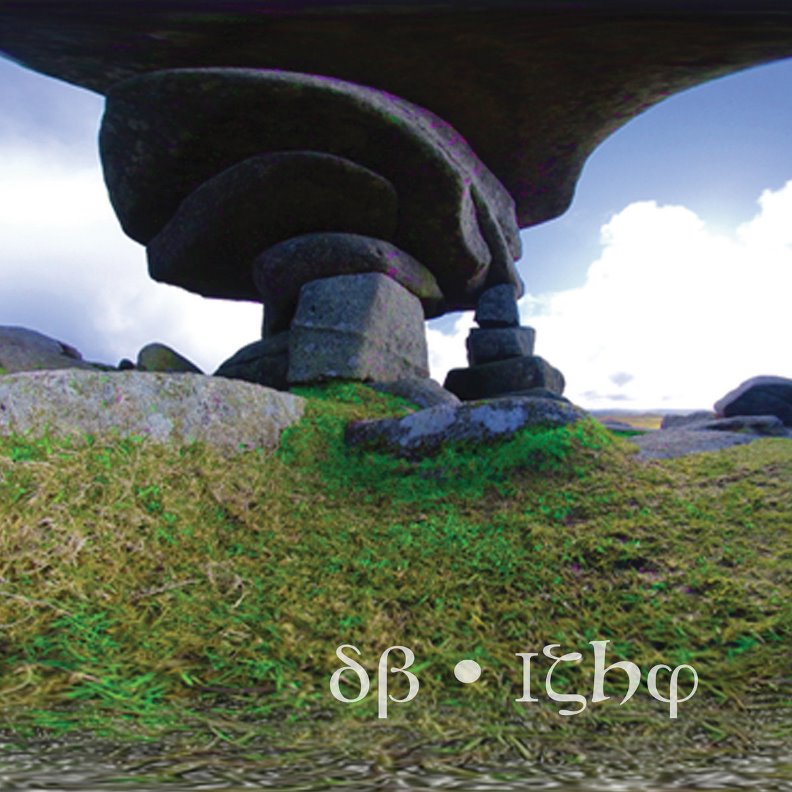
Well that quote was a reaction from Neil Butler of SPATIALIZE when he first heard one of the tracks. It tickled my sense of humour but I also think it encapsulates in a few memorable words some of the spirit of the album. It has some pretty ‘alien’ sounds and yet it also refers to the Cornish landscape. The album was recorded in Cornwall. There is more to the music than just that but as a sound bite I think it points in the right direction.
How did you come to collaborate with ISHQ and what was the role split and working method on the album?
I discovered online that ISHQ lived not too far from me. We live in a rural area so when you find like-minded electronic musicians, you tend to meet up at least for a chat. The collaboration grew out of a chat in a cafe and just seemed to grow of its own accord.
We found ourselves musically on a similar wavelength and I had wanted to do something in a more ambient style for a while. We started with some jam sessions in my studio and then took them away to work them up with a bit more structure and some overdubs.
The original jams were all analogue hardware but ISHQ has a distinctive style which means he manipulated and added quite a few sounds later with his Roland V Synth. He tends to resample the material and bend it out of shape in interesting ways. There is also a light scattering of found sounds mostly recorded from my collection of broken and antique instruments. The only real rule I set myself for this one was no guitar – I didn’t want to bring in those stylistic associations for the mood we were trying to achieve.
Did either hardware or software synthesizers dominate on the new album and was there a piece of studio kit that specifically defined the sound of the work?
I don’t think any software plug-in synths were used on ‘Inbetween’, it was mainly analogue hardware with some contributions from digital hardware. Plus a few processed acoustic sounds. Probably two pieces of kit became important for the soundworld we created, ISHQ’s use of the V Synth is very creative and quite distinctive and I used the 4MS Spectral Multiband Resonator on several tracks as a starting point.
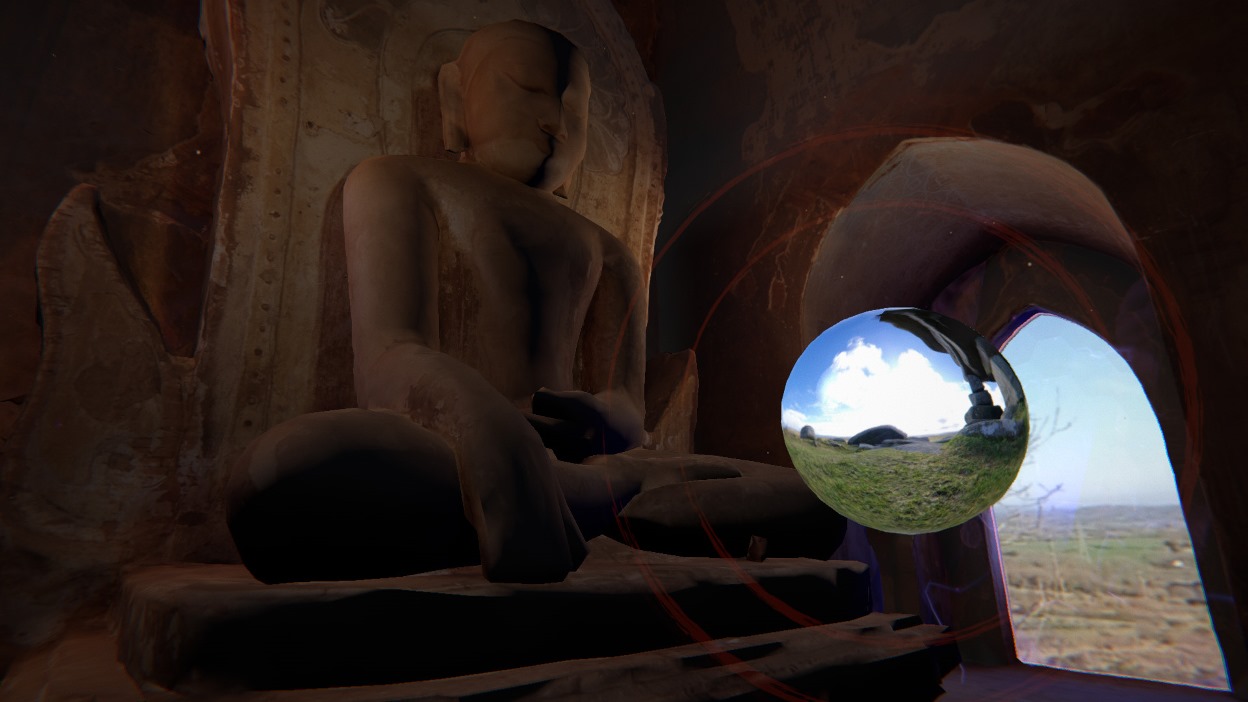
‘Inbetween’ is innovative in that it is the first full length ambient album to be released with a Virtual Reality (VR) format. What inspired you to incorporate this medium and what do you feel it adds to the experience of the album?
Well it was initially down to serendipity / synchronicity. The opportunity to do that came up in a conversation with one of my ex-students Ben Payne who is currently doing a PhD on VR. VR fits very well with the ideas ISHQ and myself had touched on – the idea of different worlds, inner and outer landscapes, that kind of thing. These are the moods and ideas we were playing with in the music and VR is obviously relevant when you are interested in exploring parallel realities and inner landscapes.
Were there any specific technological hurdles you encountered when adding the VR format?
We were doing OK until it came to trying to package it up for different platforms. Initially we had wanted to make it available for all operating systems and VR platforms, but it quickly became obvious we didn’t have the resources to achieve that and beta test it on all those formats. So we had to narrow it down to make the project deliverable.
Jean Michel-Jarre attempted a not entirely successful ‘live’ VR-style performance online earlier in the year. Can you see VR being adopted by other musicians and if so, what do you see the future possibilities for it?
I think VR has a lot of possibilities to explore certain ideas and styles of music. People are still working out what it’s good for at the moment, but I have discussed with ISHQ ideas for future VR projects and some of them may well expand the format in unusual ways. COVID-19 has focussed attention on and pushed the development of these kind of tools and online delivery options. One thing holding VR back still is that the technology is not widely adopted yet and is still in a state of flux and development from the technical standpoint. That is beginning to change though. Probably at some point it will achieve critical mass and then really take off.
I don’t like to criticise other musicians online but I hope Jean-Michel Jarre will excuse me if I say that I don’t think he had something artistic he wanted to say which necessitated the use of VR. Probably it seemed like a good idea to have a virtual gig in these unusual times, but I think VR demands a bit more than replicating existing delivery forms. In a way, it’s like the birth of cinema we are still inventing the conventions and structures that suit VR and there will inevitably be some trial and error. I think Björk has a bit more of a handle on that aspect.
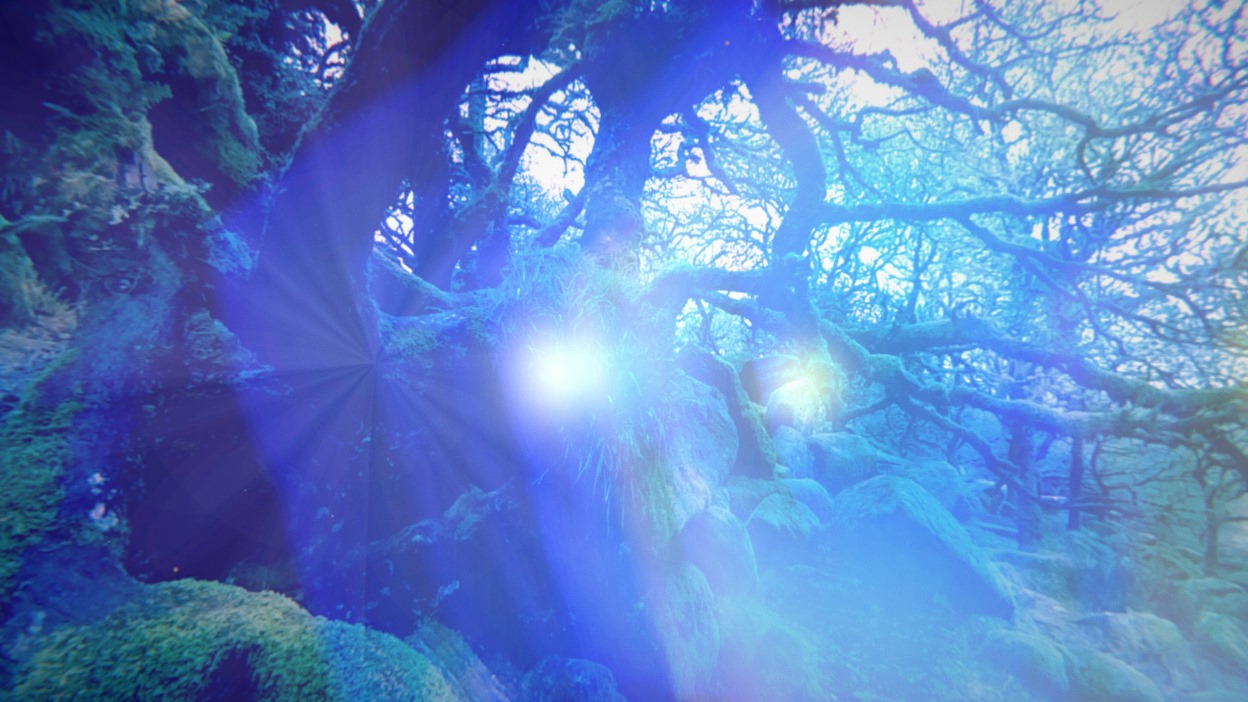
With ‘Inbetween’, we tried to achieve a different look than the usual game 3D rendered style, by creating a kind of altered reality aesthetic. We deliberately didn’t use all the bells and whistles of VR. To throw lots of whirling bright colours and impossible fractal perspectives at the listener wouldn’t have enhanced our musical intentions which we hope were a bit more subtle than that.
Purchasers of the album without a VR headset can still experience a virtual desktop Windows version. Was there a specific reason why an Apple format wasn’t made available for the album?
Only for the reasons I mentioned above – we just didn’t have the resources to develop and test all the possible permutations of operating systems, computer platforms, VR formats, different headsets etc etc. If anyone wants to try porting it to a Mac, you can find us on Facebook!
With its heartbeat pulse and TOMITA-style arpeggios, one of the highlights on the album is ‘Atlas Obscura’, was there a particular inspiration for this piece?
We didn’t verbalise any intentions before we started playing, but we had a sort of musical conversation which we did analyse a bit after the event, that gave rise to some of the titles. So ‘Atlas Obscura’ is about mapping landscapes – the Cornish landscape with its standing stones and wild Atlantic seascapes and the internal psychological landscape which somehow seems tangled up in that real landscape in some indefinable way. I hope that makes sense to someone ha ha!
You sell and distribute your material via Bandcamp (which has really come into its own during the COVID-19 situation), how important do you feel this platform is for both you and other musicians?
I’m known online for championing Bandcamp. I think it is single handedly supporting a whole raft of creative niche music and is allowing new artists a vital space to develop. It also provides a viable model to allow musicians to progress to a point where they can actually finance their projects and make a living, which in these days of Spotify and other streaming services is a lifeline. In short, I think Bandcamp is essential and I take my hat off to them. I hardly ever buy music elsewhere these days. Support Bandcamp = support the artists.
How has the COVID-19 situation affected you personally in terms of your musical output or work ethic and how do you feel about the wider impact this has had on the arts / music industry?
I think the arguments and points of view around this are well rehearsed, so I don’t want to add too much to the mountain of comment. I will just say that personally I haven’t been as badly affected as those who rely heavily on income from live performance. The longer it goes on, the more damage will be done to the live music scene.
What’s next for you musically?
I always have projects on the go and I have just started a new collaboration. It’s at very early stages though so not the right moment to say anything more about that particular one. I also have another album waiting in the wings for DiN records. That will be my third collaboration with Bakis Sirros of PARALLEL WORLDS. That one is actually finished and just waiting for a release slot in the DiN schedule. Beyond that, there are a couple of ideas I’m exploring including possible further VR projects with ISHQ. Probably somewhere down the road is another solo album which will be the follow-up to ‘Reality Engine’.
ELECTRICITYCLUB.CO.UK gives its warmest thanks to Dave Bessell
We use cookies to ensure that we give you the best experience on our website. If you continue to use this site we will assume that you are happy with it.



 which successfully combined the soaring vocal aspects of Britpop with the melodic melancholy of Nordic synth.
 . Like DEPECHE MODE meeting MUSE before building with some mighty synth arpeggios, it morphs from a drum ‘n’ bass lilt into a blistering mutant attack.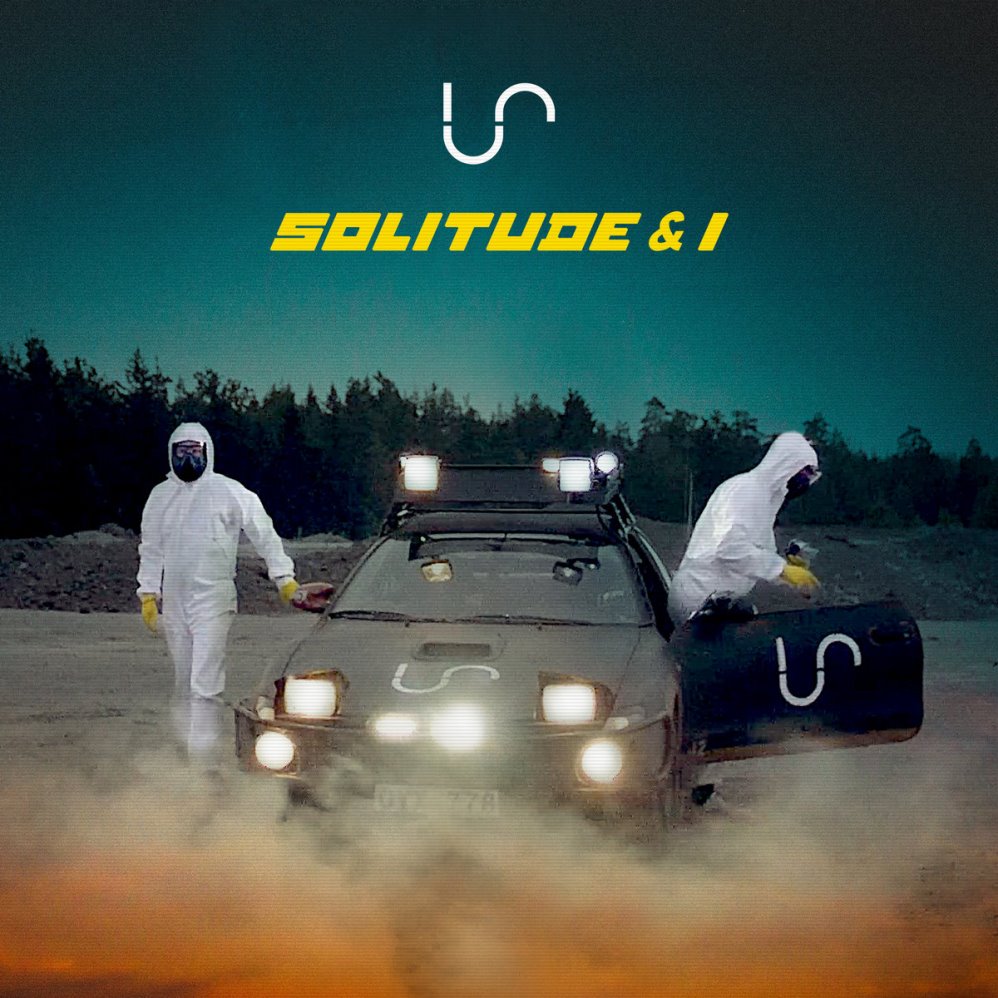

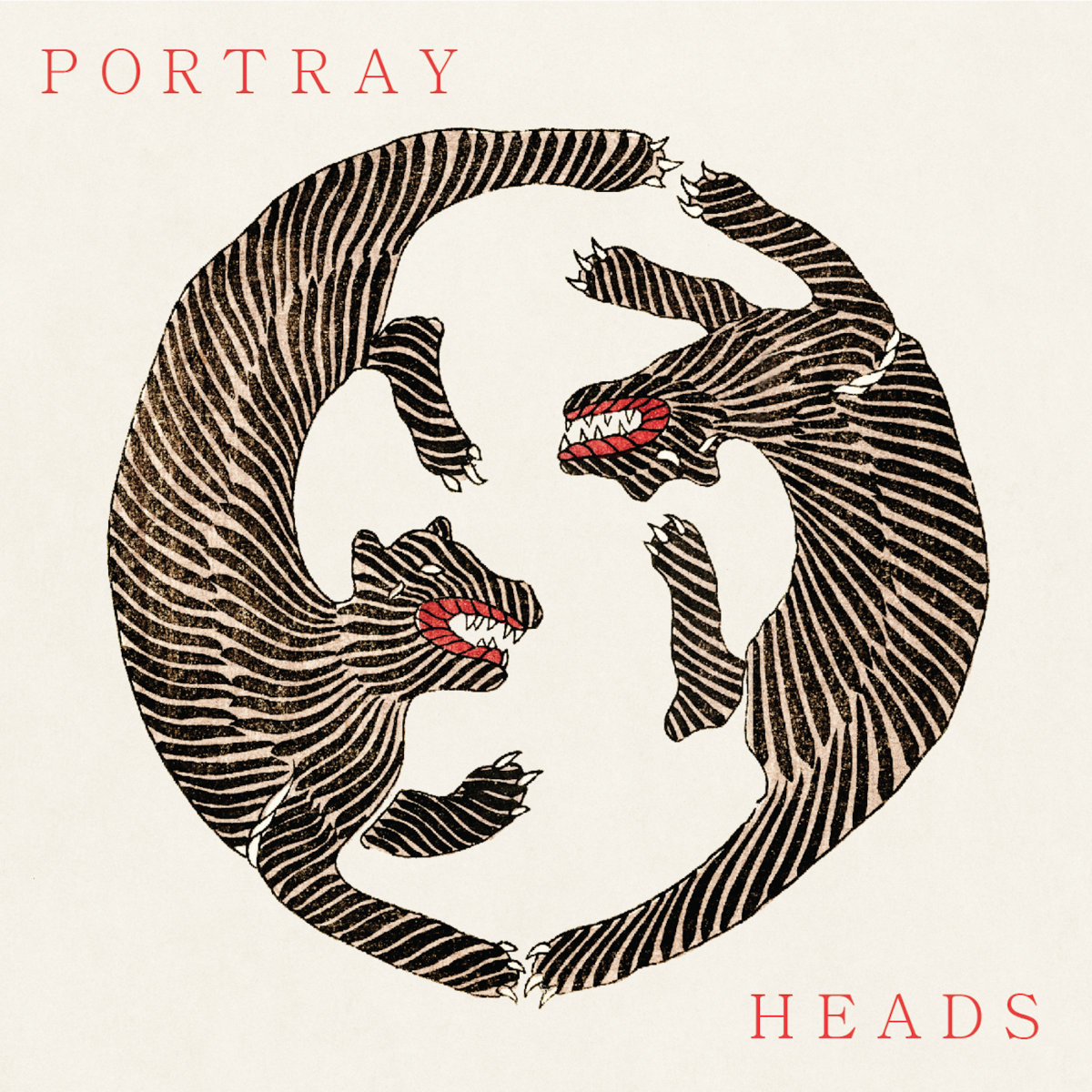
 is released by Minimal Wave and Bitter Lake Recordings as a double vinyl LP direct from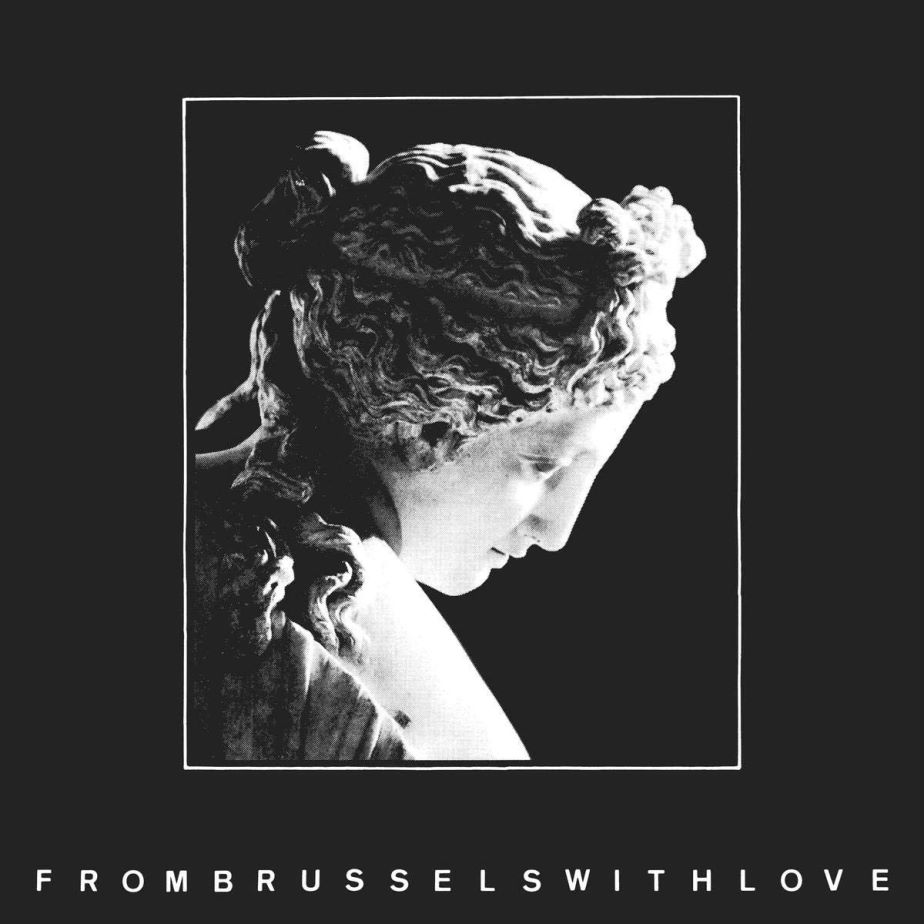
 was notable for featuring the first released recording by the three surviving members of JOY DIVISION following the sad passing of Ian Curtis before they adopted the name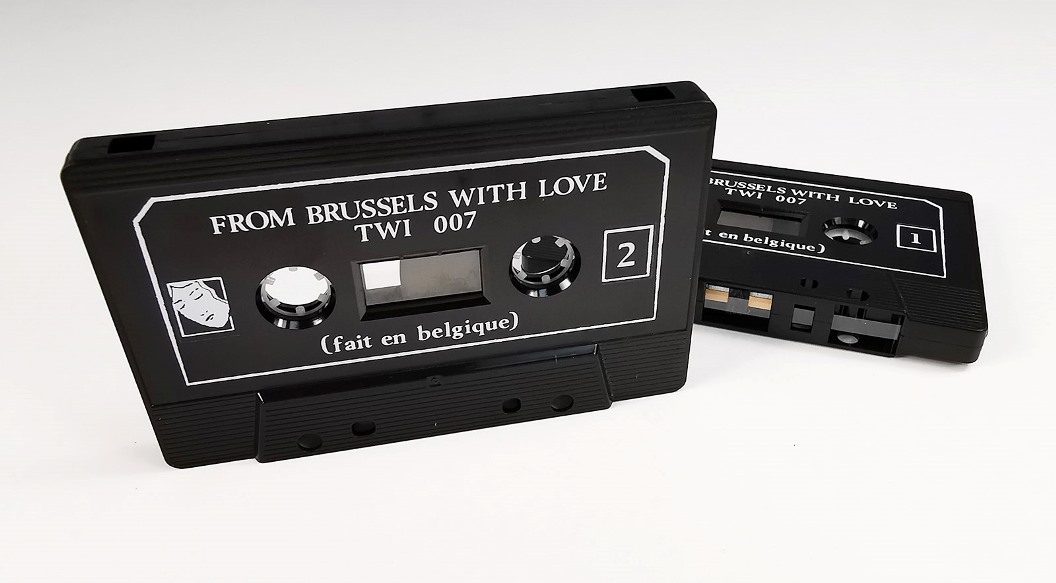


Follow Us!